
Tugadaily
PT
View over the rooftops of Lisbon
Real Estate 29 June 2026

Foreign buyers are purchasing fewer and fewer homes in Portugal

Purchases by non-residents fell 15.6% early in the year. Prices are still at record highs, but the market is starting to lose steam.

For years, the foreign buyer was the fixed character in any conversation about housing in Portugal. The latest INE data now tells a different story: early in 2026, purchases by non-residents fell to 1,770 units, down 15.6% on the previous year.

It is not an isolated detail. Over the same period, the total number of homes sold dropped 8.7%, to 37,745. In other words, fewer sales to everyone — and foreigners, who helped push prices up in the most coveted areas, are clearly easing off.

High prices, cooling demand

The paradox is that prices are still at record highs, with the average value around 263,000 euros. But there are signs of fatigue: the year-on-year rise slowed for the first time in nearly two years. Higher interest rates, tighter rules for some visas and prices that price buyers out all help explain the retreat.

For anyone house-hunting in Portugal, this does not mean bargains are coming — it means a slightly less frantic market, where there may be room to negotiate. For sellers, the warning is the opposite: the era of “list today, close tomorrow” may be ending.

See also: average house prices at record highs. The official data is on the INE portal.

Imagem: Wikimedia Commons

Historic building in central Lisbon
Real Estate 29 June 2026

Older homes are rising faster than new ones: the widening gap

In early 2026, prices of existing homes rose 19.7% and new builds 12.6%. The gap is changing the maths for buyers.

When people talk about house prices, they usually reach for a single number. But INE data for early 2026 shows two very different realities under the same roof: existing homes rose 19.7% year-on-year, while new builds advanced 12.6%.

At first glance it looks like a technical detail. It is not. It means that older housing, long the cheaper option, is getting more expensive faster than newly built homes — and the gap between what used to be affordable and what was top of the range is closing.

Why older homes are surging

Several forces are pushing up the price of existing homes: not enough new supply, location (older homes are often in the most sought-after centres), and buyers who, priced out of new builds by scarcity or cost, pile into the existing market instead. The result: more demand chasing the same ageing stock.

For house-hunters, the practical takeaway is that the old rule “older always pays off” is no longer automatic. In some areas, carefully comparing price per square metre between new and old can throw up surprises — and with demand cooling across the market, there is room to negotiate that did not exist a year ago.

See also: foreign buyers are purchasing fewer homes. The official data is on the INE portal.

Imagem: Wikimedia Commons

View over the rooftops of Lisbon
Real Estate 29 June 2026

Lisbon, the least affordable European capital on an average salary

With rents at 21.8 euros per square metre and rising living costs, Lisbon tops the list of capitals where an average wage stretches least.

Anyone living in Lisbon hardly needs a study to know the city is expensive. But now there’s a number that stings: according to a recent analysis, Lisbon is the least affordable European capital for a single person on an average salary. Not the most expensive in absolute terms — but the one where what you pay and what you earn line up worst.

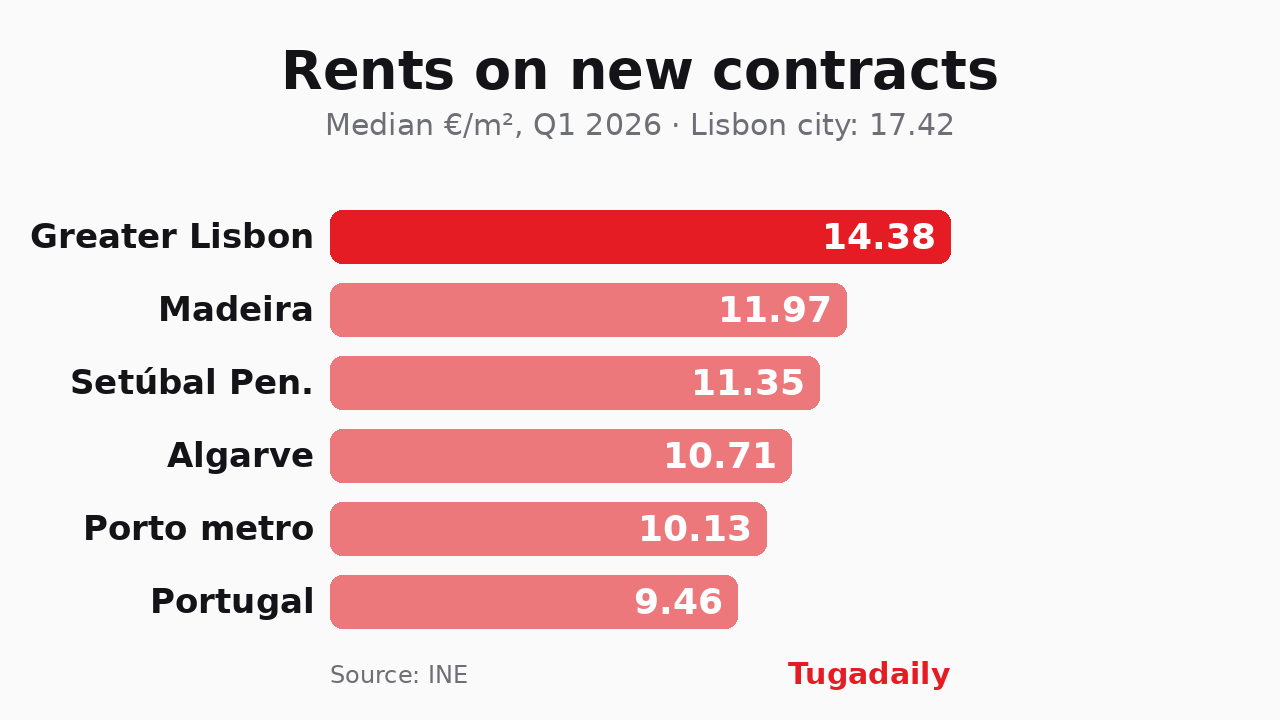
The maths is brutal. The median asking rent in the city sat around 21.8 euros per square metre in May, well above the national average of 16.3 euros. Add food, transport and energy on top, and the average wage evaporates before the month is out.

And it’s not just Lisbon

Porto squeezes too, with median rents around 16.4 euros per square metre. Nationally, there’s a curious wrinkle: rent inflation eased a little, partly because incentives for young buyers nudged some demand out of renting and into purchasing. But that’s relative relief — for those who can’t buy, the market remains a tough league.

The OECD has been insisting that Portugal needs more housing, and faster, especially at affordable prices. That’s the crux: without new supply, prices keep climbing. Market reports are available at idealista/data.

See also: the median house price hitting a new record.

Image: Wikimedia Commons

House keys resting on a table
Real Estate 29 June 2026

Portuguese homes hit a new record: average price tops €262,000

Statistics office INE confirms all-time highs for housing. There's a hint of slowdown, but buying a home is still a stretch for most.

If you’re house-hunting, you already suspected it: it keeps getting more expensive. The numbers from INE confirm what your wallet feels. In the first quarter of 2026, the average price of homes sold reached €262,839, an all-time high, up 13% on a year earlier.

And it’s not just the sale price. The median bank valuation hit €2,208 per square metre in May, also a record, with Lisbon and Porto pulling the figures up as usual.

A very gentle brake

There is, however, one detail worth noting. The housing price index rose 17.8% year on year — wild, yes, but it was the first slowdown since mid-2024, after touching 18.9% at the end of 2025. In other words: still rising fast, just a little less fast.

Families are starting to hesitate too. Between January and March, 37,745 homes were sold, down 8.7% on the same period in 2025. With Euribor stubbornly refusing to fall and prices sky-high, some would rather wait and see.

The picture is the familiar one, made worse: wages that don’t keep up, supply that doesn’t arrive, and a younger generation feeling that owning a home drifts a little further away each year.

See also: how the home loan instalment looks with Euribor and the IMT exemption for young buyers. The official data is at INE.

Illustrative · Photo: Jakub Zerdzicki / Pexels

Coimbra and the Mondego river
Real Estate 28 June 2026

Renters can deduct more on their income tax this year

The rent deduction in income tax rises to 900 euros in 2026, and older rents can only go up by 2.24 per cent. What changes for tenants.

Good news for anyone living in a rented home who eyes the bill warily every month. In 2026 there are two numbers worth keeping in mind.

The first is the rent deduction in income tax, which rises to 900 euros. That means when settling up with the tax office, tenants can write off more than before of what they paid in rent over the year. And there is more good news on the horizon: from 2027, this limit rises again, to 1,000 euros.

And how much can the rent rise?

The second number reins in the bad side. The update of older rents is capped by a coefficient set by the statistics institute: 1.0224. In other words, landlords can raise the rent by at most 2.24 per cent, slightly above last year’s figure, but far from the increases that frighten.

Together, these are measures meant to give some breathing room to renters, in a country where finding a home at a reasonable price remains one of the biggest headaches. They do not solve the underlying problem, but they ease the end-of-month bill and the tax season.

The practical advice is the same as always: keep your rent receipts and make sure the contract is reported to the tax authority, because without that the deduction does not happen.

See also: Euribor squeezing those with home loans. More information at portugal.gov.pt.

Imagem: Wikimedia Commons

Panorama of the city of Braga
Real Estate 28 June 2026

IMT Jovem in 2026: full exemption on homes up to 330,000 euros

The exemption ceiling on transfer and stamp tax for buyers under 35 rose to 330,539 euros this year. Here is how the benefit works.

Buying a first home is never cheap, but there is a support that many young people still do not fully know about: IMT Jovem. And in 2026 it became a little more generous.

The rule is this. Anyone up to age 35 buying their first own and permanent home can be exempt from transfer tax (IMT) and stamp duty. This year, the ceiling for full exemption rose from 324,058 to 330,539 euros, an increase of about 2 per cent set by the State Budget.

And above that figure?

Not everything is left out. Between 330,539 and 660,982 euros, a reduced 8 per cent rate applies to the portion above the first limit. Only above that second bracket do the normal rules kick in. So even those buying a pricier home can use part of the benefit.

In practice, this is thousands of euros staying in the pockets of people just starting out, at a moment when every euro counts toward the deposit and the renovations. It is worth doing the maths before you sign.

A useful caveat: the benefit has conditions, from age to value limits to never having owned a home before. Check it all carefully, ideally with help from someone who knows, so the deed brings no surprises.

See also: House prices hit a new record. Official details at the Tax Authority portal.

Imagem: Wikimedia Commons

Houses above the Douro river in Porto
Real Estate 28 June 2026

Rising Euribor squeezes Portugal's mortgage holders again

With the ECB lifting rates to 2.25%, Euribor climbs and home-loan payments bite into family budgets once more.

Anyone with a home loan has learned to watch a strange word like it’s the weather forecast: Euribor. And the forecast has turned upward again. With the European Central Bank setting its reference rate at 2.25 percent, Euribor follows, and the mortgage payment rises with it.

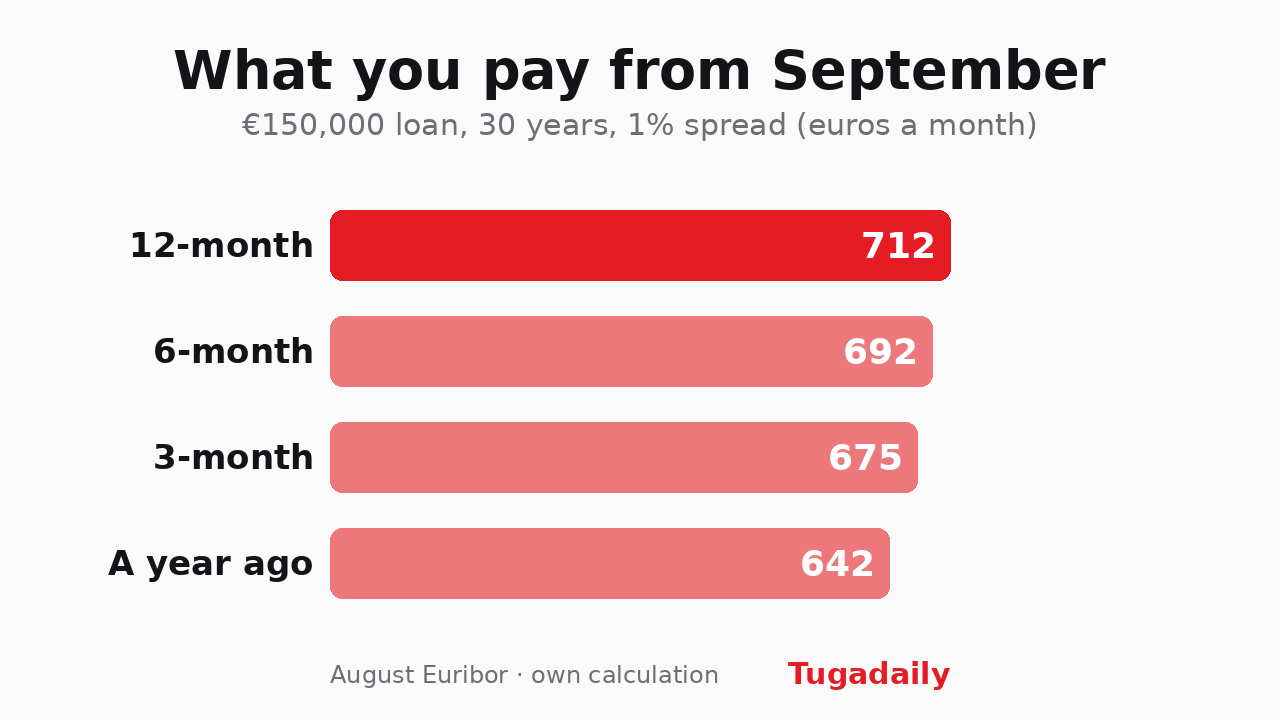
The mechanics are simple. Most loans in Portugal are pegged to six- or twelve-month Euribor. When it climbs, the payment only changes on the contract’s review date, but change it does. For a family with an average loan, that’s tens of euros more a month, adding up over the year.

What you can do

The first step is knowing which index you’re on and when the next review lands. Then it’s worth shopping around: renegotiating the spread, moving the loan to another bank, or weighing a mixed rate are all on the table. There’s no magic fix, but there’s room to manoeuvre.

There’s a flip side too. Higher rates cool demand and help slow the climb in prices, something already showing up in the latest figures. For house hunters, it’s a small relief; for those who already bought, it’s the bill arriving.

The golden rule is not to do the maths on the rosy scenario alone. Anyone borrowing today should simulate the payment with Euribor higher, to avoid nasty surprises down the line.

See also: House prices jump 10.2% to a new record.

Imagem: Wikimedia Commons

View of Lisbon
Real Estate 28 June 2026

Prices slow for the first time since 2024 as sales fall

The House Price Index rose 17.8% in Q1 — the first deceleration since 2024. Transactions dropped 8.7%.

There’s a new signal in the market, subtle but important. In the first quarter of 2026, the House Price Index rose 17.8% year on year, according to INE. Still sky-high, but it’s the first deceleration since the second quarter of 2024, right after a historic 18.9% jump at the end of 2025.

At the same time, fewer deals got done: 37,745 homes changed hands at the start of the year, an 8.7% drop on the same period in 2025. More cautious families, rising rates and lofty prices explain much of the pullback.

Braking or just a pause?

No one should mistake a slowdown for a fall. Prices are still rising, just at a slightly less dizzying pace. For sellers, it’s time to be realistic on the asking price; for buyers, there’s more room to negotiate than a year ago, even if the bar stays high.

The next quarter will tell us whether this is a real brake or just a breather.

See also: the new price record and the DBRS read. Official statistics at INE.

Image: Wikimedia Commons

House keys on a table
Real Estate 28 June 2026

House prices jump 10.2% to a record €3,142/m²

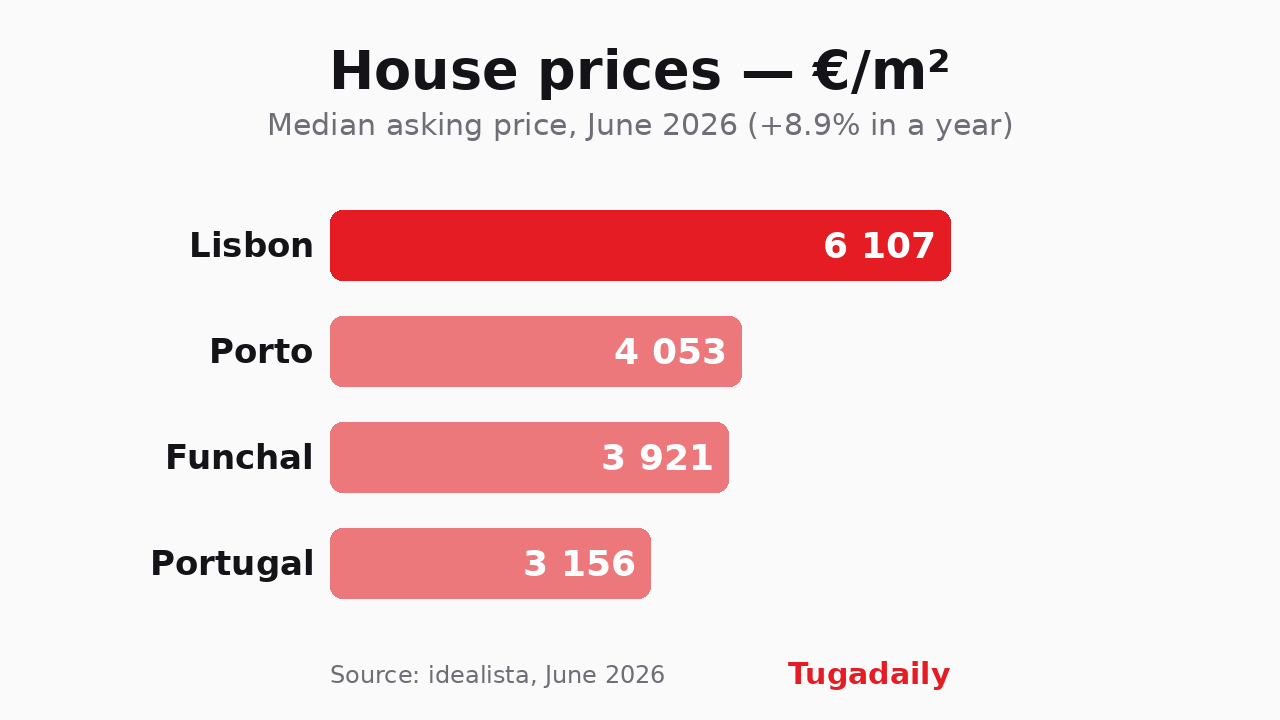
The median price to buy a home in Portugal hit €3,142/m² in May, a seventh straight record. Lisbon leads at €4,391/m².

If you’re house-hunting, you already know: the bar has risen again. The median price to buy a home in Portugal reached €3,142 per square metre at the end of May, up 10.2% on a year ago and a new all-time high, the seventh month in a row setting a record.

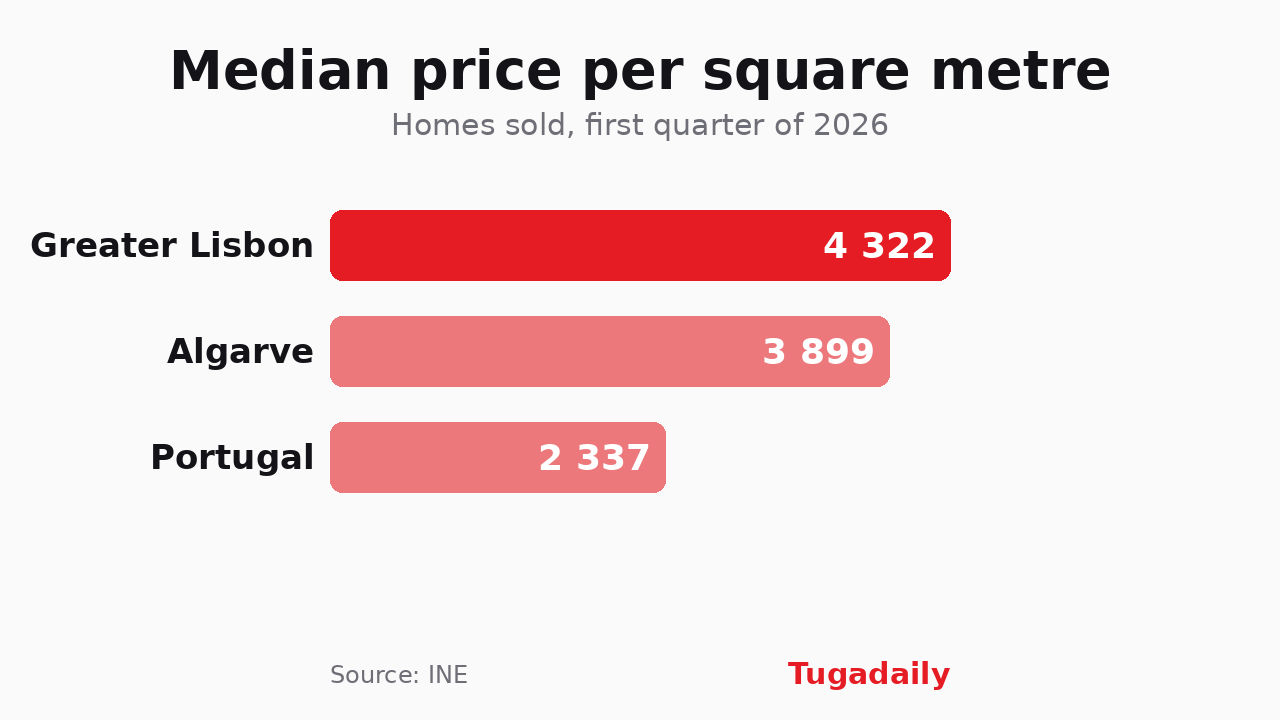
The geography of your wallet hasn’t changed much. The Lisbon Metropolitan Area remains the priciest at €4,391/m², followed by the Algarve (€4,057/m²) and Madeira (€3,647/m²). At the other end, there are still interior regions where the numbers breathe a lot easier.

So what now?

The good news, if we can call it that, is that the climb is losing steam compared with the leaps of 2025. The bad news is that a record is a record, and the effort to buy stays heavy, especially for first-time buyers.

Those who can wait may see supply loosen; those who must buy now should negotiate hard and look beyond the big cities.

See also: transactions cooling and the rate effect. Official market data at INE.

Illustrative · Photo: Jakub Zerdzicki / Pexels

Contemporary urban townhouse facade
Real Estate 27 June 2026

Buying a home in Portugal: the real bill is well above the sticker price

Between IMT, Stamp Duty, the deed and fees, buying in Portugal runs 7% to 10% over the advertised price. Here's what to budget.

There’s a classic trap for first-time buyers in Portugal: looking only at the listing price. That number is the start of the bill, not the end. Once you add taxes and fees, the real cost usually lands 7% to 10% above the price of the house.

Where the extra goes

The biggest piece is IMT, the property transfer tax. It’s tiered: the pricier the home, the higher the percentage, with exemptions for cheaper primary residences. Then there’s Stamp Duty, around 0.8% of the value. Add the deed and registration, and, if you take a mortgage, some bank and valuation costs on top.

If you buy through an agency, the commission is usually paid by the seller — but always confirm, as it shapes your negotiating room. And nearly everyone hires a lawyer or solicitor to check the registry and handle the process: money well spent to avoid nasty surprises about ownership.

Before you sign

Ask for a written breakdown of all costs before moving forward, and make sure you’ve sorted a NIF (tax number) and a Portuguese bank account — without them, the process stalls. Foreigners should also confirm the rules and timing for transferring funds, which can delay the deed.

Bottom line: budget a cushion of about 10% over the price and you’re unlikely to get a fright at the notary’s desk.

Illustrative · Photo: Jan van der Wolf / Pexels

House keys
Real Estate 27 June 2026

Housing: DBRS thinks the price surge will slow — and explains why

Rating agency DBRS expects a gradual brake on Portugal's house-price climb if immigration falls, inflation rises and credit tightens.

Good news for would-be buyers? Maybe. Rating agency DBRS has said the runaway rise in Portuguese house prices should lose steam in the coming period. Before the champagne, it’s worth understanding the “why” — because it has thorns.

Recall the starting point: house prices climbed 10.2% over the past year, to a fresh record of 3,142 euros per square metre. That pace can’t last forever, and DBRS points to three brakes coming into play.

The three brakes

The first is immigration. Fewer people arriving means less demand for housing, and demand has been one of the great engines of prices. The second is inflation, which erodes disposable income and leaves less room for a mortgage payment. The third is tighter credit — with rates and bank requirements filtering who can actually buy.

Note the irony: the slowdown wouldn’t come from more homes being built (what everyone wants), but mainly from fewer people able to buy. It’s relief from the wrong side of the equation.

What it means for you

Slowing isn’t falling. DBRS talks about slower growth, not a price drop or a bursting bubble — indeed, several experts insist Portugal has a housing crisis, but not a bubble. Anyone waiting for a crash to get into the market could be waiting a very long time.

The honest read: the rocket may become an aeroplane, but it’s still climbing. Building more homes is what would truly change the game.

Illustrative · Photo: Jakub Zerdzicki / Pexels

Construction site beside residential buildings
Real Estate 27 June 2026

Penafiel bets on collaborative housing: 2.7 million to grow old with company

A new social-housing project in Penafiel answers ageing and the shortage of affordable homes with a community-based solution.

Housing isn’t only about big national numbers. Sometimes the most interesting solution turns up in a town in the northern interior — and that’s exactly the case in Penafiel.

The council is moving ahead with a social-housing project that breaks from the usual apartment block: a collaborative, community-based housing solution, designed to tackle two problems at once — an ageing population and the shortage of affordable homes. The investment is around 2.7 million euros.

What “collaborative housing” means

The idea is simple and old, just dressed up in modern form: people (often older) living in their own homes but with shared spaces and services, to fight isolation and cut costs. Instead of everyone shut away in their own corner, there are common areas, mutual help, and a neighbourhood network built on purpose.

For a country ageing fast, where many older people live alone in big, cold houses, it’s a model that makes more and more sense. It links the problem of loneliness to that of expensive housing and tries to solve both in one go.

Small, but pointing the way

It’s no silver bullet for the national crisis — it’s a handful of homes in one town. But it’s the kind of experiment worth following: if it goes well, it could inspire other councils to see housing not just as bricks, but as community.

Sometimes innovation in housing isn’t a skyscraper in Lisbon — it’s a good idea in Penafiel.

Illustrative · Photo: SHOX ART / Pexels

Colourful houses along the Algarve coast, in Portugal.
Real Estate 27 June 2026

Homes hit a new high: prices up 10.2%, but the pace is starting to ease

Median house prices set a fresh record in Portugal. Even so, agencies and analysts are beginning to talk about a gentle slowdown on the horizon.

Anyone house-hunting in Portugal already suspected it, but now there are numbers to confirm it: prices have hit a record again. The median value rose 10.2% in a year, reaching around €3,142 per square metre — a new all-time high. Put plainly, buying has never cost this much.

Regional gaps remain vast. Greater Lisbon leads with a median price of about €4,391/m², followed by the Algarve (around €4,057/m²) and Madeira (close to €3,647/m²). Looking for a home in Lisbon or along the Algarve coast is, today, an exercise for deep pockets — or for plenty of patience and a willingness to head inland.

But there’s an important nuance here, and this is where hope lives for those who haven’t bought yet. Several signs point to a gradual cooling. The ratings agency DBRS expects price growth to slow, driven by factors such as fewer immigrants, higher inflation and less generous credit. It doesn’t talk of a crash or a bubble — quite the opposite, it rules that out — but of a rise that’s running out of steam.

The listings themselves are starting to tell that story. In early 2026, 8% of homes for sale had cut their price — not much, but more than the 6% of a year earlier. It’s a timid, almost imperceptible move, but it shows some families are more cautious and that not everything sells at the first asking price.

The overall read, then, comes in two tempos. In the short term, the market stays expensive and tight, with limited supply holding values up. In the medium term, the expectation is of a gentle slowdown, without major jolts. For buyers, that’s not exactly immediate relief — but it may be the first sign that the runaway race of recent years is, at last, losing speed.

Illustrative · Photo: Vera Emilie / Pexels

A hand holding a keyring with several house keys
Real Estate 27 June 2026

Rents: the new median is 9.46 euros per square metre — and now you can see it street by street

Portugal's statistics office began publishing rents at local level. The median for new contracts rose 9.1% in the first quarter of 2026.

Anyone hunting for a flat to rent doesn’t need to be told it’s expensive. But now there’s an official figure — and, better still, you can see what it costs almost on your own doorstep.

Portugal’s National Statistics Institute has started publishing housing rents at local level, a new series built from Stamp Duty data the tax authority now shares. In practice, the vague national average gives way to municipality-by-municipality detail.

The first-quarter picture

The median rent for new contracts settled at 9.46 euros per square metre at the start of 2026 — a 9.1% jump on the same period last year. Translated to a 70-square-metre flat, that’s around 660 euros a month at the median — and that’s the median: in Lisbon, Porto and the Algarve the numbers climb well above.

The phrase to hold onto is “new contracts.” People who’ve rented the same place for years usually pay far less; the shock lands mainly on those moving now, those arriving from abroad, and young people leaving home. It’s the old gap between those who got into the market early and those knocking on the door today.

Why these numbers matter

Having data at local level won’t lower rents, but it changes the conversation. Councils, investors and families can argue with facts instead of hunches, and policies like affordable rents or rental support can finally be aimed where the squeeze is tightest.

For now, here’s the cold confirmation of what everyone already felt in their wallet: renting in Portugal keeps rising faster than wages.

Illustrative · Photo: Jakub Zerdzicki / Pexels

A symbolic representation of real estate finance featuring keys, model houses, and euro banknotes.
Real Estate 26 June 2026

Buying a home in Portugal: prices at record highs and only 8% of listings drop

Housing access worsened again in June. With supply missing, prices stubbornly refuse to fall.

Bad news for anyone house-hunting: housing access in Portugal has worsened again. The average price is at a record high and, contrary to what many expected, the long-awaited “drop” still isn’t showing up.

The numbers tell the story. In May, the square metre in Portugal sat at €3,142 — up around 10% year-on-year. In Porto, the country’s second most expensive municipality, it’s about €4,044/m². And only 8% of listings cut their price at the start of 2026; in Porto and Viana do Castelo, the share is even smaller.

Why prices won’t budge

The explanation is almost always the same: not enough supply. It’s structural — there simply aren’t enough homes reaching the market for the demand that exists, and that demand stays strong, partly thanks to public support for young buyers.

The read for Lousada

When Lisbon and Porto tighten, towns like Lousada gain appeal — a more humane price per square metre, improving transport, and quality of life. It isn’t immune to the broader rise, but for many families it’s still the budget that actually balances.

Illustrative · Photo: Jakub Zerdzicki / Pexels

Euro currency, keys, and miniature houses symbolize real estate and finance concepts.
Real Estate 26 June 2026

The price map: where a home costs a fortune (and where it doesn't)

Asking prices in Portugal hit €3,142 per square metre. But that average hides huge gaps between Lisbon, Porto and everywhere else.

“How much does a home cost in Portugal?” is still the question with no clean answer, because it depends a lot on where you put your finger on the map. In May, the national asking price per square metre reached €3,142, up 10.2% on a year ago. But that national average is like the country’s average temperature: it tells you little about the spot where you actually are.

Lisbon at the top, as always

Lisbon remains the kingdom of high prices: around €4,813 per square metre for buyers with tax residence here, and a striking €6,026 for buyers with tax residence abroad. Greater Lisbon runs about €3,439, the Algarve €3,139 and the Setúbal Peninsula €2,596.

And the North?

The Porto Metropolitan Area sits at €2,305 per square metre — above some regions’ averages, but well below the capital. For anyone house-hunting on our side of the country, that’s a gap you can breathe in: the same budget that barely covers a one-bed in Lisbon can mean a lot more space up here.

And renters?

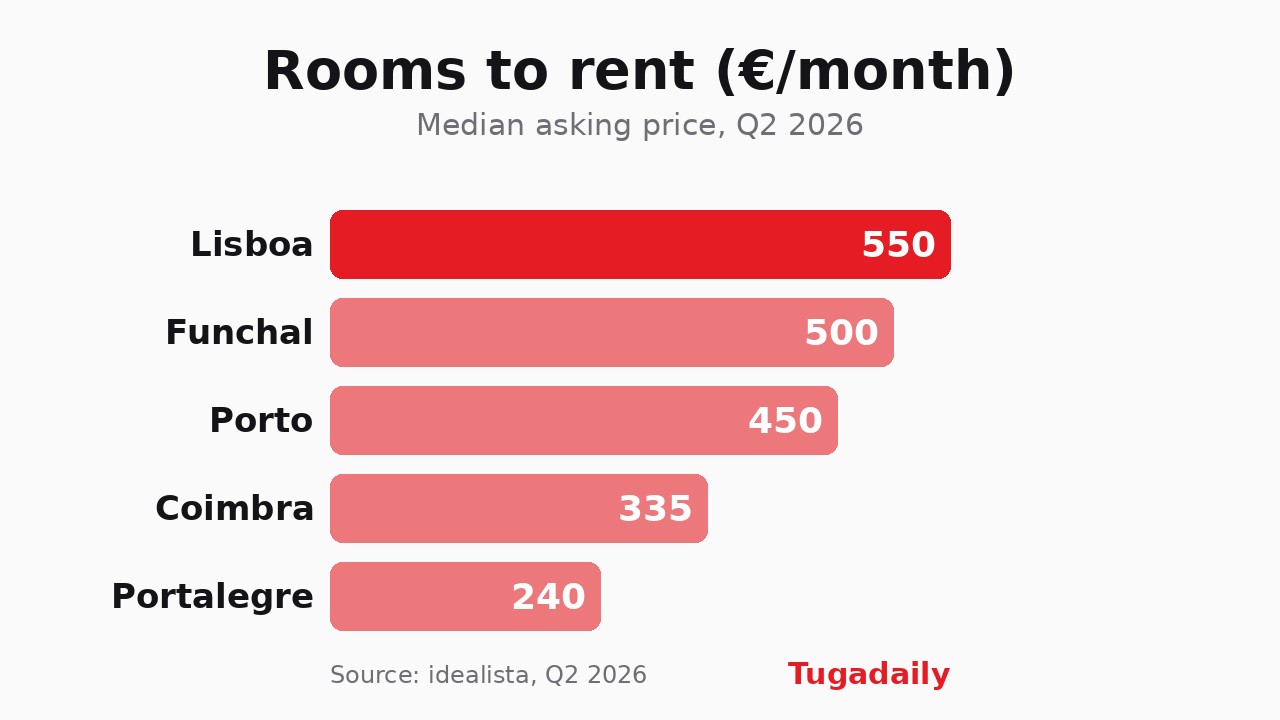
On the rental side, the median asking rent was €16.3 per square metre nationally. Lisbon leads at €21.8 and Porto sits at €16.4. The good news, if we can call it that, is that the year-on-year growth in asking rents slipped into negative territory. It’s not a real drop — more a tap on the brakes after years of running. For anyone searching, even a pause already tastes like relief.

Illustrative · Photo: Jakub Zerdzicki / Pexels

A row of modern houses reflected in a calm pond, showcasing serene suburban architecture.
Real Estate 25 June 2026

The US is about to cap how many homes big investors can buy. What about us?

Congress passed a bill to limit funds snapping up single-family homes and ease new construction. The debate sounds awfully familiar in Portugal.

Houses are expensive on the other side of the Atlantic too — and the US Congress just moved on it. The House of Representatives passed a bill that does two things at once: it caps how many single-family homes large investors can buy, and it loosens federal rules to make new construction easier. The President is expected to sign it.

The logic is easy to follow. When giant funds roll into a neighbourhood and buy homes by the dozen to rent out, there’s less left for the family chasing a first place — and prices climb. At the same time, with no new homes going up, any brake on demand is only half a fix.

Why this matters here

Sound familiar? It should. Portugal is wrestling with the exact same puzzle: how to cool prices without drying up supply. There’s no magic formula, and copying laws from abroad rarely goes smoothly. But it’s worth watching what other countries try — and checking back in a year to see if it worked. For now, the reminder stands: the housing squeeze isn’t only ours.

Illustrative · Photo: TLK GentooExpressions / Pexels

Aerial shot of a sunlit residential area showcasing tiled rooftops and lush greenery.
Real Estate 25 June 2026

Homes: Fitch sees another 15% in 2026. Blame supply

After 2025 closed up nearly 18%, the agency expects another jump this year. The usual reason: too few homes, too much demand.

Bad news if you were hoping prices would stall: ratings agency Fitch reckons they’ll rise another 15% this year. And that’s on top of 2025, which closed up close to 18%. In other words, the rocket hasn’t landed — it just changed gear.

The day-to-day numbers match the mood. In May, the median asking price hit 3,142 euros per square metre, a fresh high. Lisbon leads by a distance (6,124 EUR/m2), Porto follows (4,064 EUR/m2). And foreign demand shows no sign of tiring.

The knot at the centre

The explanation is nearly always the same, and it’s tiring precisely because it keeps repeating: there aren’t enough homes. Building is slow and thin, demand — local and from abroad — stays strong, and when a lot of people chase few doors, prices only go one way. Untangling this isn’t shutting one tap; it’s opening many, and that takes years.

If you’re house-hunting

Not financial advice, just reading the ground: buyers should plan for firm prices, not bargains. And it always pays to look beyond the usual spots — towns a comfortable distance from the big cities, where the price per square metre can still breathe.

Illustrative · Photo: David Brown / Pexels

Close-up of a hand holding a key above colorful miniature houses, symbolizing real estate transaction or investment.
Real Estate 24 June 2026

24 applicants per home: the rental market is in combat mode

While sales start to slow, renting is tightening: each home draws an average of 24 enquiries and demand is up 20% in a year.

There’s good news and bad news in the housing market, and they’re holding hands. The good: home buying has finally started to slow, and prices — which set records for months — are showing signs of easing off the gas. The bad: anyone looking to rent is still in an elbows-out scrap.

At the start of 2026, each rental home drew an average of 24 enquiries, with tenant demand growing 20% in a year. Translation: when a decent listing appears, there’s a queue at the door before your coffee goes cold.

What’s going on

With sale prices sky-high and interest rates still heavy, plenty of people who’d love to buy are stuck renting — and that shoves rental demand upward. The result: tense rents and applicants competing for every key.

For Lousada and the surrounding area, where prices are friendlier than in Porto, this can be an opportunity — but also a warning. If you’re house-hunting, get your paperwork ready and move fast.

Illustrative · Photo: Jakub Zerdzicki / Pexels

A modern wooden house with a prominent 'House for Rent' sign in the green yard.
Real Estate 24 June 2026

Government promises a new rental framework

Among Montenegro's announced measures is a fresh legal regime for renting. The details are missing, but the intent is clear: give landlords more confidence.

Tucked into a package of measures unveiled at the PSD congress, Prime Minister Luís Montenegro slipped in a topic that touches a lot of people: a new legal regime for renting. The fine print isn’t on the table yet, but the direction is familiar.

The underlying problem is an old one: many owners are scared to rent out — afraid of unpaid rent, of eviction cases that drag on for years in the courts. The result is shuttered homes that could be on the market. The idea behind a new framework is to give landlords more legal certainty without leaving tenants exposed. Balancing that is the trick, and nobody said it was easy.

Why it matters

Because Portugal’s housing problem isn’t only about purchase prices — it’s also about the people who can’t (or don’t want to) buy and need to rent. If more homes come back onto the rental market, there’s more supply, and more supply tends to cool rents. In towns like Lousada, where plenty of young people are hunting for a first place, that could make a real difference. For now it’s a promise — let’s see the small print.

Illustrative · Photo: Ivan S / Pexels

Wooden model houses on graphs depict real estate market analysis and trends.
Real Estate 24 June 2026

House prices will keep rising in 2026 — just more slowly

Prices hit their seventh straight record, up 10.2% in May. S&P expects a slowdown to 7% this year. A slowdown, mind you, is not a drop.

Good news and bad news on the same chart. In May, the median house price in Portugal rose 10.2% year on year, to about €3,142 per square metre — the seventh consecutive all-time high. Yes, seventh in a row.

The part that offers house-hunters a sliver of hope: S&P Global expects that climb to slow to 7% over 2026. Read it carefully, though — slowing is not falling. Homes keep getting pricier, just at a less dizzying pace. And even that 7% sits well above the European average, estimated around 4.3%.

What changed

It’s down to demand. Households are more cautious, sales have started losing steam, and when fewer people are pushing, prices stop rocketing. It’s not a dramatic turn — it’s the market easing off the gas.

For anyone searching around Lousada and the Vale do Sousa, the message is the usual one, with an asterisk: buying now won’t be cheaper tomorrow, but the “buy today or never” panic is a little less justified than it was.

Illustrative · Photo: Artful Homes / Pexels

Elegant villa on a rocky Algarve cliff with clear blue skies in Faro District, Portugal.
Real Estate 23 June 2026

Portuguese homes: another price record, with the Centro as the refuge

The median price hit €3,142/sqm in May, a seventh record in a row. Lisbon leads, the Centro stays the most affordable.

Anyone house-hunting already knew it, but the figures confirm it: buying in Portugal keeps getting pricier. In May, the median sale price reached €3,142 per square metre — a new all-time high, the seventh month in a row setting a record. Year on year, that’s a 10.2% rise.

For a sense of scale, Portugal sits in the global top three for house-price growth among nearly 60 countries, and first in Europe. Rising this much, this fast, is great for those who already own — and a headache for everyone still looking.

The price map

Greater Lisbon remains the most expensive at €4,391/sqm, followed by the Algarve (€4,057) and Madeira (€3,647). At the other end, the Centro region stays the most affordable at €1,794/sqm — almost half of Lisbon. For anyone flexible on location, that’s where a budget still has room to breathe.

Signs of a slowdown

There’s an important nuance, though: after months of galloping, sales have started to slow and prices themselves are showing signs of easing their climb. It’s not a fall — more a gentle foot on the brake. For anyone saving for a deposit, it could be the difference between catching the train now or waiting to see.

Illustrative · Photo: Jeffrey Eisen / Pexels

Low-angle view of a modern wooden house with a 'House for Rent' sign, showcasing contemporary architecture.
Real Estate 22 June 2026

"Moderate" rent: what changes for tenants and landlords

6% VAT on construction, landlord income tax dropping to 10%, and bigger deductions for renters. A quick guide to the housing measures now kicking in.

There’s one word running through everything the Government is doing on housing: “moderate.” And it’s worth understanding what it means for your wallet.

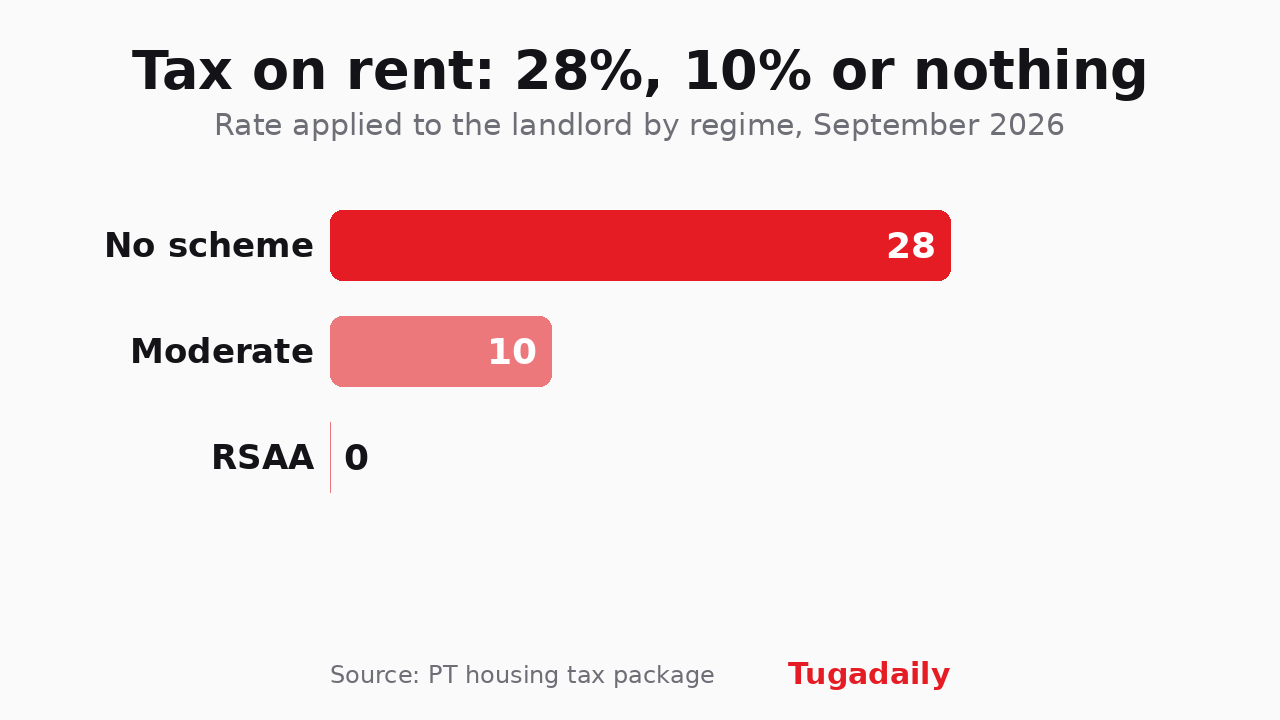
The core idea is to pull more homes into controlled prices, with tax carrots on both sides of the counter. For renters, the income-tax deduction on rent rises in steps — €900 in 2026 and €1,000 from 2027. For landlords, the income-tax rate on moderate-rent contracts drops from 25% to 10%, and there’s a capital-gains exemption if sale proceeds are reinvested into moderate-rent housing.

Construction joins in too

To push supply, VAT was set at 6% on building homes worth up to €648,000 (or, for rentals, with rents up to €2,300 — that “moderate” threshold again). There’s also a new Affordable Rental Regime, capping rents at 80% of the median per-m² value in each municipality.

What it’s worth in practice

The anchor numbers for 2026: “moderate” monthly rent up to €2,300 and a “moderate” sale price up to roughly €660,982. Sound high? In Lisbon and Porto, sadly not really — and that’s where most of the incentives are aimed. For municipalities like Lousada, the per-m² ceilings are much lower, so the “moderate” yardstick is always local. The eternal question hangs in the air: enough to bring rents down, or just to slow the climb? The end of the year will tell.

Illustrative · Photo: Ivan S / Pexels

Aerial perspective of suburban homes and urban high-rises, showcasing contrasting environments.
Real Estate 22 June 2026

Houses at record highs: it's not mainly the interest rates

Prices rose 10.2% in a year and hit a fresh record. A recent analysis points the finger at a growing economy and a shortage of supply — more than at the cost of credit.

If you’re house-hunting, this isn’t the cheeriest headline: in May, asking prices for homes in Portugal rose 10.2% year-on-year, with the median reaching €3,142 per square metre. That’s a fresh all-time high — the seventh month running to set a record.

The obvious question is “why?”. For a long time the easy answer was interest rates. But a recent analysis flips the argument: what pushes prices up most is a growing economy and a shortage of supply — more people able to buy and too few homes to go around. Rates matter, of course, but they’re not the main engine.

And if you’re watching

There’s a small consolation in the data: after months running hot, sales have started to slow and price growth is losing some steam. It’s not a fall — just the foot easing off the accelerator.

On the map, Greater Lisbon leads at €4,391/m², followed by the Algarve. The Centro region remains the most affordable at €1,794/m². For anyone searching in the northern interior and the Vale do Sousa, the gap to the capital is still the strongest argument for settling away from the coast.

Illustrative · Photo: Pavel Danilyuk / Pexels

A vibrant orange model house stands out among black miniature houses, symbolizing real estate concepts.
Real Estate 21 June 2026

Prices up, sales down: the 2026 housing puzzle

The latest data tells an odd story — homes cost more, yet change hands less often. Here's what's behind it.

There’s a puzzle in the housing market that doesn’t seem to add up: prices keep climbing, but fewer homes are selling. How do those two go together?

The most recent INE figures put the median around €2,076 per square metre, up roughly 17% on a year earlier. At the same time, the number of homes that actually changed hands fell about 9% early this year. So: expensive, and slowing on sales.

Why

The simplest explanation is the monthly payment. With Euribor creeping back up, borrowing got heavier, and plenty of would-be buyers either dropped out or eased off the gas. Sellers, meanwhile, are in no rush to cut their asking price — they hold.

The national numbers hide very different maps. In Greater Lisbon the median sits near €3,439/m², the Algarve around €3,139, and the Porto Metropolitan Area about €2,305. This is where the eternal Vale do Sousa argument comes in: someone working in Porto and doing the math starts eyeing towns like Lousada, where the square metre still lets your wallet breathe. Fewer sales doesn’t mean a frozen market — it means a market choosing more carefully.

Illustrative · Photo: Jakub Zerdzicki / Pexels

Picturesque view of colorful rooftops against a clear blue sky in Viana do Castelo, Portugal.
Real Estate 20 June 2026

Portuguese house prices hit a new record — and in 157 municipalities they more than doubled

The median price reached €3,142 per square metre, the seventh straight high. And it's no longer interest rates doing most of the pushing.

If you’re house-hunting and feel like prices simply won’t stop, it’s not in your head. The median cost of buying a home in Portugal reached €3,142 per square metre at the end of May — a new all-time high, and the seventh month in a row breaking the previous record.

The number that really lands, though, is another one: in 157 municipalities prices have more than doubled over recent years. And this isn’t just Lisbon and Porto — the climb has spread across the country, and plenty of areas that used to be “affordable” no longer are.

There’s an interesting twist in the explanation, too. For a long time we blamed interest rates. Now analysts say what’s pushing prices most is economic growth and a shortage of supply — too much demand, too few homes. In other words, lowering Euribor alone won’t fix the underlying problem.

What it means for us

The Centro region remains the cheapest (around €1,794/m²), which keeps the argument alive for anyone swapping city crowds and city prices for municipalities like ours. There are signs of cooling — buyers are more cautious and slower to decide — but anyone waiting for “the big drop” could be waiting a long while.

Illustrative · Photo: Reinaldo Simoes / Pexels

Euro notes with house model and financial charts symbolize real estate investment and economic growth.
Real Estate 15 June 2026

Rates up, prices up: 2026's double squeeze on buyers

With the ECB tightening and prices at record highs, buying a home in Portugal just got a touch harder. Here's how to think about it.

Bad news if you’re house-hunting: the two factors that matter most to your sums are both pushing the same way — up.

On one side, prices. The median in Portugal is now around €2,076 per square metre, a jump of nearly 17% in a year. In the Porto Metropolitan Area it’s about €2,305 — above the national average. On the other side, credit: with the ECB lifting its deposit rate on 11 June, Euribor stops helping and your monthly payment tends to flatten out or edge up.

Where does Lousada fit?

This is exactly where the inland Vale do Sousa keeps making sense. When the price per square metre in Porto bites, towns like Lousada — half an hour away by car — give you more house for the same money. It’s not magic: it’s geography and patience.

The same calm advice as always: model your payment with a Euribor a bit higher than today’s, leave slack in the budget, and don’t buy at your absolute limit. There are plenty of houses; regrets over a stretched mortgage are plentiful too.

Illustrative · Photo: Jakub Zerdzicki / Pexels

Vibrant and historic apartments in Porto, Portugal bathed in sunlight.
Real Estate 15 June 2026

Porto keeps climbing — and Lousada is starting to make a lot of sense

With homes in Porto brushing €4,000/m², people who work in the city but want to breathe are looking inland. Lousada is in the conversation.

House prices in Portugal keep rising like fresh bread: up more than 17% in a year, with the national median hovering around €2,198/m². In Porto the story is steeper still — the average sits near €3,940/m², and across the metro area it tips past €4,000.

Translation: buying inside the city of Porto is, for a lot of people, a race that’s already halfway done without them. And this is where the map starts arguing for the interior.

Lousada is about 40 minutes from Porto, with a train link via Caíde station. For anyone who works in the city but wants a garden, neighbours who say hello, and a mortgage that doesn’t steal their sleep, the maths starts doing itself.

It’s not magic — it’s geography and patience. As Porto tightens, towns like Lousada stop being “plan B” and become, for many, plan A with a yard. If you’re mulling it over, it’s worth getting to know the town before the rest of the country clocks the secret.

Illustrative · Photo: Efrem Efre / Pexels

A detailed view of a half-renovated wooden house facade, showing old vs new.
Real Estate 15 June 2026

Homes in Portugal: after a record 2025, 2026 gives no breaks

Prices rose nearly 17% and some see another 15% this year. What it means if you're buying, selling — or hunting for alternatives.

If you’re dreaming of a home of your own, you might want to sit down before reading this. The median price of homes sold in Portugal rose 16.8% versus 2024, reaching €2,076 per square metre. And some think the party isn’t over: ratings agency Fitch points to another roughly 15% rise in 2026.

In the Porto Metropolitan Area, the median sits at €2,305 per square metre, above the national average, with thousands of transactions confirming demand isn’t slowing. The recipe is familiar: lots of people wanting to buy, few homes coming up, and prices forever pushing higher.

What it means on the ground

This is exactly the tide that makes municipalities like Lousada increasingly appealing. When Porto slips out of reach for many wallets, well-connected, more affordable towns start drawing people who want quality of life without mortgaging their entire future.

This isn’t financial advice — just a snapshot of the market. If you’re buying, patience and careful sums; if you’re selling, the wind may yet blow your way a little longer.

Illustrative · Photo: Neriman Özaydın / Pexels