
PT
A hospitality worker serving at a table
Opportunities 29 June 2026

Summer jobs in tourism: employment fairs reach five cities

With high season heating up, tourism needs hands. Job fairs are coming to Vilamoura, Évora, Lisbon, Porto and Coimbra — and IEFP helps open doors.

Apply / Learn more

If you’re job-hunting for the months ahead, summer is your friend. With hotels full and restaurants packed, tourism is the sector that hires most at this time of year, and in 2026 there’s an organised way in: the tourism employment fairs.

Where and how

The fairs, run as a partnership between Turismo de Portugal, the IEFP and job exchanges, pass through five cities this year: Vilamoura, Évora, Lisbon, Porto and Coimbra. The idea is simple and effective — instead of firing off dozens of CVs into the void, you speak face to face with recruiters, often with interviews on the spot.

The most sought-after roles are the usual high-season ones: receptionists, waiting and bar staff, kitchen crew, cleaning and entertainment. Many don’t need long experience; what counts is willingness, a friendly manner and, in plenty of cases, some languages — English nearly always opens doors, and French or Spanish are a bonus.

Before you go

It’s worth preparing a short, up-to-date CV, bringing several copies and, if possible, having your IEFP registration in order. You can also browse the openings on the IEFP online portal and apply before showing up. For anyone needing extra help, the IEFP helpline answers on working days.

It’s seasonal work, yes, but for many it’s the way to put some money aside, gain experience and sometimes land a contract that lasts beyond the summer.

See also: the IEFP Iniciar internships and the hiring incentives. Official openings are at IEFP.

Illustrative · Photo: Andrea Piacquadio / Pexels

Volunteers from an organisation working together
Opportunities 6 July 2026

Portugal NGO equality fund: €4 million open for applications until 17 July

The PESSOAS-2026-2 call funds NGOs working on equality and non-discrimination in Portugal with €30,000 to €200,000 per project. Applications close on 17 July 2026.

Deadline
17 July 2026
Apply / Learn more

There is €4 million waiting for organisations working on equality in Portugal — and the window closes on 17 July. The PESSOAS-2026-2 call, run by the CIG under the Pessoas 2030 programme, funds NGOs and non-profit civil society organisations working on equality and non-discrimination, with grants of €30,000 to €200,000 per operation.

Who can apply to PESSOAS-2026-2?

Non-governmental organisations and non-profit civil society entities working in the call’s areas: gender equality, combating domestic violence, non-discrimination and preventing human trafficking. The call, launched in March, aims to strengthen these organisations’ technical and financial capacity — in other words, it doesn’t just fund one-off projects, it funds muscle.

How much can each organisation receive?

Each approved operation gets eligible funding between €30,000 and €200,000, from a global budget of €4 million. The original deadline has already been extended once, to 17 July 2026 — best not to bet on a second extension.

How do you submit an application?

Applications go through the programme’s portal, with the full notice and forms available on the CIG’s open-calls page. For questions, the commission can be reached at cig@cig.gov.pt. As with any EU-funds application, the trick is reading the full notice before writing a single line — the eligibility and scoring criteria are all in there.

See also: the Portugal 2030 calls open to companies. The full notice is at the CIG and Pessoas 2030.

Illustrative · Photo: RDNE Stock project / Pexels

Healthcare professional in a hospital
Opportunities 5 July 2026

The health service opens thousands of posts: where the doctor and nurse competitions are

711 places for family medicine, nearly 1,750 for hospitals and several nursing competitions. Where to look and what changes with full-commitment pay.

If you work in health or are training in the field, 2026 brings a big wave of hiring in the National Health Service. And unlike other state competitions, here the demand for professionals is real and spread across the country.

How many SNS posts are open, and where?

The Health Ministry identified 711 places to hire young doctors in general and family medicine, 68 in public health and 1,749 in the hospital area. The family-medicine and public-health competitions are opened by ACSS, while in hospitals it falls to the local health units and the cancer institutes (IPO) to launch the procedures. Among hospital specialties, anaesthesiology has 126 vacancies, paediatrics 109 and obstetrics-gynaecology 91.

In nursing, several specialist-nurse competitions are open — for example at the Lisboa Ocidental Local Health Unit, in areas such as rehabilitation, community health, child and paediatric health, maternal and obstetric health and mental health. The Northern Regional Health Administration opened a procedure for 61 places in the special nursing career.

The full-commitment factor

One detail weighs on pay: the full-commitment regime (dedicação plena), with a 25% supplement, is reflected in the 2026 salary tables. For many professionals it is the difference between staying in the private sector or backing the public one.

Where to look? The competitions appear on the SNS recruitment portal and on the ACSS and regional-administration sites. This hiring is the flip side of a problem we have covered: more than 1.6 million people without a family doctor. See the official vacancies on SNS recruitment.

Illustrative · Photo: RDNE Stock project / Pexels

The flag of the European Union
Opportunities 3 July 2026

Portugal 2030: the funding open to companies and would-be founders

There are millions in EU money waiting for projects. A simple map of the funding calls and where to start your application.

There’s a phrase that sounds like bureaucracy but can be worth a lot of money to anyone with a project in the drawer: Portugal 2030. It’s the name of the big package of EU funds that finances investment, innovation, digitalisation and training in Portugal through the end of the decade — and, over the year, it keeps opening calls with generous envelopes for companies and entrepreneurs.

What tends to be funded

The support covers varied areas: modernising small and medium companies, the digital and green transition, research and development, worker training and the creation of innovative businesses. Each call has its own rules — who it’s for, what expenses it covers, what percentage it co-finances — so the secret is to read the conditions carefully before dreaming of the cheque.

Where to start

The starting point is the official Portugal 2030 portal, which lists the open calls and their deadlines. Many companies use consultants to build the application, but the first step — working out whether there’s a call that fits your project — can and should be taken on your own. A good project poorly framed gets lost; an average project well applied moves forward.

The usual advice: deadlines tighten fast, so anyone mulling it over shouldn’t leave it to the last minute.

See also: summer seasonal jobs, for those looking for work now. Calls and applications on the Portugal 2030 portal.

Image: Wikimedia Commons

A person studying on a laptop
Opportunities 2 July 2026

Cheque-Formação: the state support for studying without quitting your job

The IEFP co-funds training for people already working, with a special focus on digital skills. How it works and where to start your application.

There’s an idea that has gained ground in recent years: learning doesn’t stop when you land a job. The trouble is that training costs money and time, two luxuries that aren’t always going spare. That’s where the Cheque-Formação comes in, an IEFP support designed precisely for people already working who want to upskill without emptying their wallet.

How it works

The logic is simple: the state co-funds part (or all, within a cap) of the cost of professional training. The most talked-about variant is the digital one, which can cover several hundred euros for anyone wanting to improve their computer skills — from spreadsheets to more advanced tools. The support is aimed at employed people, whether on a payroll, freelancing or self-employed, and doesn’t require a specific starting level.

What to keep in mind

As with almost anything involving public funds, the secret is in the details. The training must be delivered by a certified provider, you need to be up to date with the tax office and Social Security, and there are documents to attach to the application, made through the iefponline portal. The amounts and deadlines change with each round, so it’s always worth confirming the current conditions before counting on the cheque.

The verdict is positive for anyone with a bit of discipline: it’s public money doing exactly what it should — making people better prepared for the job market.

See also: the Portugal 2030 support for companies. Measures and applications on the IEFP portal.

Illustrative · Photo: Pexels

A waiter on a summer terrace
Opportunities 2 July 2026

Summer work: where the seasonal jobs are this year

Restaurants, hotels and beaches need people from July to September. A quick guide for anyone wanting to earn some cash (and experience) over summer.

The Portuguese summer has two faces: those going on holiday and those working to make those holidays happen. Between July and September, restaurants, hotels and shops in beach areas shift into fast-hiring mode — and that’s where thousands of seasonal opportunities appear for students, young people seeking experience and anyone simply wanting a budget boost.

Where to look

The obvious counters are the usual ones: restaurants, bars, terraces, hotels, campsites and shops in tourist areas. The Algarve, the Alentejo coast, Lisbon, Porto and the islands concentrate much of the demand, but the touristy interior hires too. It’s worth combining the old method — handing your CV in at the door — with online job portals and the venues’ own social media.

What to keep in mind

Seasonal work is real work: it should come with a contract, set hours and contributions paid up. Before accepting, confirm the terms, overtime pay and days off. A summer job can be tiring, but it’s also where many people learn their first lessons in responsibility — and make contacts that last.

For students, it’s also a line on the CV that counts more than it seems.

See also: IEFP internship applications now open. Employment measures and support on the IEFP site.

Illustrative · Photo: Pexels

A team working in a modern office
Opportunities 1 July 2026

The most in-demand jobs in Portugal in 2026

With unemployment at record lows, some sectors are short of hands and full of openings. Where the best opportunities are this year — and why languages give you an edge.

Portugal’s job market is in a good moment. With unemployment near 6% — among the lowest figures in years — there are sectors where employers really are looking for people. If you are thinking of a change, this could be the year.

Where the openings are

Technology continues to lead. IT analysts, support engineers, DevOps specialists and cloud consultants are at the top of the list, and the fields of artificial intelligence and cybersecurity are set to grow strongly over the coming years.

Next come multilingual roles: customer service, sales, digital marketing and technical support, especially for those who speak English, German, Dutch, French or Nordic languages. Portugal has become a favoured base for large international service centres, and that translates into thousands of openings.

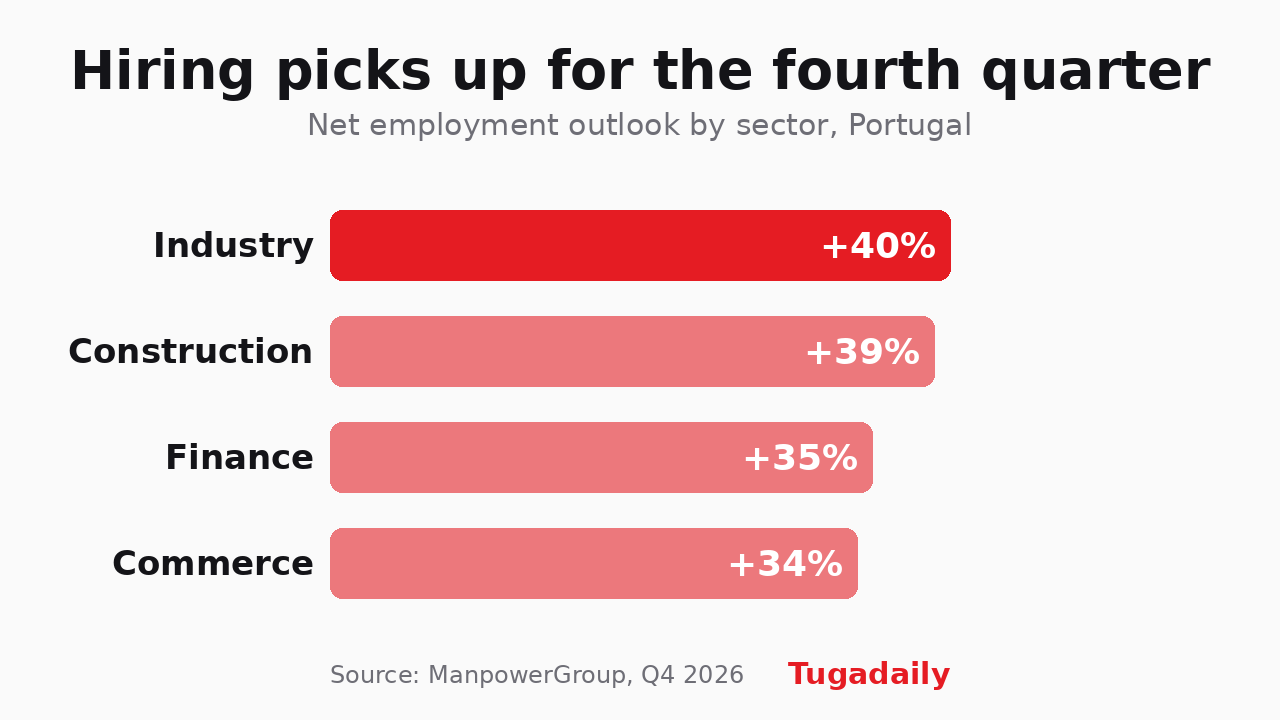
Tourism, which employs around 10% of the workforce, remains a reliable source of jobs, and green energy is the bet on the future that is already starting to create positions.

Speaking languages gets you halfway there

If there is one tip worth gold, it is this: anyone who speaks more than one language has a huge advantage. Many of the best opportunities in Portugal run through international companies that need teams able to talk to half the world.

It is also worth looking at supports for entrepreneurship and innovation, like the ones we described around Portugal 2030. To search for jobs and training, the official starting point is IEFP.

Illustrative · Photo: Pexels

A startup team working in an office
Opportunities 1 July 2026

Money to innovate: Portugal 2030 support open to businesses

From Portugal 2030 to the Startup Voucher, funding lines are running in 2026 for anyone with a solid project. Where to knock.

Apply / Learn more

Having a good idea is half the battle; the other half is usually finding someone to fund it. For businesses and entrepreneurs in Portugal, 2026 brings several open doors, and they’re worth knowing before the deadlines close.

The Portugal 2030 umbrella

The big canopy is Portugal 2030, the package of European funds that supports companies with a blend of financing, advice and training. The lines cover concrete things: technology adoption, business development, upskilling teams and expanding into new markets. It isn’t money falling from the sky — it requires an application, paperwork in order and a project that stands up — but it’s among the most robust support on offer.

For bigger innovation projects, there are dedicated funds worth tens of millions of euros, aimed mostly at sectors like technology, health, climate and digital tools.

For those just starting

Anyone still at the launch stage has the Startup Voucher, monthly support of around 700 euros for a limited period, designed to get an idea off the page. And between national and European programmes, the amounts range from a few thousand euros to much higher figures, depending on the stage and sector.

The common thread among those who tend to succeed? A clear problem, a realistic budget, clean books and a genuine link to the Portuguese economy. One well-prepared project beats ten applications flung at random.

See also: the year’s biggest hire in artificial intelligence. Details and applications at the Portugal 2030 portal.

Illustrative · Photo: Pexels

Hospitality and restaurant team at work
Opportunities 30 June 2026

Summer work in tourism: the Algarve is hiring in earnest

Hotels and restaurants need thousands of people for peak season. Where the jobs are and what to expect.

If you are after quick work for the summer, tourism remains the country’s biggest seasonal employer, and the South leads the race. One hotel collection in the Algarve alone took on around 1,600 people for kitchen and table service for the season, and the story repeats across dozens of venues from north to south.

Where the jobs are

Demand is strong in hotels, restaurants, bars and tourist-activity companies. The most requested roles run from kitchen and floor to reception, housekeeping and activity support. Many openings do not require much experience; they value availability, a knack for dealing with people and, in many places, English or another foreign language, because the customer is international.

What to expect and how to apply

These are intense jobs, with long hours and plenty of weekends, but they pay through the season and open doors for those who want to stay in the sector. It is worth applying on job portals, directly on hotel groups’ sites and, for those living nearby, knocking on doors with a CV in hand. In tourist areas, word of mouth still hires plenty of people.

With the season heating up, whoever moves now grabs the best openings before August fills everything.

See also: the StartUp Voucher for young people and the summer festival agenda.

Listings and applications on portals such as Jobs in Portugal.

Illustrative · Photo: Western Skyline Hotel / Pexels

Startup team at work
Opportunities 30 June 2026

StartUp Voucher: 700 euros a month to get your idea off the page

The programme backs young people aged 18 to 35 who want to launch a business, with a monthly stipend and mentoring.

Apply / Learn more

Having a business idea is easy; surviving the first months with no income is what stops most people. That is exactly where the StartUp Voucher comes in, a programme designed for those just starting out who need time and a bit of financial floor to validate the project.

What it gives, in practice

The measure is aimed at young people aged 18 to 35 with a company idea, and offers a monthly stipend in the order of 700 euros for a period that can reach twelve months. More than the money, the package counts: access to mentoring, technical support and entry into a network of incubators spread across the country. It is the nudge to go from napkin to prototype.

Worth applying?

If you have a reasonably worked-out idea and are willing to put in real time, it is one of the most accessible supports for those without their own capital. It will not make anyone a millionaire, but it gives room to fail, adjust and, with luck and work, take off. The trick is to prepare the application well and understand the rules before diving in.

For anyone thinking of changing their life, it is one of those programmes that deserve five minutes of attention.

See also: how to apply for a public-sector job and the tech ecosystem in Portugal.

Conditions and applications at Startup Portugal.

Illustrative · Photo: cottonbro studio / Pexels

Applicant filling in a job form
Opportunities 30 June 2026

Want a public-sector job? The quick guide to the competitions

Public Employment Pool, the Emprego Público portal and CRESAP: where the public-sector vacancies are and how not to miss the deadlines.

Working for the state still draws plenty of people: stability, predictable hours and, in many careers, clear progression. The catch is that public competitions have their own logic, with short deadlines and language that can be intimidating. Here is the map so you do not get lost.

Where to start

The starting point is the Public Employment Pool, the BEP, where public administration vacancies are posted. There is also the Emprego Público portal, where you can create a personal area and track your applications, ranking lists and notifications for the procedures you entered.

For senior management roles, the door is CRESAP, the commission that recruits for those posts. And there are private sites, such as internship boards, that aggregate offers updated daily — useful if you are just starting out.

Three practical tips

First: read the opening notice to the end, because that is where the requirements and the selection method live. Second: respect the deadline to the minute — public competitions do not forgive lateness. Third: keep proof of everything you submit.

See also: today is the last day to file your tax return and the wait for golden visa biometrics. Official vacancies are on the Emprego Público portal.

Illustrative · Photo: Tima Miroshnichenko / Pexels

Stacked coins symbolising investment
Opportunities 30 June 2026

Golden visa: the wait for biometrics now reaches 12 months

Golden visa investors face about a year between application and biometrics. What that means for anyone weighing whether to go ahead.

Apply / Learn more

The golden visa keeps drawing investors from around the world to Portugal, but anyone joining now needs a virtue that is rare in finance: patience. The gap between submitting an application and giving biometrics is running at around 12 months, according to those who track these cases closely.

In practice, applicants who filed by the end of 2025 are being scheduled for biometrics in the final quarter of 2026. That is a long time, especially for a programme that lives on the promise of a relatively quick route to residency.

Is it worth it, even with the queue?

It depends on the goal. For those mainly after mobility and a residency plan B in Europe, the golden visa still has demand, now centred far more on investment funds than on real estate after the changes of recent years.

But you have to go in with eyes open. The queues are real, the timelines slip and the programme has been under political scrutiny. Anyone proceeding should expect long horizons, not instant gratification.

The practical advice is to treat this as a medium-term investment, with professional guidance and realistic expectations about timing. Promises of miraculous speed are usually a red flag.

For now, the government insists it is working to shorten the wait. Investors are grateful, but want to see it to believe it.

See also: The government promises to end golden visa delays. Official information at AIMA.

Illustrative · Photo: Towfiqu barbhuiya / Pexels

Calculator and documents for filing taxes
Opportunities 30 June 2026

Income tax: today is the last day to file your return

The deadline to file your IRS return ends on 30 June. A quick reminder of what to do today to avoid a fine.

Deadline
30 June 2026
Apply / Learn more

If you have not yet filed your IRS return, stop what you are doing. Today, 30 June, is the last day of the deadline to file the return for last year’s income. Letting the date slip can cost dearly, with fines starting in the hundreds of euros.

The good news is that the process keeps getting simpler. For many taxpayers, especially employees and pensioners without big complications, there is the automatic IRS option, where the return comes pre-filled and you just confirm.

Before you hit submit

It is worth looking carefully at a few points. Check that expenses and deductions are correct, that dependents are properly listed and that no income was left out. Small errors now avoid headaches later.

Anyone with deeper doubts, income from several sources or self-employed activity should consider professional help. An accountant can save more than they cost, especially when specific deductions are in play.

And if today really is too late? File anyway as soon as you can. Filing late beats not filing at all, and sorting things out quickly helps limit the penalty.

One last note: do everything through the official portal and beware of messages and links asking for tax details. This is peak season for scams in the name of the tax office.

See also: Term deposits started paying again. File your return at the Portal das Finanças.

Illustrative · Photo: Polina Tankilevitch / Pexels

Oriente station at Parque das Nações in Lisbon
Opportunities 29 June 2026

Invest2030: the non-refundable support for SMEs that want to grow

Within Portugal 2030, Invest2030 funds innovation and expansion for SMEs in industry, services and tourism. What it is and who it's for.

Growing costs money, and not every good idea has the cash to get going. That’s where Invest2030 comes in, an instrument within Portugal 2030 that offers non-refundable funding — support you don’t have to pay back — to small and medium-sized businesses looking to innovate and expand on the mainland.

Who it’s for

The programme covers SMEs in services, industry and tourism. The logic is simple: help companies with their feet on the ground take the next leap, whether through new equipment, digitalisation, new markets or extra capacity. For a country where the vast majority of the business fabric is SMEs, it’s support that reaches a lot of people.

What to keep in mind

Non-refundable support sounds like a dream, but it demands homework: a solid investment plan, accounts in order, and a project that fits the call’s criteria. It’s worth understanding the deadlines, support ceilings and eligible costs before diving in — and, if needed, asking for help from people who know these processes.

At a time when credit is more expensive, a euro you don’t pay back is worth two. For anyone with a growth plan in the drawer, now’s the moment to pull it out.

See also: savings are paying off again as rates rise. The calls are on the Portugal 2030 portal.

Image: Wikimedia Commons

Belém Tower in Lisbon
Opportunities 29 June 2026

30 million to innovate in tourism: the grant open until year's end

Portugal 2030 has a tourism support programme worth 30 million euros, open to public bodies, associations and SMEs. How to apply.

If you’ve got a project to shake up tourism and you’ve been waiting for a hand to get it off the ground, there’s good news. A tourism support programme under Portugal 2030 is open, with a budget of around 30 million euros, aimed at public bodies, non-profit associations and small and medium-sized businesses.

What it aims to fund

The focus is on innovative projects that modernise the sector, with an eye on sustainability, digitalisation and competitiveness — and it covers the mainland, Madeira and the Azores. In other words, it isn’t only for big operators in Lisbon or the Algarve: it works for the family guesthouse, the local-experiences operator or the council wanting to upgrade a trail.

How and until when

The application window is open on a rolling basis until 31 December 2026, or until the budget runs out — whichever comes first. Translation: there’s no point putting it off until December, because the money may dry up before then. It’s worth reading the conditions carefully, preparing the application calmly and checking whether your project fits the sustainability and digitalisation criteria.

For anyone working in the sector that weighs most on Portugal’s economy, it’s one of the most concrete opportunities of the year. A good project in the drawer earns nothing; submitted, it can change scale.

See also: summer jobs in tourism and fairs. The calls and applications are on the Portugal 2030 portal.

Image: Wikimedia Commons