

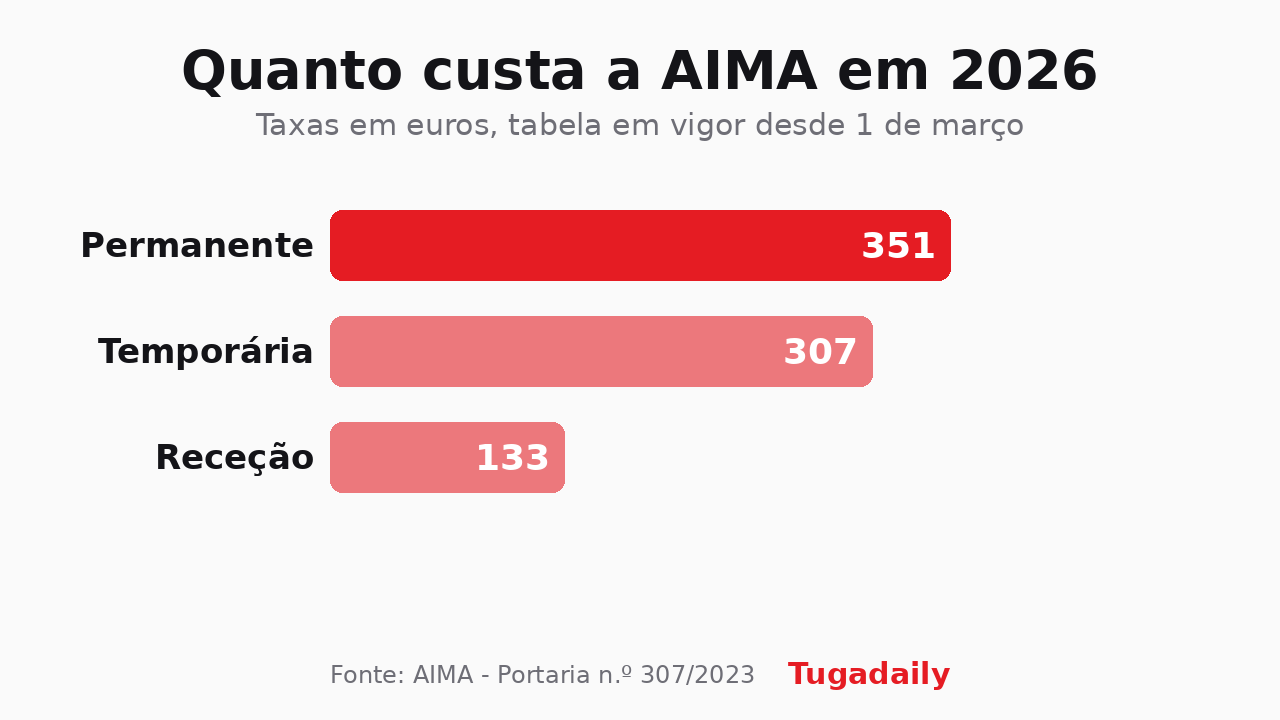
The three AIMA fees that cover most residence applications in 2026
Filing costs 133 euros, granting or renewing temporary residence costs 307.20 euros and permanent residence costs 351.10 euros. AIMA calls the March change an annual indexation, not a rise.
Anyone dealing with AIMA learns quickly that a residence application has two costs, time and money. We have written plenty about the time. On the money, the fee table changed on 1 March 2026, and it is worth knowing exactly what you owe before you open the portal.
Start with the three figures that cover most applications.
Filing and assessment of the application costs 133 euros. It applies to the most common temporary residence routes, including work, research, study, traineeships, volunteering and family reunification. It buys your place in the queue. It does not buy a favourable decision.
Granting or renewing a temporary residence permit costs 307.20 euros.
Granting a permanent residence permit costs 351.10 euros.
Was this a fee increase or not?
That depends who you ask, and both answers hold up.
AIMA’s position is that it decided nothing. Portaria 307/2023 of 13 October, the order that approved the fee table for entry and residence procedures, builds in an automatic update every 1 March, indexed to the average change in the mainland consumer price index excluding housing. For 2025 the national statistics institute set that figure at 2.2 per cent, and that is the percentage applied. The agency published its notice on the updated table.
Reporters who went through the published table read it differently: on certain lines, particularly the most heavily used ones, the increase approaches a third. Both things can be true, because indexation applies to different base values with rounding, and because the table is not uniform in structure.
If you are the one paying, the distinction is academic. What matters is the final number, and the final number is higher than last year’s.
Three habits that avoid surprises
First, check the table currently in force on AIMA’s own site before you submit, because as a rule it changes every March.
Second, keep the filing fee and the granting fee separate in your head. They fall at different stages of the process and are charged separately, and this is where nearly every miscalculation comes from.
Third, keep the payment receipts with your case number attached. If a discrepancy comes up later, that is what settles it.
Quick questions
Are fees refunded if the application is refused?
The filing and assessment fee pays for handling the case, not for the outcome. An unfavourable decision is not in itself grounds for a refund.
Does renewal cost the same as a first grant?
For temporary residence, the order treats granting and renewal under the same line, at 307.20 euros. Always check the exact line that applies to your route.
Where do you pay?
Payment sits inside the application flow itself. If you are renewing, the route is set out in our guide to renewing a residence permit online, which no longer requires an in-person appointment.
What if AIMA misses its deadline?
There is a tacit approval mechanism for renewals with a defined time limit, which comes up alongside the wider deadlines in our coverage of the 2026 nationality law changes. Paying the fee does not speed anything up. It does entitle you to a process.
Chart: Tugadaily · data from AIMA and Portaria 307/2023


