
The court about to rule on Portugal's immigration law is not the court that ruled last year
Eleven provisions, a deadline of 31 August, and four judges who were not on the bench for the 2025 decision that struck down five out of seven.
Portugal’s Constitutional Court has until 31 August to rule on the new foreigners law. It is the second summer running that the judges spend their recess on the same subject, and setting the two occasions side by side tells you more than any forecast would.
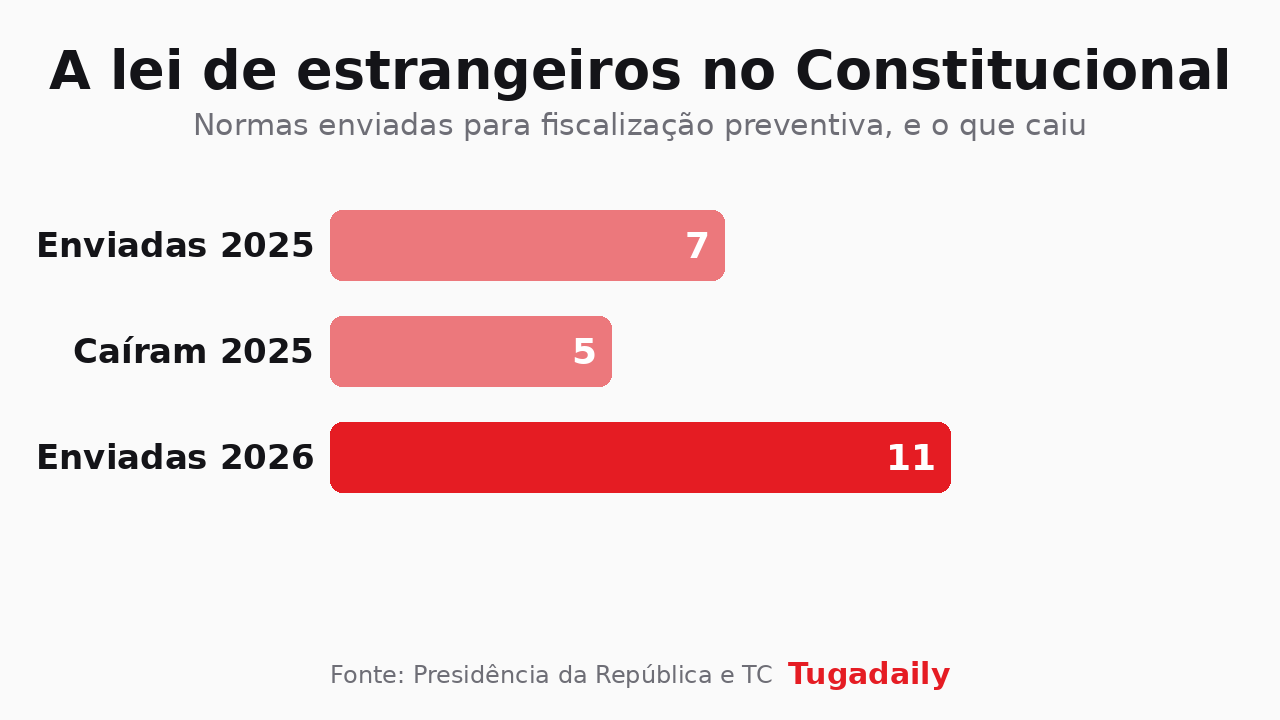
Last August it was seven provisions, referred by the then president, Marcelo Rebelo de Sousa. The court struck down five of them. Ruling 785/2025 blocked, among other things, the two-year residence requirement before a family reunification request could be filed, and the wording that left spouses outside the circle of family who could be reunited. That was the first of the reform’s three big pieces to pass through the building.
This year it is eleven, referred by António José Seguro. We covered what the president actually challenged when he sent the decree over: the expulsion of foreign nationals who have Portuguese minor children, the detention of children seeking international protection in temporary installation centres, and the extension of administrative detention to 180 days.
Four seats out of thirteen changed hands
This is the part that gets lost, and it is probably the part that matters most.
The bench reading these eleven provisions is not the bench that read last year’s seven. The 2025 ruling came without unanimity and with openly stated disagreement among the judges. In the months that followed, four of them left the court, and agreement on their replacements dragged on until June this year. Luís Filipe Brites Lameiras, Joaquim Pedro Formigal Cardoso da Costa, Maria Gabriela Abrantes Leal da Cunha Rodrigues and Maria Paula Bonifácio Ribeiro de Faria were sworn in.
Four out of thirteen does not flip anything by itself. It is not a footnote either, not when the nearest precedent was decided on narrow margins.
The provisions nobody challenged are waiting too
There is a side effect here that rarely gets explained to the people it lands on. When a decree goes for preventive review, it is not only the challenged parts that stop. The whole text stops, unpromulgated, until the court rules.
So provisions the president never questioned are stuck on the same clock. Among them, the end of regularisation through vocational study and through having a minor child on Portuguese soil, and a measure that worked in favour of people caught in AIMA’s backlog. Anyone counting on those waits exactly as long as anyone contesting the rest.
What applies until then
The current rules, in full. No new deadline starts running, and no application gets assessed against a text that is not yet law.
When the ruling lands it goes up in the Constitutional Court’s case-law database, usually the same day it is read out. It is worth noting where the tally ends up: with this referral, the court will have been asked to weigh in on all three pieces of the migration reform, one after another.
Infografia: Tugadaily · dados da Presidência da República e do Tribunal Constitucional