
Portugal's burnt area in 2026 has passed 30,000 hectares — the third worst since 2016
ICNF's tally to July 15 puts 2026 at 30,690 hectares burnt across 4,975 rural fires. Viseu takes the biggest share, Porto logs the most ignitions, and burnt area is up 67% on the ten-year average.
Thirty thousand six hundred and ninety hectares. That is the figure ICNF closes the first six and a half months of the year on, and it is enough to make 2026 the third worst year for burnt area since 2016 — the year after the fires that changed how the country talks about fire at all.
How much of Portugal has burnt in 2026?
Between January 1 and July 15, 30,690 hectares burnt across 4,975 rural fires. The number of ignitions is the fifth highest since 2016; the burnt area is the third. Set against the ten-year average for the same window, fires are up 9% and burnt area is up 67%. Read that again: Portugal is not having many more fires, it is having fires that get much bigger.
The large-fire column shows it plainly. Up to July 15 there were 36 fires of 100 hectares or more, and those 36 alone accounted for 21,047 hectares — close to seven in every ten hectares lost nationally. Everything else is thousands of small incidents adding up.
Which districts were hit hardest?
Depends what you count. By number of fires, Porto leads with 702, then Braga on 489 and Vila Real on 438 — the familiar northwest pattern, densely populated and heavy on burning garden waste. By area, the picture flips: Viseu lost 8,016 hectares, roughly 26% of everything that burnt in the country, largely down to the fire that crossed the serra in the first half of July.
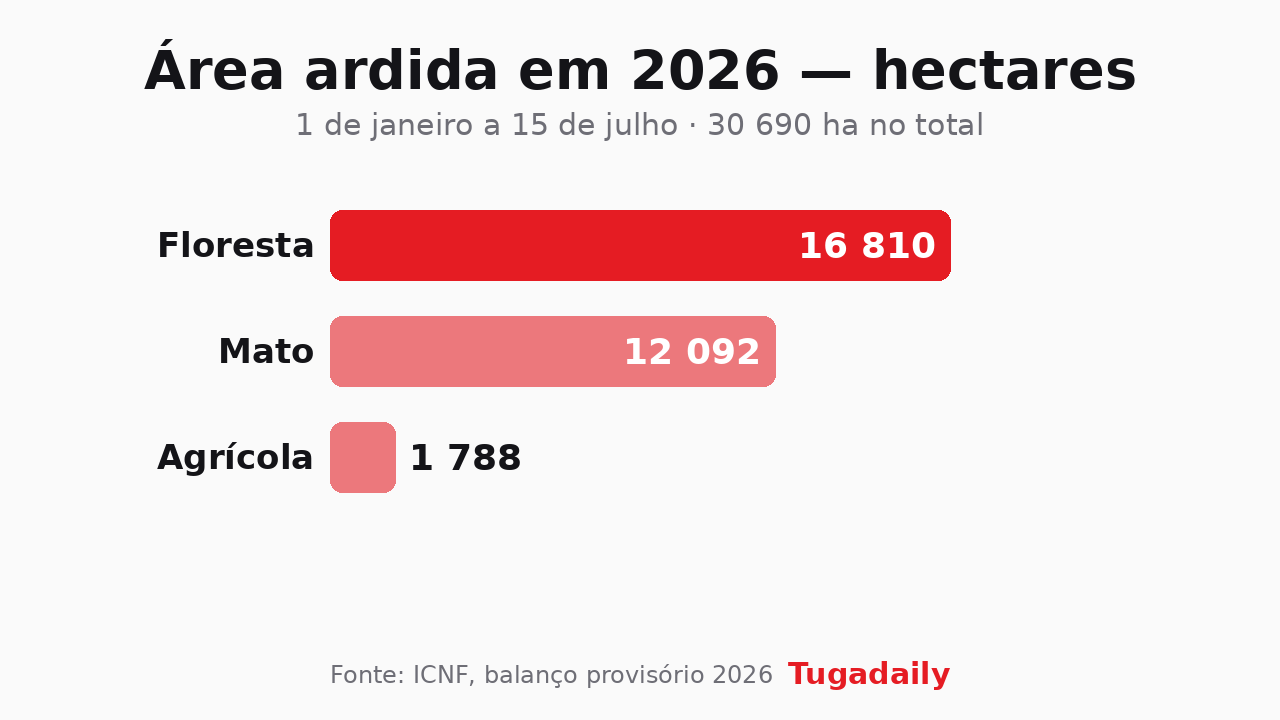
By land type, forest took the biggest share at 16,810 hectares, then scrub at 12,092 and farmland at 1,788.
And the tally stops on July 15, which is worth repeating: August has not started, and the two weeks since brought another large fire between Valpacos and Mirandela. Provisional reports go up on the ICNF portal, which is the place to check the real number rather than the one going round social media.
Chart: Tugadaily · data ICNF