
Portugal has just had its driest July of the century
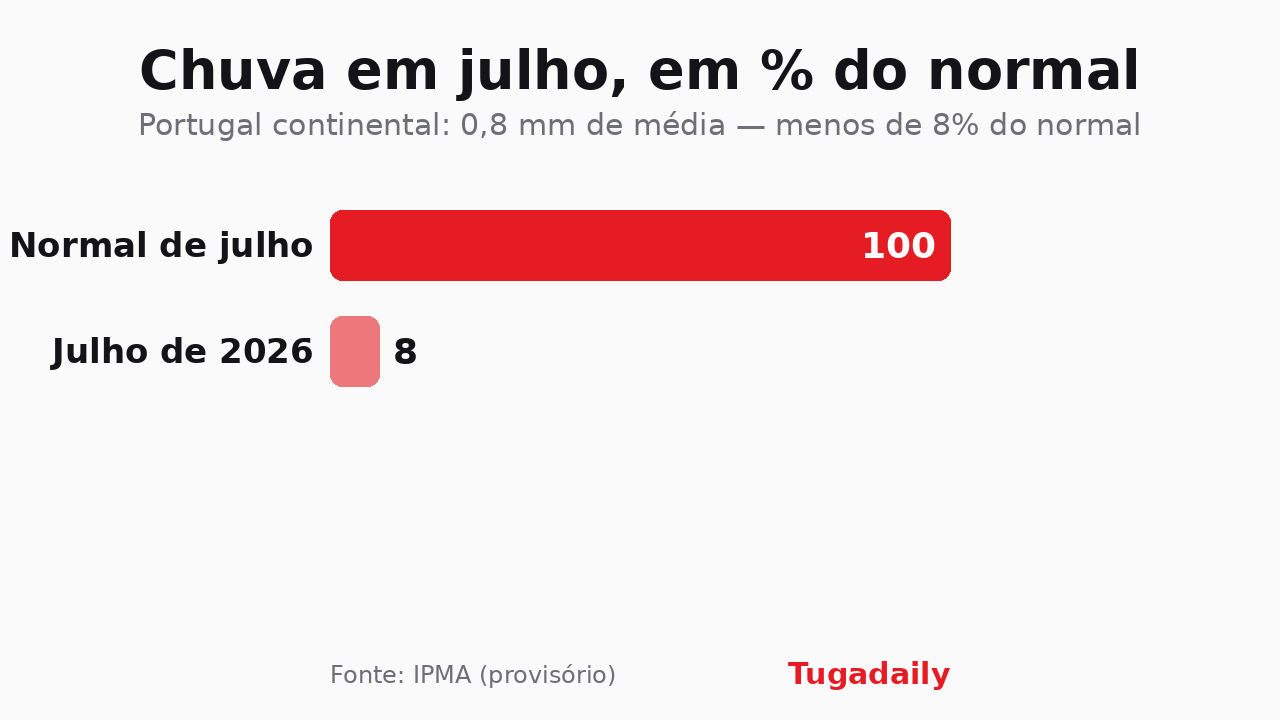
An average of 0.8 millimetres of rain fell across the mainland, under 8% of the normal figure for the month, and meteorological drought went from covering 60% of the country to all of it.
Mainland Portugal recorded an average of 0.8 millimetres of rain across the whole of July. That is under 8% of what the month normally delivers, according to IPMA’s provisional figures.
It makes July 2026 the driest July of this century, and the eighth driest since comparable records began in 1931.
Outside Viana do Castelo and Braga, essentially nothing fell anywhere. The drought map moved accordingly. At the end of June, meteorological drought covered more than 60% of the mainland; thirty-one days later it covered all of it, at levels ranging from mild to moderate.
A hot month stacked on a dry one
Mean air temperature came in at 24.04C, an anomaly of +1.41C against the 1991-2020 reference period, making this the seventh warmest July since 1931.
Much of that heat arrived at the very start of the month, in the heatwave that ran from 2 to 5 July and hit the inland North and Centre hardest. The month’s highest reading was 44.3C, measured at Mora on 3 July.
Dry soil, hot air and cured vegetation is a familiar Portuguese combination, and it showed up in the fire numbers within days. More than 60 municipalities sat at maximum rural fire danger over a single weekend at the start of August, and several inland districts are under yellow heat warnings again this week.
What is still provisional
These are preliminary readings. IPMA publishes its final July climate bulletins for the mainland, the Azores and Madeira in the middle of August, and that is when the rainfall, temperature and drought-index numbers are fixed; the monthly summaries sit on IPMA’s climate monitoring portal.
The practical reading for anyone living here does not really change, though. A July that dry is not recovered in August, which is historically drier still. What matters now is how much of the autumn rain arrives early enough to refill the reservoirs.
Chart: Tugadaily · provisional IPMA data