Tugadaily
PT
Flag of Iran
Politics 29 June 2026

Iran threatens to suspend talks with the US

Washington accuses Tehran of breaching the framework deal; Iran says it may cut talks entirely. The Strait of Hormuz is back at the centre of the board.

Dialogue between the United States and Iran is hanging by a thread again. The US president accused Tehran of breaching the framework deal both sides were trying to stitch together, and Iran answered in kind: it may halt the negotiations entirely.

For anyone who has lost the thread, the backdrop is still Iran’s nuclear programme and the game of sanctions and counter-sanctions around it. Every public accusation pulls the parties away from the table and nudges the region towards another stretch of uncertainty.

The detail that moves prices

There is one point that matters directly to Portugal: the Strait of Hormuz, through which a huge slice of the world’s oil passes. Whenever tension rises, energy markets get jittery and the price of a barrel reacts. It is the shortest bridge between geopolitics and what we pay at the pump.

The International Atomic Energy Agency keeps asking for access and transparency, while European capitals try to keep a channel open to avoid a complete breakdown. For now, the most likely scenario is the usual one: plenty of pressure, few advances and a deal that keeps getting pushed to later.

See also: the reopening of the Strait of Hormuz to shipping. The technical state of play is at the IAEA.

Imagem: Wikimedia Commons

Flag of Lebanon
Politics 29 June 2026

Southern Lebanon flares up again between Israel and Hezbollah

Israeli airstrikes on around 150 Hezbollah-linked positions left at least ten dead, including three Lebanese soldiers.

The truce holding southern Lebanon together has cracked again. Israel carried out airstrikes on around 150 positions it says are linked to Hezbollah, in a day that ended with at least ten dead, among them three Lebanese soldiers.

It is exactly the kind of incident that keeps analysts on edge: each strike of this size tests a ceasefire that was never solid. Israel says it is hitting military infrastructure; Beirut answers that the country’s sovereignty is being trampled and that military casualties change the nature of the confrontation.

A balance always hanging by a thread

Southern Lebanon is one of those maps where a single spark can set the region alight. The Lebanese army is trying to assert itself as the sole authority on the ground, but remains squeezed between Israeli pressure and Hezbollah’s presence. When regular soldiers die in strikes, the government in Beirut is left in an almost impossible spot.

For Europe, and for the Portuguese community living and working in the region, the risk is the familiar one: an escalation that drags in neighbours, complicates routes and pushes people back into exile. International diplomacy is calling for restraint, but words have counted for little against the facts on the ground.

See also: the framework agreement announced between Israel and Lebanon. The UN mission in the country is described at unifil.unmissions.org.

Imagem: Wikimedia Commons

Emergency operators answering calls in a control room
Politics 29 June 2026

Emergency operators on strike: 112 keeps running, but the message is clear

Portugal's Civil Protection telecom operators began a week-long strike demanding a dedicated career path. Emergency response stays guaranteed.

When we dial 112, we rarely think about who’s on the other end of the line. This week it’s worth thinking about. Portugal’s emergency telecom operators at the Civil Protection authority began a week-long strike on Monday — and the reason is easy to grasp: they want a recognised, dedicated career path that reflects what they actually do.

Before anyone panics: emergency response is guaranteed. The workers themselves are at pains to say so, and minimum services are in place to make sure an emergency call still gets answered. The strike is a way of pressuring the government, not a cut to the service.

What’s at stake

The core demand is status. These professionals take the calls, triage the urgency and dispatch resources — firefighters, ambulances, police — often in seconds and in life-or-death situations. What they’re asking is that this responsibility be matched by a defined career, with progression and conditions to match, rather than being stuck in a contractual limbo.

It’s one of those jobs that goes unnoticed until it fails. Which is exactly why it deserves a closer look: the backbone of emergency response is people, not just phones. You can read about the role and structure of the National Emergency and Civil Protection Authority on its official portal.

See also: the rejected labour law and what the government does next.

Illustrative · Photo: 112 Uttar Pradesh / Pexels

The chamber of Portugal's Assembly of the Republic during a debate
Politics 29 June 2026

Labour law rejected: so what does the government do next?

After parliament blocked the rewrite of the Labour Code, Montenegro vows to try again. But the maths in the chamber hasn't changed.

The government’s proposal to rework the Labour Code got a no from parliament, and it was a no with plenty of company: voting against were Chega, the PS, Livre, the PCP, the BE, PAN and JPP. In favour stood only the PSD, the CDS and the Liberal Initiative. In politics, when the left and André Ventura’s party vote on the same side, it’s a sign the topic has legs.

Why it fell

The government insists it negotiated seriously, above all with Chega, and that on most points there was even agreement. The knot tightened on one issue: Chega demanded changes to the sustainability of Social Security and an opening to alter the retirement age. The government refused, and without those votes the proposal was left without a net.

What comes next

Luís Montenegro has already said he won’t give up and that parliament “will have its moment” on this. In the meantime he’s promising new measures for families, perhaps a way to show movement while the labour reform sits on the back burner. The problem is arithmetic: the make-up of the chamber hasn’t changed, and any new version needs to find a majority that, for now, doesn’t exist.

For workers, the translation is that day-to-day rules — hours, dismissals, contracts — stay as they are for now. Nothing changes tomorrow. But the tug-of-war will go on, and it promises to be one of the threads running through this second term.

See also: PS blocks the labour reform and the government’s agenda on immigration and work. You can follow the debates on the Parliament website.

Imagem: Wikimedia Commons

Map of Iran and the Gulf region
Politics 28 June 2026

US and Iran: the ceasefire nobody can guarantee

With strikes on both sides, diplomacy is trying to hold a fragile ceasefire. Egypt and Qatar push for talks; Gulf states condemn the escalation.

Some ceasefires exist more on paper than on the ground, and the understanding between the United States and Iran looks like one of them. After a night of crossfire in the Gulf, the big political question is simple: is there still a deal to save?

There is a memorandum, with fourteen points, that was meant to end the hostilities. But Washington accuses Tehran of repeatedly violating it, and Iran’s Revolutionary Guard returns the charge, saying it was the Americans who broke the terms. When both sides say the other started it, the understanding hangs by a thread.

The neighbours in the middle

The escalation rattles the Gulf states, who did not ask to be part of this. The United Arab Emirates firmly condemned the Iranian strikes on Bahrain and Kuwait, seeing them as a threat to the security of the whole region. Egypt and Qatar, for their part, prefer dialogue and again urged that talks between Washington and Tehran not die.

For Europe, and for Portugal, the issue is followed closely for one very concrete reason: stability in the Gulf moves energy and prices. A drawn-out crisis there is felt at the fuel pumps here.

For now, diplomacy is racing the clock, with the region hoping reason speaks louder than missiles.

See also: Iran strikes US bases in the Gulf. Follow it via UN News.

Imagem: Wikimedia Commons

José Luís Carneiro, leader of the Socialist Party
Politics 28 June 2026

PS says it blocked the labour reform and dares Montenegro to react

José Luís Carneiro claims a Socialist win for halting the labour 'counter-reform' and the single social benefit, urging the PM to 'take his head out of the sand'.

The Socialist Party did some chest-thumping on Sunday. Meeting in Lisbon, the PS National Commission heard its leader, José Luís Carneiro, claim as a party victory the fact that it had managed to halt two government proposals: what he calls the labour counter-reform and the new single social benefit.

Carneiro did not mince words. He said that since the AD won the elections there had been two lost years, and aimed straight at the prime minister: Mr Prime Minister Luís Montenegro, take your head out of the sand, your government is not working.

Common sense or obstruction?

As with almost everything in politics, the reading depends on where you sit. For the PS, this was a brake on measures it considers unfair to workers and to those who rely on social support. For the government and its supporters, it is another example of an opposition making it hard to pass reforms they say the country needs.

What interests us is what it means in practice: for now, the changes to labour rules and the merger of various supports into a single benefit are on hold. For people who work or depend on these supports, this is the kind of tug-of-war that can move the household budget.

The debate is far from over, and the next chapter plays out in Parliament. We will follow it without taking sides, as always.

See also: The Montenegro government’s immigration and work agenda. Follow official activity at portugal.gov.pt.

Imagem: Wikimedia Commons

Andre Ventura, leader of Chega
Politics 28 June 2026

Immigration and labour dominate Montenegro's government agenda

A tighter immigration law passed with Chega's support, a contested labour reform and a strained health service define the AD's second government.

A year after taking office, Luis Montenegro’s second government has a clear agenda, and almost all of it splits the room. The Democratic Alliance was again the most-voted force in 2025, but it governs without an absolute majority, which means negotiating nearly everything.

The loudest issue is immigration. The new, more restrictive rules passed with the support of Chega, the party of Andre Ventura. It’s a clear turn away from the more open policy of recent years, and shows how the centre-right and the right have moved closer on this front.

Open fronts

Labour reform is another battle. Proposals to make the job market more flexible sent unions into the streets and promise more friction. Meanwhile, the National Health Service keeps drawing criticism over strained emergency rooms, and housing remains the wound nobody can heal quickly.

None of this is unique to Portugal. Across Europe, centre-right governments are answering the same questions about borders, cost of living and the welfare state. The difference is in the details and the alliances each one strikes to pass laws.

For readers, the takeaway is simple: this is a government that will lean on case-by-case deals. Every big law will be a negotiation, and the final shape rarely matches the original programme.

See also: Montenegro’s sovereign fund eyes REN and EDP.

Imagem: Wikimedia Commons

Luís Montenegro
Politics 28 June 2026

Montenegro's sovereign fund could buy into REN and EDP

The Government is creating a sovereign fund, managed by the IGCP, to take stakes in strategic sectors — energy, banking, telecoms and airports.

The State wants weight again where strategy is decided. Luís Montenegro announced the creation of a sovereign fund, to be managed by the IGCP, the agency that already handles public debt, with a mandate to take stakes in companies across energy, banking, telecoms and airports.

The political read is straightforward. The fund acts as a vehicle to manage the State’s minority holdings and, potentially, to strengthen the public presence in firms where foreign shareholders now loom large.

The names on the table

REN is the priority. Its biggest shareholder is China’s State Grid, and the Government hasn’t hidden its unease over how the power outage was handled. EDP is in the conversation too, with China Three Gorges holding more than 21% of the capital.

Montenegro has repeatedly said Portugal can’t sit and wait for EU funds to develop, and should soon give more to the bloc than it receives. A sovereign fund fits that autonomy story. What’s missing is the how: which money, on what timeline, and under what governance rules, so old mistakes in public management aren’t repeated.

See also: the XXV Government’s agenda. Debt and treasury detail lives at the IGCP, and Government decisions at portugal.gov.pt.

Image: Wikimedia Commons

Map of Ukraine
Politics 28 June 2026

Ukraine and Russia trade large-scale overnight strikes

Ukraine hit a dozen Russian regions and occupied Crimea; Russia answered with strikes across several Ukrainian areas.

The war grants no truce, and night was the stage again. Ukraine launched a large-scale overnight attack on around a dozen Russian regions, occupied Crimea and the surrounding waters. Russia answered in kind, striking several areas of Ukrainian territory.

It’s the pattern that’s repeated for months: crossing offensives, infrastructure in the crosshairs and civilians living to the rhythm of the sirens. Each side tests the other from a distance, with no serious window for talks in sight for now.

What’s at stake

For Europe, and for Portugal, the impact is felt mainly on two fronts: energy and defence. As the conflict drags on, prices stay exposed to shocks and the pressure to boost military spending remains on the table in Brussels and national capitals.

We’ll keep following it with the usual rule: verified facts, no scaremongering.

See also: the previous update on the war. Allied response tracking is at NATO.

Image: Wikimedia Commons

Emblem of the United Nations
Politics 27 June 2026

Portugal elected to the UN Security Council: what it means

For the fourth time, Portugal will take a seat at the UN's top table. It was the most-voted country, ahead of Germany and Austria, for the 2027-2028 term.

Amid so much other news, there’s a Portuguese diplomatic win worth underlining: Portugal has been elected a non-permanent member of the UN Security Council for the 2027-2028 term. And it wasn’t a squeaker — it was the most-voted country in its race.

A quick recap for anyone who missed it. The Security Council is the most powerful body in the UN, the one that decides on peace, sanctions and peacekeeping operations around the world. It has five permanent members with veto power (the United States, China, Russia, the United Kingdom and France) and ten rotating seats, elected for two-year terms. It’s one of those ten seats that Portugal has won.

The vote took place on June 3 in New York, at the 80th General Assembly. Portugal was contesting two Western European slots with Germany and Austria, and came out on top: it gathered 134 votes, against Vienna’s 131 and Berlin’s mere 104. Being the most-voted of a trio that included Germany is no small thing, and says something about how the country is seen on the international stage.

It’s not a first. Portugal had already held one of these seats in 1979-1980, 1997-1998 and 2011-2012, making this the fourth time. The bid rested on the motto “Prevention, Partnership, Protection”, a way of signalling the kind of role the country says it wants to play: bridge-builder and champion of dialogue, rather than a power player.

In practice, the term only begins on January 1, 2027 and runs for two years. What changes? During that period, Portugal will have a voice and a vote in the big decisions on international security, at a time when the world is hardly at peace. It’s an added responsibility, but also a showcase: a chance for a small country to be heard where big things are decided. And in a moment this globally tense, that’s a seat worth occupying with steady hands.

Image: Wikimedia Commons

São Bento Palace in Lisbon, seat of the Assembly of the Republic
Politics 27 June 2026

Portugal approves a new climate strategy through 2030 — and critics are already pointing fingers

The government approved the National Strategy for Adaptation to Climate Change 2030. Ambitious on paper, but some note what's missing.

In a summer that has already brought tightening heat and fires threatening the interior, climate adaptation could hardly be more topical. And that’s exactly what the Council of Ministers set out to tackle: it approved the new National Strategy for Adaptation to Climate Change 2030, opening the third cycle of national policy on the subject.

The idea, in short, is to prepare the country for what’s coming — heatwaves, droughts, fires and floods — with a more preventive approach grounded in recent science. The strategy ties together water policy, forest management and land-use planning, and its delivery is linked to the national recovery and resilience programme. The document now heads to parliament, while the previous 2020 strategy has been extended to the end of 2026 to ensure continuity.

What the critics say

Not everyone applauded. Environmental groups such as ZERO were quick to point out that a strategy is only worth as much as its execution — and they flag the absence of concrete financing and a defined timetable. In other words: fine intentions on paper, but the hard part is making it happen.

The government counters with the risk maps, which place Portugal among the European countries most exposed to the effects of climate change. Hard to argue with anyone who lived through the last few summers.

You can read the official framing of the strategy at the Portuguese Environment Agency.

See also: Heat builds, fire risk maxes out.

Imagem: Wikimedia Commons

Flag of Israel
Politics 27 June 2026

Israel and Lebanon: a framework deal is announced, but the hard part starts now

The United States announced a deal in principle between Israel and Lebanon. It's a step, not a peace — and some want to derail it.

Middle East diplomacy took one of those steps this week that look big in the announcement and fragile in practice: Washington unveiled a framework deal between Israel and Lebanon. In plain terms, an outline of understanding — the broad lines both sides say they’re willing to negotiate over seriously.

It’s worth being clear about what a “framework deal” is. It’s not a peace treaty and not a definitive ceasefire. It’s closer to agreeing the shape of the table before everyone sits down to argue about what’s on it. The Middle East has seen plenty of outlines that never became agreements.

Why it matters here

It may feel far away, but stability in that region touches all of Europe — and Portuguese wallets. Tensions there send energy prices spiking, and we’ve already seen this year how that shows up in electricity and fuel bills. A diplomatic path, however uncertain, is better news than another escalation.

That said, voices are warning it won’t be easy: several analysts note there are players in the region with every interest in sabotaging the deal. The next test is whether the words of the announcement turn into concrete commitments — dates, guarantees, monitoring.

For now, the factual record: there’s a framework, there’s stated willingness, and there’s a long road ahead. We’ll follow it without alarmism or easy optimism.

Image: Wikimedia Commons

Flag of Ukraine
Politics 27 June 2026

No truce in Ukraine: another night of strikes traded both ways

While diplomacy moves forward elsewhere, the war between Ukraine and Russia drags on with no ceasefire in sight. Where things stand.

Some conflicts slip off the front pages without ever ending, and the war in Ukraine is now one of them. While the world follows deals in the Middle East, eastern Europe keeps living through nights of strikes traded both ways, with no ceasefire in sight.

In the most recent night, Ukraine launched an offensive against multiple points across Russian territory and Crimea, and Russia answered with attacks on different Ukrainian regions. It’s the pattern that has repeated for far too long: each side trying to wear the other down, with no turning point on the horizon.

Why it still concerns us

It may feel distant, but this war keeps touching everyday life. It helped push energy and grain prices over the past few years, and any escalation is felt again in European markets — which Portugal is part of. There’s also the human scale, with millions displaced and entire communities living to the sound of sirens.

Diplomacy hasn’t given up. The United Nations and several countries keep channels open, but for now the talks haven’t halted the strikes. Meanwhile, the human toll keeps adding up.

The official situation reports from UN agencies can be followed at news.un.org.

See also: Israel and Lebanon announce a framework deal.

Image: Wikimedia Commons

View of the Congreso de los Diputados, a neoclassical landmark in Madrid, Spain.
Politics 26 June 2026

US eases Venezuela sanctions to let the aid through

Washington carved out an exception and pledged rescue assets. An emergency gesture that many will watch closely, given the recent history.

There are moments when politics takes a step back so urgency can move to the front. That’s roughly what happened this week: after the earthquakes that devastated western Venezuela, the United States eased part of the sanctions weighing on the country to allow in humanitarian aid that would otherwise be blocked.

Washington also said it would send rescue teams and military assets — ships and planes — to support operations on the ground. In a disaster with nearly 600 dead and tens of thousands missing, every pair of hands and every hour counts.

Why this is delicate

The relationship between the two countries is far from simple, and the recent context makes the gesture especially loaded. Easing sanctions, even for humanitarian reasons, always raises questions: how far does the exception reach, who controls the distribution of aid, and what happens once the emergency passes.

Those who back the decision say the obvious — faced with a tragedy of this scale, letting aid through is the bare minimum, and keeping relief separate from politics is exactly what’s expected of a major power. Those who are wary recall that aid and influence often travel together, and will want to see whether the opening stays strictly humanitarian or grows other edges.

For now, what’s on the table is concrete and limited: letting in supplies, teams and equipment. The bigger debate — about what this means for the relationship between the two countries — can wait until the rubble settles.

Illustrative · Photo: Toni.063371 - Antonio Sáez / Pexels

Black and white photo of a traditional legislative assembly chamber, featuring empty seats and desks.
Politics 26 June 2026

Venezuela: the debate dividing the world over sovereignty and power

Six months after Maduro's capture, the international community is still split between 'accountability' and 'dangerous precedent'.

The situation in Venezuela keeps making news — and not only because of the humanitarian crisis. There’s a deeper argument here, quieter but perhaps more important in the long run: how far can one state go to act inside another’s borders?

The backdrop is familiar. In January, US forces captured Nicolás Maduro in a raid on Caracas; since then, former vice president Delcy Rodríguez has governed as acting president, and Maduro faces trial in the United States.

Two arguments, no middle ground

At the UN Security Council, the positions don’t meet. On one side, some see the action as a form of accountability — a leader accused of serious crimes brought to court. On the other, voices like Moscow and Beijing warn of the risk of normalising the unilateral use of force and eroding head-of-state immunity, a long-standing principle of international law.

We won’t take sides — and there are serious people on both. But it’s worth grasping why this matters beyond the headlines: the rules set (or broken) in a case like this end up shaping what’s acceptable in the next one. And the next one could involve anyone.

Illustrative · Photo: Héctor Berganza / Pexels

Zohran Mamdani
Politics 25 June 2026

New York: Mamdani's progressive wing sweeps the primaries

Candidates backed by the mayor toppled veteran congressmen. A jolt inside the Democratic Party.

There was an earthquake in New York’s primaries. Three progressive candidates backed by Mayor Zohran Mamdani won their races — and some of those wins came against heavyweights from their own party.

Former city comptroller Brad Lander beat Congressman Dan Goldman. And Darializa Avila Chevalier, a 32-year-old Afro-Latina organiser, unseated Adriano Espaillat, a five-term congressman and chair of the Congressional Hispanic Caucus. It’s not every day that fresh faces knock off names this established.

What it signals

Without taking sides, the message is clear: inside the Democratic Party, the wing further to the left has gained momentum and shown electoral muscle in one of the country’s biggest cities. Primaries aren’t general elections, and New York isn’t the whole United States — but trends often start exactly like this, in one place, then spread. Eyes on.

Image: Wikimedia Commons

The United States Capitol in Washington
Politics 25 June 2026

US Senate moves to halt the war with Iran — a first in history

For the first time since 1973, both chambers pass a resolution directing the President to end a conflict. A rare institutional moment.

Something rare happened in Washington: the Senate passed a war powers resolution directing President Trump to end the conflict with Iran. The historic detail is this — for the first time since the War Powers Resolution of 1973, both chambers of Congress have approved a concurrent resolution telling a president to end a military action.

In parallel, on the diplomatic track, the head of the UN’s atomic agency said Iran’s nuclear enrichment sites would be inspected under an interim deal. So there’s domestic political pressure and there are channels opening abroad, all at once.

Why it matters

Without weighing in on who’s right, what you’re seeing is Congress reasserting a power it often leaves dormant: the say over war. Resolutions like this tend to run into a presidential veto, so the practical effect may be limited — but the institutional signal is large. Worth watching the next step.

Image: Wikimedia Commons

Historic government building in Yerevan, framed by greenery, under a cloudy sky.
Politics 24 June 2026

Montenegro shores up the PSD: Bugalho, Moedas and Pedro Duarte join the top table

At the Anadia congress, the leadership was re-elected with 88% and gained three well-known faces as vice-presidents. What it signals about the party's direction.

The PSD gathered at the Sangalhos velodrome in Anadia and walked out with Luís Montenegro’s leadership reinforced — re-elected with 88% of the vote at the party’s 43rd congress.

The headline is in the names. Stepping up as vice-presidents are MEP Sebastião Bugalho, who doubles as party spokesperson, and two heavyweight mayors: Carlos Moedas of Lisbon and Pedro Duarte of Porto. Hugo Soares stays on as secretary-general. Leaving the vice-presidencies are Carlos Coelho, Lucinda Dâmaso and Rui Rocha.

Why it matters

Putting the mayors of Lisbon and Porto on the top table is a big-stage move: it pulls the leadership closer to local power and hands the party faces with votes of their own. Bugalho — young and media-savvy — sharpens the messaging.

All of this lands days after the government lost a parliamentary vote on its labour reform — a reminder that, outside the congress hall, Montenegro is still governing without a majority. Tidying the house from the inside is one thing; winning over the opposition is another matter entirely.

Illustrative · Photo: Valeria Drozdova / Pexels

Capture of the iconic Palace of Westminster along the Thames River in London, showcasing Gothic architecture.
Politics 22 June 2026

Portugal is getting a sovereign wealth fund: what Montenegro announced

Closing the PSD congress, the prime minister laid out eight priorities for the coming weeks — headlined by a sovereign fund that could buy into strategic companies.

If one headline came out of the PSD congress this weekend, it’s this: Portugal is getting a sovereign wealth fund.

In his closing speech on Sunday in Anadia, Luís Montenegro announced the creation of a Sovereign Fund of Portugal, run alongside the IGCP (the agency that manages public debt). The idea is to give the State a tool to take — or strengthen — stakes in companies in sectors deemed strategic: energy, banking, communications, even airport infrastructure, should current concession holders fall short of their commitments.

Not just the fund

The fund was the star, but it didn’t come alone. Montenegro set out eight priority areas for the coming weeks, including a reform of administrative and tax justice, changes to the rental regime, and fresh investment in railways and artificial intelligence. Along the way he repeated the line he’s hammered since the labour reform was voted down: “the day I have to cut pensions, I resign.”

Why it matters

A sovereign fund that pools the State’s holdings and can buy more isn’t a technical footnote — it’s a shift in how Lisbon sees its role in the economy. The criticism will come (the opposition is already crying the opposite of “standing still”), and the devil, as always, will be in the fine print we haven’t seen yet. For now, it’s intent. The coming weeks will show how much of it becomes law.

Illustrative · Photo: Baptiste / Pexels

Vibrant interior of a parliament hall with a grand dome and intricate architecture.
Politics 22 June 2026

Labour package voted down: Chega sided with the left

The Government's labour-law reform was rejected in parliament. Only PSD, CDS and IL backed it — and the Government says it isn't giving up.

There was a twist on Friday worth unpacking slowly. The Government’s proposal to overhaul Portugal’s labour law — the so-called “labour package” — was voted down in parliament. And the outcome had an unlikely lead character: Chega, which for days had hinted it would let the bill through, ended up voting against.

The result: only PSD, CDS and the Liberal Initiative voted in favour. Against it lined up the entire left — PS, Livre, PCP, Bloco, PAN and JPP — plus Chega. It’s one of those votes where parties that rarely agree on anything found themselves on the same side, each for their own reasons.

What sank the deal

The Government gave ground on plenty during the talks, but not on two sensitive points: the rules on outsourcing tied to dismissals, and the retirement age. That’s exactly where the understanding with André Ventura ran aground. Without agreement there, the bill didn’t pass.

Luís Montenegro responded by saying the Government “will not give up” on making the country more competitive and productive. Translation: this will be back. For workers, the familiar uncertainty remains — for now, the rules of the labour market stay as they were.

Illustrative · Photo: Czapp Árpád / Pexels

The Europa building, seat of the European Council, in Brussels
Politics 21 June 2026

Brussels Wraps Its Summit — and Turns Straight to Moldova

EU leaders left Brussels with conclusions on the budget, defence and Ukraine — and Monday brings a summit with Moldova.

EU leaders spent Thursday and Friday in Brussels working through the usual list — except this time nearly all of it at once. Ukraine, the Middle East, the EU’s next long-term budget, defence and security, migration and even enlargement all landed in the same meeting.

The budget was the heavy course. The so-called “multiannual financial framework” decides where European money goes for years to come — and that touches everything, from regional funds to support for Ukraine. Leaders agreed conclusions; the real haggling will drag on.

What’s next?

On Monday, 22 June, there’s an EU-Moldova summit. It continues a push to pull Chisinau closer to Europe, at a moment when enlargement is firmly back on the agenda.

Why does this reach Portugal? Because the European budget — and the funds that flow from it — ends up paying for roads, schools and projects right here. When Brussels settles the big accounts, the echo reaches our street.

Image: Wikimedia Commons

Luís Montenegro
Politics 21 June 2026

Montenegro's second term: what's on the table

With the XXV Government sworn in on 5 June, here's the agenda set to shape the months ahead — immigration, labour, health and housing.

Election done, Luís Montenegro is into a second term. The XXV Constitutional Government was sworn in on 5 June, and you can already see where the priorities point — no crystal ball needed.

Immigration sits front and centre: new legislation has passed, with Chega’s backing, tightening the rules on entry and residence. It’s one of the hottest topics, and one of the most divisive.

The rest of the list

Alongside immigration come labour reform, changes to the National Health Service and the welfare state, and the old headache that never quite goes away: housing. Each of those is a big lift — and none gets solved in a month.

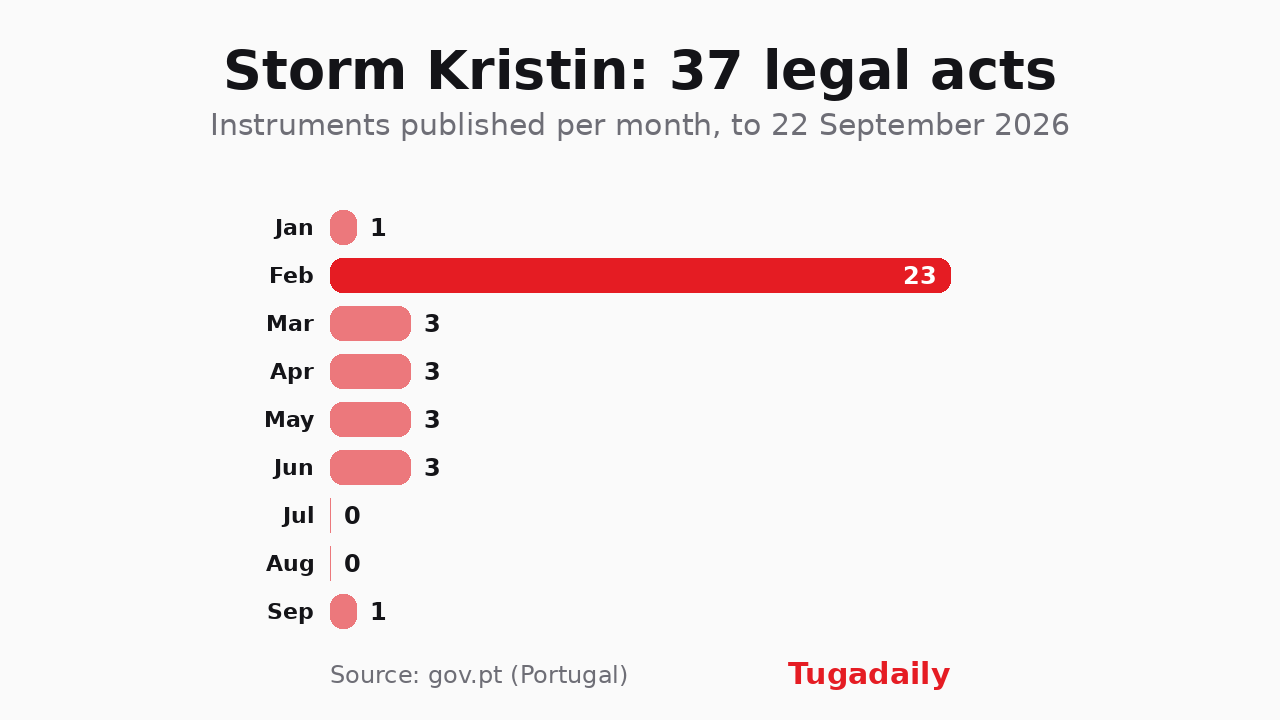
There’s also the part nobody picks but turns up anyway: disaster response. Criticism over the handling of the August 2025 wildfires and January 2026’s Storm Kristin cost the interior minister her job. With summer heating up and fire risk rising, that’s a test landing again far too soon.

For people across Portugal, the read is simple: a lot of these files — work, health, home — are felt at the end of the month, not in the speeches. Worth watching the actions, not just the headlines.

Image: Wikimedia Commons

A detailed view of an empty legislative chamber with rows of desks and microphones, evoking governance.
Politics 20 June 2026

PSD gathers in Anadia with the labour reform hanging over it

The PSD's 43rd Congress opens in Anadia right after its labour package was voted down. What's at stake for Montenegro and the government.

Some party gatherings are all smiles and banners. This one isn’t quite that. The PSD meets this weekend in Anadia, at the Sangalhos National Velodrome, for its 43rd Congress — and it arrives with a fresh headache: the government’s labour reform package was rejected in a first parliamentary vote just days earlier.

Luís Montenegro opens proceedings on Saturday. There’s no leadership fight here — he was re-elected at the end of May as the sole candidate, with close to 95% of the vote, though on one of the lowest turnouts the party has ever seen. Nobody’s challenging the chair. What’s up for grabs is the mood.

Why it matters

Montenegro has been prime minister for two years and party leader for four. A congress held right after a parliamentary defeat is a pulse check: it can show the troops in line, or let the cracks show through. Criticism from senior party figures is already in the air, and Madeira has been pushing loudly for answers of its own.

For anyone in Portugal, the read is simple: how the PSD comes out of this congress — united or scuffed — shapes how much room the government has to legislate in the coming months, from labour to housing. Worth a glance at how it wraps up on Sunday.

Illustrative · Photo: Héctor Berganza / Pexels

Wooden voting panel with multilingual buttons in Bern's Parliament, Switzerland.
Politics 20 June 2026

Labour reform voted down in Parliament: the Government loses, but vows to keep pushing

The package of changes to labour law fell in the Assembly. Montenegro points at Chega and says he "won't give up".

The Government took the kind of defeat you notice. The package to overhaul labour law — one of the big bets of Luís Montenegro’s government — was voted down in the Assembly of the Republic. Without a guaranteed majority, the prime minister couldn’t gather enough votes to push it through.

After the vote, Montenegro didn’t hide his frustration and pinned the outcome on Chega, stressing that “pensions are sacred” and that the Government “will not give up” on giving the country the conditions to be more competitive. Translation: the idea will be back, perhaps in a different outfit.

For anyone outside the political bubble, here’s the part that matters: the rules of work — contracts, hours, dismissals — aren’t changing for now. What was on the table is on hold, and it all hinges on whether the Government can stitch together deals it doesn’t currently have.

Without taking sides

It’s a portrait of a minority government: it governs, but has to negotiate everything. Some see the rejection as a defence of workers; others, a country missing a chance to modernise. The practical truth is soberer — without agreement in Parliament, the big reforms wait.

Illustrative · Photo: Christian Wasserfallen / Pexels

Modern architecture of the European Parliament in Strasbourg on a cloudy day.
Politics 15 June 2026

Trabalho XXI: the labour reform hits the hard part

The government wants to change more than a hundred articles of the Labour Code. Without a majority, it'll need borrowed votes — and that's where it gets interesting.

Some reforms slip through unnoticed. Others touch everybody’s daily life. The labour one is firmly in the second camp.

The government’s package — branded “Trabalho XXI” — cleared the Cabinet and went to Parliament. It rewrites more than a hundred articles of the Labour Code: it makes dismissals easier, gives companies more leeway over working hours, and reshapes collective bargaining rules. Supporters call it modernising and a productivity boost. Critics call it a door to precarious work. Both readings will sit side by side in the debate.

The maths is in charge

The detail that decides everything is simple: the AD coalition has no majority. To pass anything, it needs votes from outside — and the obvious lenders pull in opposite directions. On the right, Chega has the weight to make or break it; on the left, the PS can bargain or block. Every article could become a trading chip.

What to expect

A final vote could come as soon as late June, but it depends on how deep the line-by-line scrutiny runs. Unions already struck on 3 June and warned it won’t be the last if the text passes unchanged. The short version: plenty of noise still ahead — and it’s worth watching the numbers, not just the speeches.

Illustrative · Photo: Artur Roman / Pexels

Panoramic view of the Palace of Westminster and Big Ben across the River Thames in London.
Politics 15 June 2026

Portugal in cohabitation: a right-leaning government, a left-leaning president

With Montenegro in São Bento and Seguro in Belém, Portugal enters one of those political arrangements that forces everyone to play nice.

Portugal is in one of those textbook political setups: a centre-right government and a centre-left president, sharing the same house without sharing a party card.

On one side, Luís Montenegro, prime minister of a minority PSD/CDS government since June 2025. On the other, António José Seguro, a Socialist who won the presidency in March with a comfortable 67% and was sworn in at Belém. It’s called “cohabitation,” and in plain terms it means: they’re going to have to get along.

In practice a president doesn’t govern, but holds a brake — he can send laws back, speak up, and set the tempo. And there’s already a test on the horizon: the government’s labour reform, which has unions out on the streets.

For anyone who experiences politics mainly through the supermarket receipt, the point is simple: when São Bento and Belém pull in different directions, you either get more balanced compromises or you get gridlock. We’ll be watching which one shows up.

Illustrative · Photo: Enrique / Pexels

Stunning view of the historic Palace of Westminster in London under a clear blue sky.
Politics 15 June 2026

Immigration takes centre stage: the new rules and what's at stake

Montenegro's government tightened immigration policy with Chega's support. We explain what changed and both sides' arguments, without taking a side.

Immigration has become the issue that dominates this parliament. Luís Montenegro’s second government has passed new legislation restricting migration policy, backed in parliament by Chega — a fact that says plenty about the political balance of the moment.

Those who back the new rules frame it as management: a country that takes people in should be able to integrate them with decent conditions — housing, services, schools — and clearer rules would bring predictability to the system. Those who criticise it worry about closing doors on people who work, pay taxes and prop up sectors that need labour, from the fields to restaurants.

Why this matters for Portugal

Because immigration isn’t only a Lisbon story. In municipalities like ours, some sectors rely on workers who came from abroad, and communities have grown over the years. Whatever your view, it’s worth following closely — national rules always end up reaching our own street.

We don’t take sides here: our job is to give you the facts and the arguments so you can form your own opinion.

Illustrative · Photo: AXP Photography / Pexels