
PT
Residential buildings in a city
Real Estate 30 June 2026

Rents are finally easing: what's really going on

After years of climbing, asking rents in Portugal are cooling — while demand in Porto explodes. The picture, without the hype.

Here’s something a lot of people barely dared to imagine: asking rents in Portugal are slowing down. It’s not a free fall, and nobody should expect miracles at the end of the month, but the trend has clearly shifted.

The numbers tell the story. By December 2025, growth in advertised rents had already cooled to a modest 0.9% year on year. In May 2026 it actually slipped into negative territory, around -2.9%. For anyone who spent years watching listing prices only ever climb, that’s quite a turnaround.

Careful: cooling isn’t cheaper

There’s an important catch. The slowdown is in asking rents — what landlords write when they list a place. The new contracts people actually sign are still pricier than a year ago, up close to 8%. In other words, the fever is breaking, but the bill still stings.

And demand isn’t letting up. In early 2026, each rental home drew an average of 24 enquiries, with tenant demand up about 20% in a year. The starkest case is Porto, where contacts per listing jumped 57% — proof that even when prices brake, there are far more people than homes.

What to expect in 2026

For contracts already running, the maximum allowed rent increase this year was set at 2.24%, a legal brake that gives some predictability to those who already have a place. The government also approved a housing package, with VAT cut to 6% on eligible works, hoping to push more supply onto the market.

The honest read is this: the worst of the surge may be behind us, but the shortage of homes, especially in Porto and Lisbon, still runs the show.

See also: bank valuations hit a record and house prices at the start of 2026. More official data at idealista and the OECD.

Illustrative · Photo: Vera Emilie / Pexels

Keys to a new home in a buyer's hand
Real Estate 6 July 2026

Portugal's youth mortgage scheme 2026: how to buy a home with 100% financing (before it ends)

The public guarantee lets under-35s buy a first home in Portugal with no deposit — but contracts must be signed by 31 December 2026. The step-by-step guide.

If you are 35 or under and want to buy your first home in Portugal without a saved-up deposit, the clock is ticking: the public guarantee that enables 100% mortgage financing for young buyers is currently set to run only until 31 December 2026 — and the contract must be signed by then. Here is how the scheme works, who can use it and what to do now.

How does 100% financing for young buyers work?

In a standard Portuguese mortgage, the bank finances up to 90% of the property’s value and the buyer covers the remaining 10% — easily €20,000 or €30,000 that many young people simply do not have. With the public guarantee, the State steps in as guarantor for up to 15% of the property’s value, allowing the bank to lend the full 100%. The State has reinforced the guarantee fund by €350 million, a sign of how strong demand has been: young buyers have gained weight in the market and the average buyer age has fallen since the measure began.

Who qualifies for the scheme?

The essential requirements: be aged 18 to 35, buy your first permanent own home, and not own another residential property. At the branch, each bank then assesses affordability as with any mortgage — the State’s backing does not replace an income compatible with the monthly payment. Conditions help: with the ECB holding its key rates steady, banks expect a strong year for mortgage lending. Foreign residents can qualify too, provided they meet the same criteria — tax residence in Portugal included.

Which taxes are waived?

The same age group benefits from IMT (property transfer tax) and Stamp Duty exemptions on a first home, with full exemption up to a price of €330,539 — we covered the thresholds in detail in our IMT Jovem guide. Adding the tax break to 100% financing, a young buyer can now purchase a home with practically no upfront capital — exactly the design that led the IMF to warn these supports, by heating demand without creating supply, may be feeding the very price rises they try to offset.

Step by step: what to do before December

First, confirm eligibility (age, first permanent own home). Second, request simulations from several banks and say upfront that you want to use the public guarantee — not all of them offer it unprompted. Third, sort your paperwork early: pre-approval, property valuation and the deed take weeks, and by year-end banks will be swamped with last-minute applications. The contract must be formalised by 31 December 2026; barring an extension the Government has not announced, a January signing misses the boat.

Frequently asked questions

How much can I borrow with the public guarantee? Financing can reach 100% of the purchase price or the bank’s valuation (whichever is lower), within the scheme’s price caps and your own borrowing capacity.

Does the guarantee cost anything? The State’s backing is not a subsidy — if you default, the State answers to the bank and then recovers the debt from you. It is a way in, not a discount.

What if the home costs more than €330,539? The IMT exemption stops being total above that price and phases out at higher brackets; the public guarantee also has a price ceiling. Luxury homes sit outside the scheme’s design.

See also: the Government’s plan to unblock housing. Official information on the supports at portugal.gov.pt.

Illustrative · Photo: Kindel Media / Pexels

View of Málaga, southern Spain, a hotspot for foreign property buyers
Real Estate 5 July 2026

Spain's 100% tax on foreign home buyers: what actually happened

No, Spain is not charging a 100% tax on foreign home buyers. Pedro Sánchez's proposal stalled in Congress and never became law. Here's what's really going on.

No, Spain is not charging a 100% tax on people buying a home from abroad. The idea made headlines everywhere, but the truth in 2026 is far simpler: the proposal stalled and never became law.

Will Spain charge foreigners a 100% tax?

Right now, no. In January 2025, Prime Minister Pedro Sánchez announced plans for a tax of “up to 100%” on property purchases by non-resident buyers from outside the European Union — people from countries such as the UK, the US or Canada. In practice, it would double the cost of the deal. But as of April 2026 no bill had been adopted, the measure was never even debated in Congress, and the government’s own January 2026 housing package quietly dropped it.

Why did Spain’s 100% tax proposal stall?

For two reasons. The first is political: the Spanish government could not gather enough parliamentary support to bring it to a vote. The second is legal: there are serious doubts that such a tax is compatible with EU law, especially the free movement of capital, and the EU Court of Justice has previously ruled against Spain over discriminatory tax measures. It is worth stressing that the proposal only targeted non-resident, non-EU buyers — residents of any nationality would be exempt.

What changes for anyone buying a home in Spain (or Portugal)?

For now, nothing new in Spain: the usual rules and taxes apply. But the episode reflects a trend running across southern Europe — political pressure to curb speculative buying by non-residents at a time when prices are squeezing locals. It is the same conversation you hear on this side of the border.

See also: the real cost of buying a home in Portugal as a foreigner. Official source at the Spanish government portal.

Imagem: Wikimedia Commons

Student residence room
Real Estate 5 July 2026

A room to study in: what changes for student housing in 2026/27

A social-support reform, 160 euros a month, and several application windows for residences. The guide for anyone starting or returning to higher education.

For many families, finding a room near the university is as stressful as the entry grades themselves. For the 2026/27 academic year there are changes worth knowing in good time — because the deadlines wait for no one.

When are student housing applications and deadlines?

For students already enrolled, applications for residence housing ran from 25 May to 30 June. For those starting for the first time, there are three later windows: 24 to 27 August, 14 to 16 September, and 30 September to 2 October. It is worth marking these dates, because residence places are limited and priority goes to students on social-action grants.

The reform that could change the maths

There is also a deeper change. In May, the Government approved a reform of the higher-education social-action system, due to take effect from 2026/27, with a promise that no student is left out for financial reasons. The idea is to calculate the grant from the gap between the real cost of studying in that municipality — tuition, food, transport and housing — and the household’s income.

For displaced students living in a residence there is a monthly support that can reach 160 euros, plus a housing complement tied to what is paid at the residence. It does not solve everything, but it eases the bill for those who must leave home to study.

Those who cannot get a residence place fall into the private market, where the pressure is well known — see how rents look in 2026. All official information on grants and housing is on the DGES site.

Illustrative · Photo: Sulaiman Afrij / Pexels

Apartment buildings on the outskirts of Lisbon
Real Estate 4 July 2026

House prices in Portugal: the tracker

A running tracker of Portugal's housing market — the INE price index, bank valuations, rents and affordability. Updated with each new data release.

We gather here, in one place, how Portugal’s housing market is moving. Instead of one article per data point, we update this page with the essentials: the INE price index, bank valuations, rents and affordability for buyers and renters. Official data is at INE.

Updates

4 July 2026

Rents have fallen for five straight months nationally, but Lisbon remains one of Europe’s least affordable capitals. Portugal is in Europe’s top three for purchase-price increases.

1 July 2026

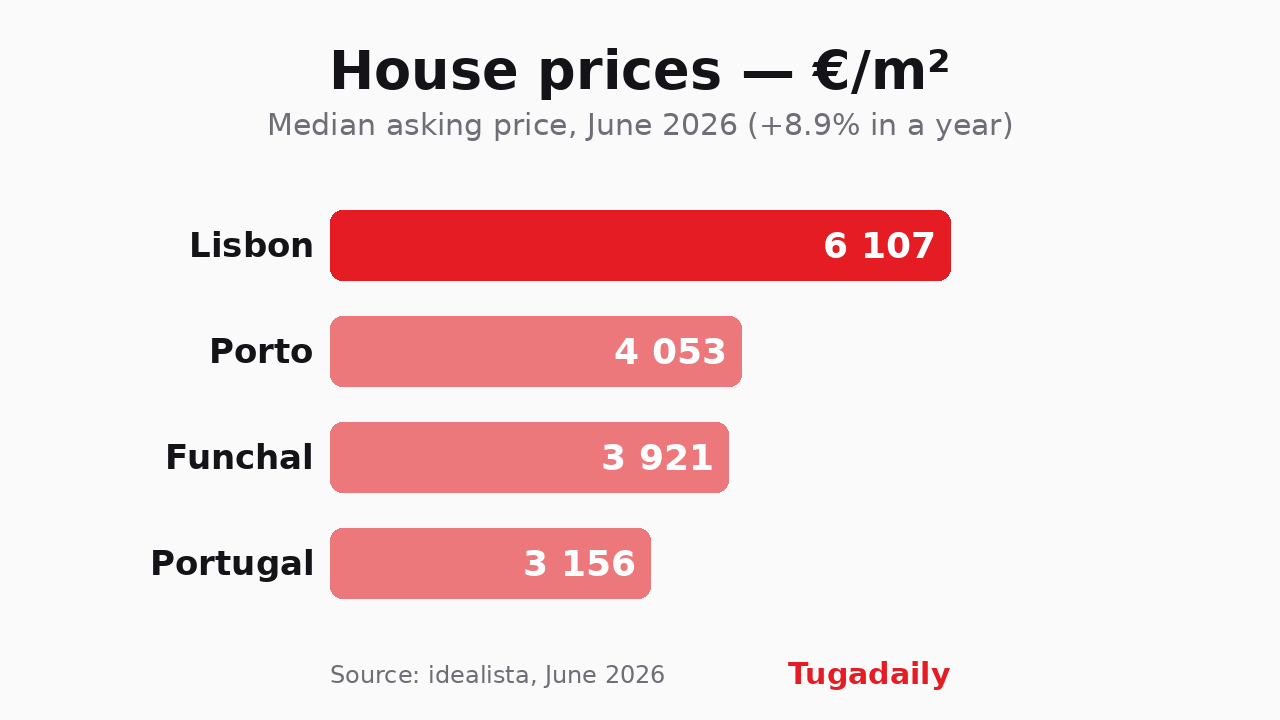
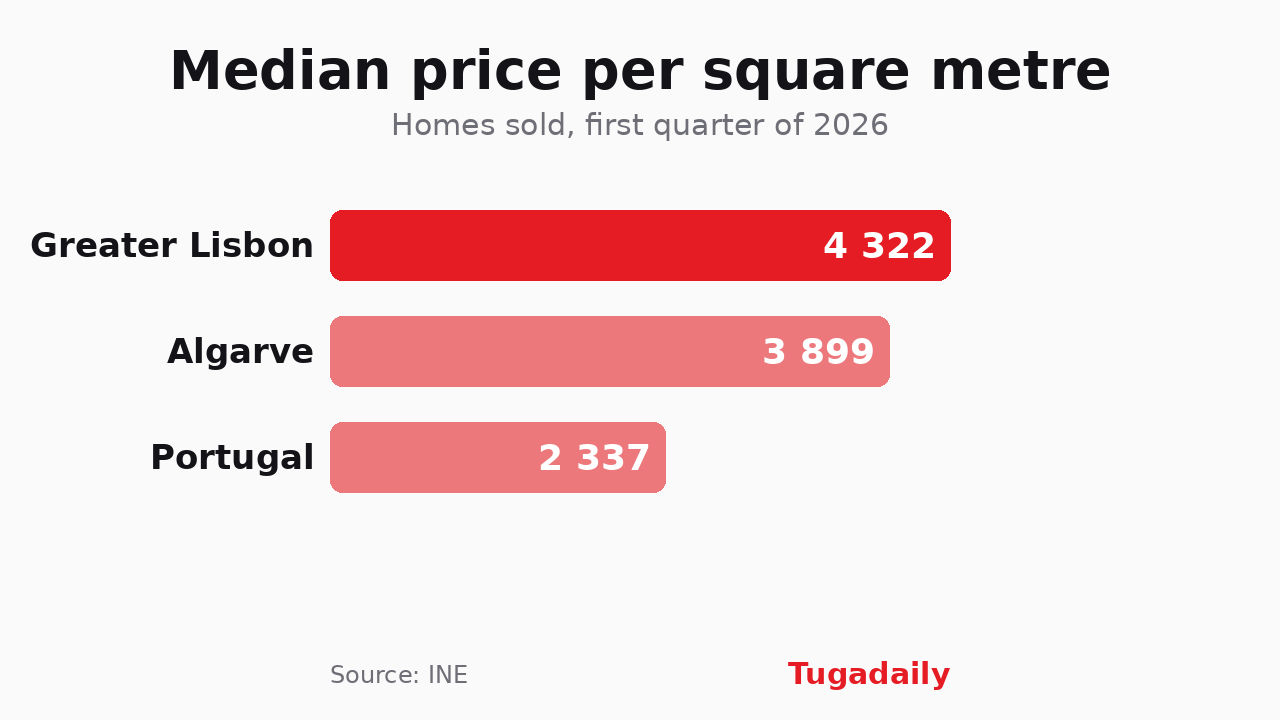
House prices hit a new record in May: up 10.2% year on year, with the median reaching 3,142 euros per square metre, though the pace is starting to show signs of cooling.

30 June 2026

Bank valuations of homes reached a new high (2,208 euros/m²) and the INE price index confirmed the rise at the start of the year.

Image: Wikimedia Commons

Cais da Ribeira in Porto, with its colourful riverside houses
Real Estate 4 July 2026

Rents have been falling for five months (but Lisbon still hurts)

Rental prices dropped 2.4% in June, the fifth straight monthly fall. Even so, renting in the capital costs 21.8 euros per square metre.

After years of climbing without a brake, the rental market is finally showing tenants some breathing room. Rents in Portugal fell 2.4% in June against the same month a year earlier — the fifth straight monthly decline. It’s no revolution, but it is a change of direction that seemed unthinkable not long ago.

The detail that spoils the party

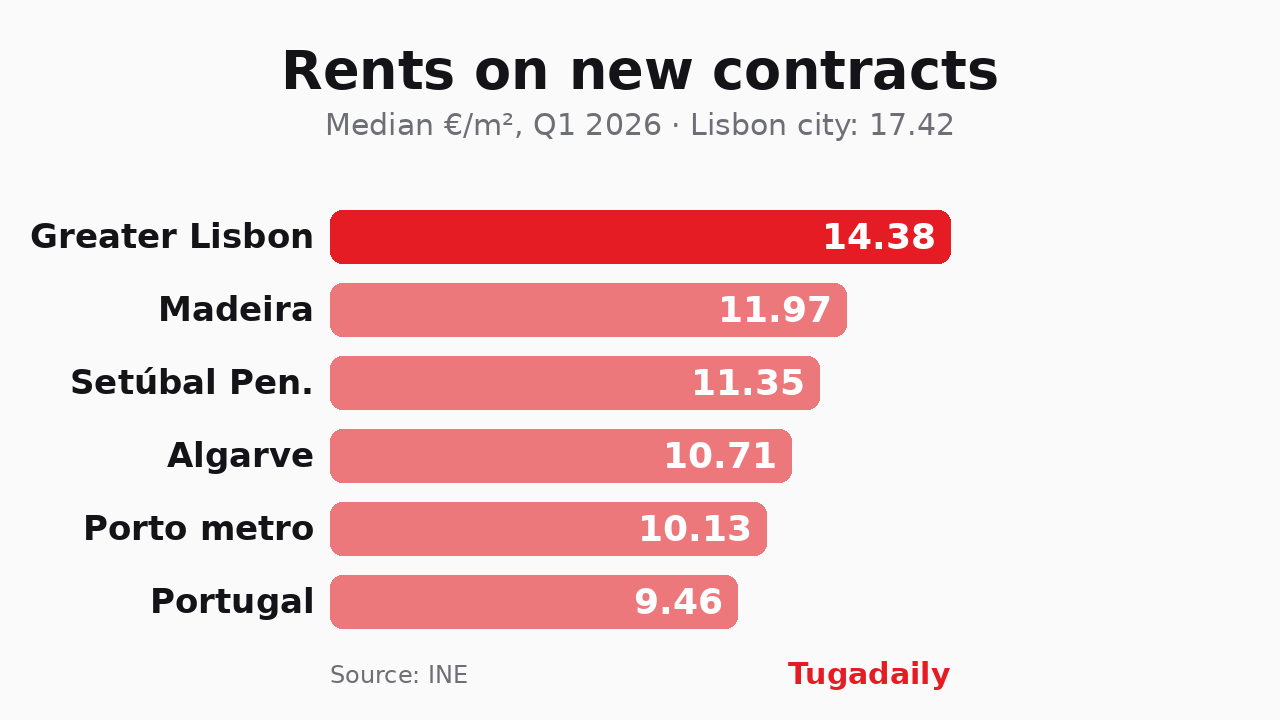
Before popping the champagne, it’s worth looking at the absolute numbers. Lisbon is still the most expensive city to rent, with a median of 21.8 euros per square metre, followed by Funchal at 16.8 and Porto at 16.4. In other words: prices may be easing, but they started so high that the end-of-month bill still squeezes anyone house-hunting in the big centres.

There’s a second layer. In the first quarter, the national median rent was around 9.46 euros per square metre, up 9.1% on a year earlier — a sign that the slowdown is recent and hasn’t undone the accumulated rise.

Buy or rent

On the buying side, the picture is the opposite: house prices keep rising, if more slowly, and the cost of credit ticked up again with higher interest rates. For many families, the rent-or-buy decision is no longer obvious and now hinges on how long you plan to stay and how much you have saved up front.

The honest read: less bad for renters, far from cheap in the cities.

See also: how home sales slowed at the start of the year. Updated price reports are available at idealista/data.

Image: Wikimedia Commons

Keys to a new home on a table
Real Estate 3 July 2026

Portugal on the European podium for rising house prices

Forecasts place Portugal among the countries where homes are getting most expensive in Europe in the coming years. Good news for owners, a headache for buyers.

If there’s one topic that never leaves the conversation in Portugal, it’s house prices. And the forecasts bring little relief: several studies place the country among those set to see homes rise most in Europe over the coming years, with increases above the European average. For those who already own, it’s an appreciating asset; for those hunting for a first home, it’s another year chasing the market.

What the projections say

Estimates point to a rise that slows but doesn’t stop. After years of records, the pace should moderate, yet still keep Portugal well above the European Union average. In other words: homes keep getting more expensive, just a little more slowly than in the frenzy of recent times.

Why Portugal is running so hot

The reasons are familiar: strong foreign demand, tourism, a shortage of new construction and an economy that, despite everything, has grown above the European average. Add the appetite for living in cities like Lisbon and Porto and you have the recipe for persistently high prices.

For the buyer, the realistic message is this: waiting for the big crash can prove costly. Better to work out what you can comfortably afford.

See also: how much it costs to build from scratch today. Market reports at idealista.

Illustrative · Photo: Pexels

A house under construction
Real Estate 2 July 2026

How much it costs to build a house in Portugal in 2026

With finished homes sky-high, many are thinking of building from scratch. But how much does a square metre really cost today — and is it worth it?

With the price of finished homes hitting records, more and more people ask the same question: what if I built from scratch? The idea is tempting — choose everything, dodge the market’s speculation — but the cost of building has also risen in recent years, driven by material prices and a shortage of labour.

The number that matters

In 2026, building a house in Portugal generally costs a few hundred euros per square metre for the construction alone, a figure that climbs sharply depending on finishes, location and the complexity of the project. On top of that you must add the land, architecture and engineering plans, permits and utility connections — extras many people forget in the first estimate and that make all the difference to the final budget.

Build or buy

Building can pay off in areas where land is still affordable and finished homes are expensive. But it demands time, patience and a financial cushion for surprises, which on a building site are all but guaranteed. Buying gives predictability; building gives control. The right choice depends on your wallet, your hurry and your tolerance for the stress of a construction project.

The key is to ask for detailed quotes and to be wary of numbers that look too round.

See also: why rents have started to fall. Construction and housing statistics at INE.

Illustrative · Photo: Pexels

A key going into the lock of a home's front door
Real Estate 1 July 2026

Renting in 2026: a race for a home that won't slow down

With purchase prices at record highs, more people are looking to rent — and rents feel the strain. A snapshot of the market this summer.

Buying a home in Portugal is pricier than ever — and that pushes more and more people toward renting. The trouble is that the rental market gives no respite either.

Lots of demand, little supply

The maths is simple and cruel: many people looking and few homes available to rent, especially in the big cities and tourist areas. The result? Rents keep climbing, and anyone hunting for a one-bedroom in Lisbon or Porto knows the cold sweat of scrolling the listings.

Much of the pressure comes from the country’s own success: more tourism, more digital nomads, more people moving here. All of that is good for the economy, but it tightens the belt for anyone who needs a roof at a reasonable price.

What to look for (and where)

The good news is there are always alternatives for those willing to widen the map. Mid-sized cities — Braga, Coimbra, Aveiro, Setúbal — offer quality of life and more bearable rents than the centres of Lisbon and Porto. Remote work has opened that door for many.

It is also worth getting to know the public rental supports and controlled-cost housing programmes, which have grown in weight in the response to the crisis. We already covered purchase prices at record highs; on the rental side, official information is at the Housing Portal.

Illustrative · Photo: Adrian Frentescu / Pexels

Residential construction site
Real Estate 30 June 2026

Less red tape and a state guarantee: the plan to unblock homes

Faster permits and a public guarantee covering up to 100% of a loan. What changes for building or buying a first home.

Portugal’s housing problem is not only price, it is also time. Projects sit stalled for years waiting on permits, and every month of delay is more cost that ends up in the final price of a home. The Government has promised to tackle that front, with shorter deadlines and less paperwork in licensing, hoping to get stalled builds moving.

The state guarantee for a first home

The most concrete measure for buyers is the public guarantee. Under a guarantee scheme, the state can cover part of a loan, allowing financing of up to 100% of a home valued at up to 450,000 euros. In practice, it is a way around the deposit hurdle, which blocks many young people even when they could manage the monthly payment.

Promises and reality

The intent is good, but history advises caution. There have been promises of cutting red tape that crashed into the administrative machine, and international bodies have warned that the underlying problem, a shortage of supply, is only solved by building more and faster. Speeding up permits helps; solving everything, hardly.

For anyone thinking of buying, it is worth checking whether you meet the conditions for the public guarantee before settling accounts with the bank.

See also: housing VAT at 6% and rents showing signs of slowing.

Official detail of the measures at portugal.gov.pt.

Illustrative · Photo: D Goug / Pexels

Houses along the coast in Cascais
Real Estate 30 June 2026

6% VAT on housing works: what changes if you build or renovate

Portugal's housing package brings reduced VAT on works and rental incentives. Who wins, and where the fine print hides.

Building or renovating a home in Portugal has always carried a heavy bill — and VAT was a big chunk of it. Now there’s a change that could ease that cost.

The housing package approved this year cuts VAT to 6% on eligible construction and renovation works, as long as the home is for owner occupation or for rental with rents up to roughly 2,300 euros a month. On works that easily run into tens of thousands of euros, dropping the rate from the usual 23% to 6% is no small change.

It’s not for everything

Here’s the fine print. The reduced VAT applies to works that meet defined criteria — it’s not an automatic discount on any job. The stated goal is clear: push more supply onto the market and reward people who put homes up for rent at controlled prices, rather than leaving them shuttered.

The package also includes tax incentives for rental investment and changes to urban licensing rules, aiming to unblock processes that today drag projects out for years.

Why it matters

In its recent survey of the Portuguese economy, the OECD again stressed that housing affordability is one of the country’s biggest problems. Supply is short, and building is expensive. Cost-side measures — like lower VAT — go straight at that knot.

The million-euro question is whether the effect reaches buyers’ and renters’ pockets quickly. Rehabilitating buildings and licensing construction takes time, and relief on rents and prices tends to show up with a lag. Still, it’s a step in the right direction: making it cheaper to put homes on the market.

See also: rents are starting to cool and house prices at the start of 2026. Official details at the Government portal.

Imagem: Wikimedia Commons

View over the rooftops of Lisbon
Real Estate 30 June 2026

Bank valuations for homes hit a new record: 2,208 euros per metre

The median bank valuation for housing reached an all-time high in May. What it says about the market and about your mortgage.

Another month, another record. The median bank valuation for housing in Portugal reached 2,208 euros per square metre in May, the highest figure ever in this series. In plain terms: what banks reckon a home is worth, for lending purposes, has never been higher.

This valuation is no technical footnote. It sets how much a bank is willing to lend. The higher the valuation, the bigger the possible loan, but also the higher the starting price for anyone trying to buy.

Good and bad news in the same number

For those who already own, the rise is, on paper, a gain in wealth. For would-be buyers, it is one more sign that the stretch keeps growing, with prices running ahead of wages.

The paradox is familiar: prices climb even as Euribor squeezes monthly payments. Strong demand, short supply and construction that cannot keep up keep the market tense, especially in big cities and along the coast.

The question many ask is whether this stalls. The signals are mixed. Some note a slowdown in the number of transactions, without that yet translating into falling prices. In other words, the market may be losing breath without losing altitude.

See also: Home sales are starting to slow and the effect of Euribor on payments. Official statistics at INE.

Image: Wikimedia Commons

Colourful houses in the Ribeira district of Porto
Real Estate 30 June 2026

House prices keep climbing as 2026 gets going

The house price index rose again in the first quarter. We look at the numbers and what they mean from north to south.

If you were hoping for a breather in house prices, the first quarter of 2026 did not bring one. The house price index rose again, extending a climb that has lasted years and shows few signs of wanting to stop.

The numbers tell a simple story: demand keeps outpacing supply. We build little, we renovate slowly, and the population, especially in the cities, still needs a roof. Add tourism and foreign investment and you see why prices stubbornly rise.

It is not the same everywhere

The average hides very different realities. Lisbon, Porto and the Algarve coast pull values up, while many inland areas still offer far more affordable prices, with the opposite problem: too few people and services.

For families, the practical effect is the usual one. Buying demands ever more savings up front, and renting has become an obstacle course in the big cities. Younger people feel the squeeze most, often pushed further out or back into the family home for longer.

The market may be losing some speed in the number of deals, but on price the inertia is strong. Anyone deciding to buy should run the numbers with room to spare, thinking about tomorrow’s payment and not just today’s.

See also: Bank valuations hit a record and sales that are starting to slow. Indicators at Trading Economics.

Image: Wikimedia Commons

Houses in the Alfama neighbourhood of Lisbon
Real Estate 29 June 2026

Prices sky-high, but selling less: the housing market cooling off

Around 37,750 homes were sold on the mainland in Q1, down 9.4% on the previous quarter. What that says about the market.

The housing market has been stuck in a curious paradox: prices keep breaking records, yet fewer and fewer homes change hands. In the first quarter of 2026 around 37,750 homes were sold on the mainland — a 9.4% drop on the previous quarter, confirming the slowdown that had been building since the second half of 2025.

Why it’s slowing

The explanation is no mystery. With Euribor at highs, credit got more expensive and many buyers either give up or wait. At the same time supply stays scarce, especially in the resale market, which keeps prices stubbornly high even with fewer deals closing. It’s the worst of both worlds for house-hunters: expensive and hard.

What to expect

Fewer transactions doesn’t mean falling prices — it means a slower market, where sellers may have to wait longer and buyers gain some bargaining power they didn’t have a year ago. For investors, it’s time to look hard at yields now that money costs more.

Anyone searching would do well to compare, haggle and not rush. The market no longer rewards people who decide in a minute.

See also: housing hits a new record average price and repayments rise with Euribor. Official housing data is at INE.

Image: Wikimedia Commons

Residential buildings in a city
Real Estate 29 June 2026

Foreign buyers are purchasing fewer and fewer homes in Portugal

Purchases by non-residents fell 15.6% early in the year. Prices are still at record highs, but the market is starting to lose steam.

For years, the foreign buyer was the fixed character in any conversation about housing in Portugal. The latest INE data now tells a different story: early in 2026, purchases by non-residents fell to 1,770 units, down 15.6% on the previous year.

It is not an isolated detail. Over the same period, the total number of homes sold dropped 8.7%, to 37,745. In other words, fewer sales to everyone — and foreigners, who helped push prices up in the most coveted areas, are clearly easing off.

High prices, cooling demand

The paradox is that prices are still at record highs, with the average value around 263,000 euros. But there are signs of fatigue: the year-on-year rise slowed for the first time in nearly two years. Higher interest rates, tighter rules for some visas and prices that price buyers out all help explain the retreat.

For anyone house-hunting in Portugal, this does not mean bargains are coming — it means a slightly less frantic market, where there may be room to negotiate. For sellers, the warning is the opposite: the era of “list today, close tomorrow” may be ending.

See also: average house prices at record highs. The official data is on the INE portal.

Illustrative · Photo: Anselmo Machado / Pexels