
Portugal's cheap night electricity is moving. Set your washing machine half an hour later
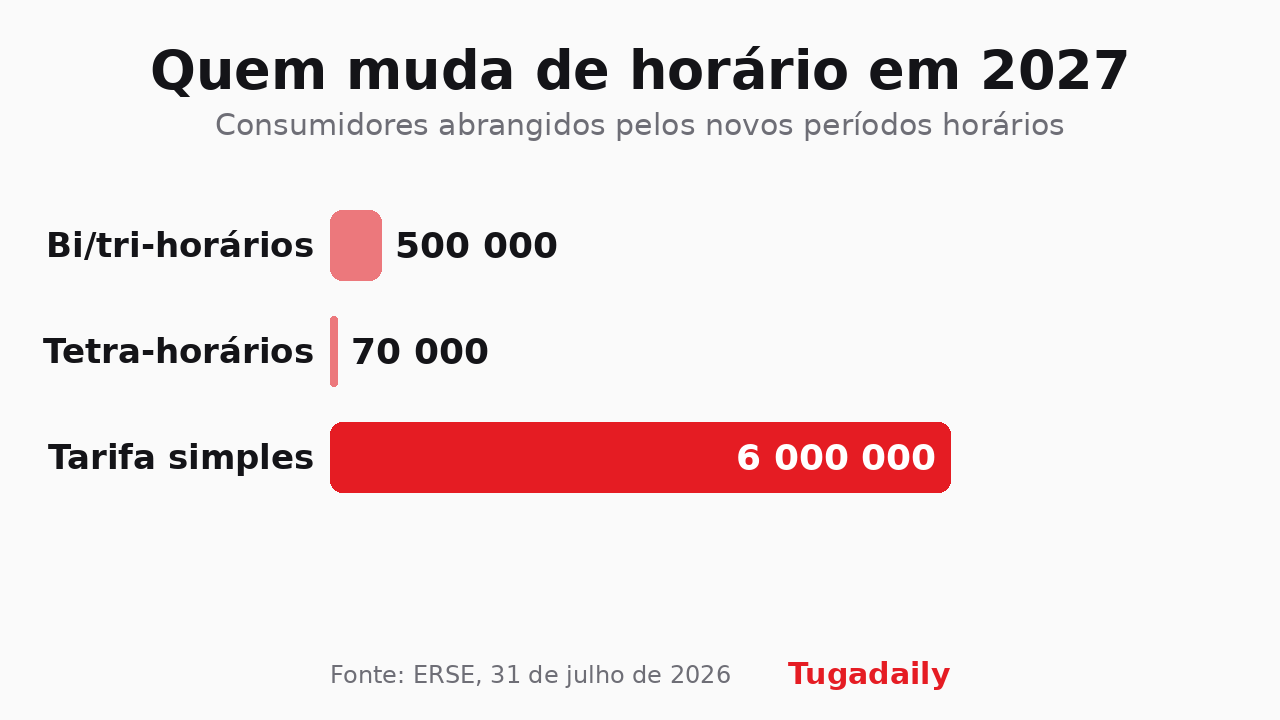
The energy regulator has signed off new time bands. On the two-rate tariff the off-peak window shifts to 22:30-08:30, half an hour later at both ends. It reaches 500,000 homes between July and December 2027, and six million simple-tariff meters get updated too.
If you are on a two-rate electricity tariff in Portugal, you have probably internalised one rule: after ten at night, the dishwasher can go on. That rule is about to be wrong.
On 31 July the regulator, ERSE, closed its review of electricity time bands for mainland Portugal, and the headline fits in two lines. On the daily cycle of the two-rate tariff, the off-peak window stops starting at 22:00 and starts at 22:30 instead. To compensate, it stops ending at 08:00 and ends at 08:30. On weekdays under the weekly cycle the same half hour applies at both ends: off-peak begins at 00:30 rather than midnight and finishes at 07:30 rather than 07:00.
For households on the three-rate tariff, and for businesses on four-rate, the change is a different shape. Morning and early-afternoon peak hours disappear altogether, and peak concentrates at the end of the day. The daily length of every band stays exactly as it is. Only the start and end points move.
Why touch this now
ERSE’s reasoning is that the electricity system no longer behaves the way it did when these bands were drawn. As decentralised renewable generation has grown, the real profile of network use has shifted, and the tariff periods stopped lining up with it. There is a second argument, and it is about money: bands that match actual use defer investment in transmission and distribution networks, and network costs land on everybody’s bill. That is the same pressure showing up in what households are currently paying at the pump — the energy bill keeps being decided by rules most people never read.
Two simplifications come with it. There will be a single daily cycle all year, with no winter-time and summer-time split, and a single weekly cycle.
When it actually reaches your bill
Nothing changes this year or next summer. Business and industrial installations all switch on one date, 1 April 2027. Households and small businesses on two or three-rate tariffs switch between 1 July and 31 December 2027, and there is nothing to do: the network operator makes the change remotely through the smart meter, and 99% of low-voltage customers already have one. Only in a small number of cases will a technician turn up at the door.
Then there is the part that went unnoticed. The roughly six million customers on the simple flat tariff are not covered by the band change at all, but their meters are being updated anyway, between 1 November 2027 and 31 March 2030, so they can read consumption by time period. Translated: anyone who has always suspected the two-rate tariff would not pay off for their household will finally be able to check it against their own numbers rather than guess. If you would rather not wait your turn, you can ask E-REDES to configure your meter early.
ERSE has promised simulators and explanatory material as the rollout proceeds. For now, the communique setting out the new bands is on the regulator’s site — and July 2027 is worth a note somewhere.
By Beatriz Mota
Chart: Tugadaily · data ERSE