
Filling up before Monday will save you about four euros a tank
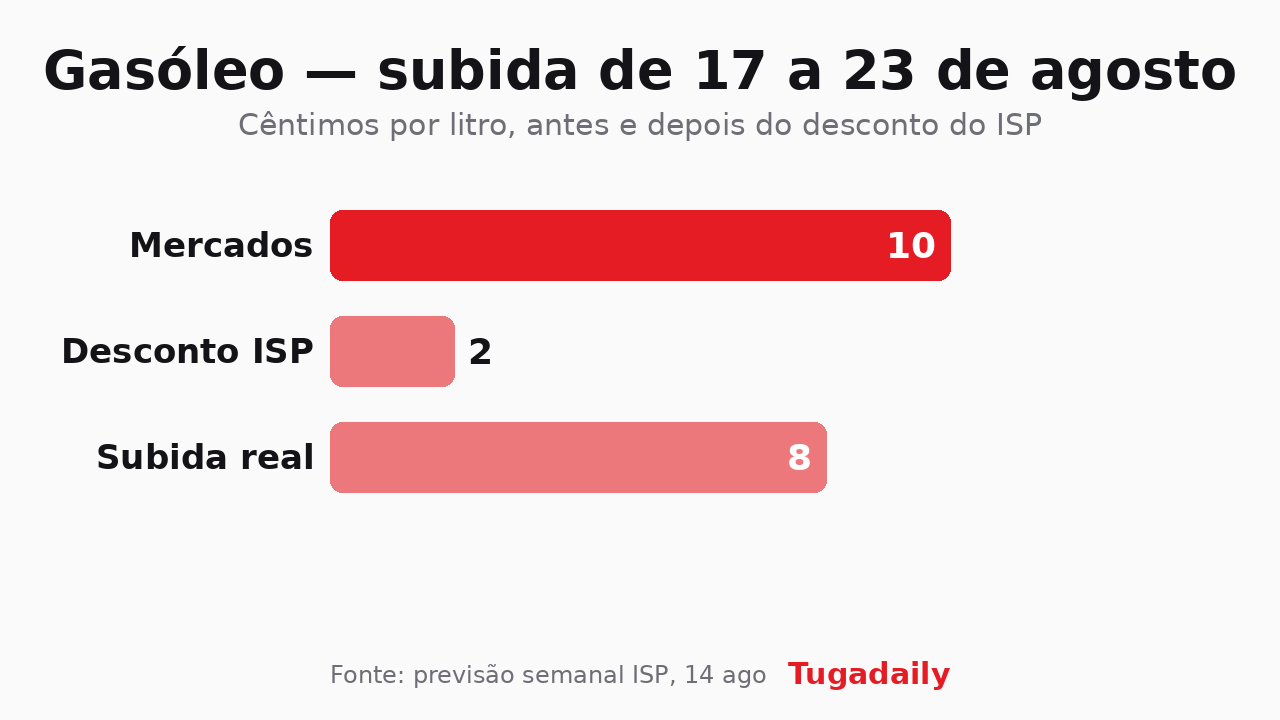
Diesel goes up around 8 cents a litre from 17 August and petrol 7.5, after the government raised the ISP discount on Friday to soften a much bigger rise.
If you can get to a pump this weekend, do. From Monday 17 August fuel goes up across mainland Portugal, and it is one of the sharper rises of the summer: roughly ten cents a litre on standard diesel and nine on 95 petrol, counting only what comes from international markets.
What reaches the forecourt is a little gentler than that.
The state gives back what it kept
On Friday the government published Portaria 345-C/2026/1, the order revising the rates of the fuel tax, ISP, raising the discount by 2.13 cents for diesel and 1.42 for petrol. That brings the real increase down to about eight cents on diesel and seven and a half on 95 petrol.
The symmetry is the part worth filing away. Last week prices fell and the government trimmed two cents off that same discount, pocketing a slice of the relief. This week prices climb and the discount goes back up by almost exactly the same amount. The mechanism runs both ways, and anyone who only notices it when it works against them is seeing half the picture.
What that means for a full tank
On this forecast the average lands at €2.048 a litre for diesel and €1.962 for 95 petrol. On a 50-litre fill, that is roughly €103 for diesel and €99 for petrol.
Step back to the start of the year and the scale of the move becomes clearer. On 1 February diesel sat at €1.659 and petrol at €1.764. That is 39 cents a litre more for diesel and 19.5 more for petrol, which means diesel has risen exactly twice as much as petrol in six and a half months. Anyone putting 50 litres of diesel in every week is close to twenty euros a tank worse off than in February.
Much of that gap comes from the risk premium diesel has carried since Gulf supply got complicated, rather than from consumer inflation, which actually eased to 3% in July.
The final price is still each station’s call
Worth repeating, because it slips: fuel pricing in Portugal is free. These figures forecast the average movement, not a posted tariff. Every brand decides what to do with the rise, and the spread between the cheapest and dearest station in the same municipality clears ten cents a litre without difficulty.
Before you fill up, DGEG’s official comparison tool lists live prices station by station, filterable by area and fuel type. It is free, and it runs on the same data the fuel companies are legally required to submit every day.
By Beatriz Mota
Infografia: Tugadaily · dados ISP e DGEG