
PT
Lisbon rooftops and residential buildings seen from the MAAT
Real Estate 11 July 2026

Rent control ending for new leases in Portugal: what changes for tenants and landlords

Portugal's rental reform brings forward the end of rent limits on new leases, cuts the eviction trigger to two months of arrears and sets transition rules for pre-1990 rents. Here is what changes.

Rent control on new leases in Portugal is set to end three years ahead of schedule: that is the headline change in the rental reform approved by the Council of Ministers on 9 July, which touches new contracts, pre-1990 rents and evictions all at once. In short: on new leases, landlord and tenant will freely agree the rent.

When does the rent cap on new leases end?

The brake limiting initial rents on new contracts already had an expiry date; the government has now brought it forward by three years, leaving prices to be set by agreement. The executive argues the cap was scaring off owners and shrinking supply; tenant associations fear an immediate jump in asking rents. The package now heads into the legislative process — the official details are on the government’s portal.

What happens to pre-1990 rents?

The transition to the modern rental regime now depends on the tenant’s age and income. Tenants aged 65 or over keep their protection. Below that age, with annual income up to 64,400 euros, the rent stays unchanged for five years; above that income, the landlord may update it to up to 1/15 of the property’s taxable value. It is the long-delayed thaw of frozen rents — with shock absorbers.

Are evictions really changing?

Yes: missed payments will justify terminating a contract after two months of arrears instead of the current three, and the process is streamlined by cutting administrative steps deemed redundant. On the other side of the scales, a housing emergency fund, run by the IHRU housing institute with Social Security, will support anyone left homeless by eviction or domestic violence.

This is the practical layer of the political package that already brought faster evictions and a social rent subsidy. For landlords, it promises a market with less fear; for tenants, the acid test will be the price on the next lease they sign.

By Duarte Figueiredo

Image: Dale Cruse - 10M views from San Francisco, CA, USA / Wikimedia Commons (CC BY 4.0)

Lisbon City Hall, seat of the municipal government
Real Estate 12 July 2026

Lisbon sells 10 municipal plots for a minimum of €59.2 million — the left wanted 500 homes

Lisbon's city council approved the public auction of ten plots 'forgotten for decades'. PS and Bloco say they could have housed around 500 families.

Lisbon’s city council is putting ten municipal plots up for public auction with a combined minimum price of €59.2 million. The proposal passed this week with the votes of the PSD/CDS-PP/IL majority and Chega — and with the entire left opposed, doing the maths on what could have been built there instead: affordable housing for around 500 families, according to the Socialists.

Which plots is Lisbon selling?

Ten parcels spread across Marvila, Beato, Penha de França, Lumiar, Belém, Campolide and São Vicente. The executive describes them as land “abandoned, some for decades” with no planned use, and argues the extra revenue will speed up investment in transport, paving, lighting and security. Several of those parishes are precisely where Lisbon’s housing debate burns hottest.

Why is the left against the sale?

Because of what the land could become. The PS opposes selling municipal land that could be channelled into affordable housing, estimating capacity for around 500 families; Bloco de Esquerda points out that some of the plots had been earmarked for the city’s affordable-rent programmes for the middle class. The row lands at a sensitive moment: the council’s housing programmes are concentrated on the Habitar Lisboa platform, while the national market sits at record highs and rent control is disappearing from new leases.

Anyone wanting to bid will find the auctions on the municipality’s portal. Anyone hunting for an affordable home in Lisbon is left with the harder sum — working out what property in the city yields, and what it costs, now that public land just got scarcer.

By Duarte Figueiredo

Image: Diego Delso / Wikimedia Commons (CC BY-SA 3.0)

Facades of residential buildings on a street in Porto
Real Estate 12 July 2026

Buy-to-let in Portugal yields 6.2%: returns are falling, but so is the risk

The gross yield on buying a home to rent out in Portugal fell to 6.2% in Q2 2026. Where returns are highest and why the risk has dropped too.

Buying a home to rent out in Portugal returned a gross 6.2% in the second quarter of 2026 — down from 6.9% a year ago and well below the 7.2% of 2024. The explanation is simple: purchase prices keep climbing much faster than rents, so every euro invested in bricks buys less rental income than it used to.

How much does buy-to-let yield in Portugal?

The national average sits at 6.2% gross per year, but the map is anything but uniform. Lisbon is, paradoxically, the worst buy-to-let deal in the country: a 4.3% yield, because purchase prices are at record levels. Faro and Porto follow at 4.8%. At the other end, Castelo Branco and Vila Real lead with 8.1% — buying cheap in the interior and renting out remains, on paper, the most profitable play.

Is a falling yield bad news?

Depends which side of the table you sit on. For the pure investor, yes: the return has shrunk. But there is a flip side the industry itself points out — lower yield also means lower risk. With an average of 24 applicants for every home listed, the odds of a property sitting empty are minimal, and the asset itself has kept appreciating: house prices have been setting fresh records in bank valuations tracked by Statistics Portugal (INE).

For anyone hunting for a home, none of this is much comfort: rents remain high, and landlords are now sharpening their pencils. The legal framework is moving too — the government approved changes to rental law this week that touch both new and old contracts.

By Duarte Figueiredo

Image: Dale Cruse - 10M views from San Francisco, CA, USA / Wikimedia Commons (CC BY 4.0)

Seal of the US Department of Housing and Urban Development
Real Estate 11 July 2026

US housing law: biggest affordability bill in decades takes effect without Trump's signature

The ROAD to Housing Act became law without a presidential signature: 40+ provisions, including a ban on big corporate landlords buying more houses.

The most ambitious American housing law in decades took effect in an unusual way: without the president’s signature. The 21st Century ROAD to Housing Act became law at midnight on July 11 because Donald Trump let the ten-day deadline pass without signing or vetoing it — in protest, he said, at the Senate’s failure to pass his voter ID bill.

What does the ROAD to Housing Act change?

The bipartisan law bundles more than 40 provisions, from manufactured-home construction to local financing. The headline measure reins in big corporate landlords: anyone owning 350 or more houses is barred from buying more, an attempt to push homes back towards family buyers. The full text is available at the US Congress.

How does a law pass without the president’s signature?

Through the constitutional ten-day rule: if Congress is in session and the president takes no action within that window, the bill becomes law on its own. Trump called the legislation “a yawn” and “unimportant”, but did not veto it — the bipartisan majorities behind it would have made a veto risky.

The relevance on this side of the Atlantic goes beyond curiosity: the US is stress-testing, at scale, the same question Europe faces — how to curb the financialisation of housing without stalling construction. In Portugal, this week’s step in that same debate was the end of rent control on new leases, redrawing the rental market’s rules.

By Duarte Figueiredo

Image: U.S. Government / Wikimedia Commons (public domain)

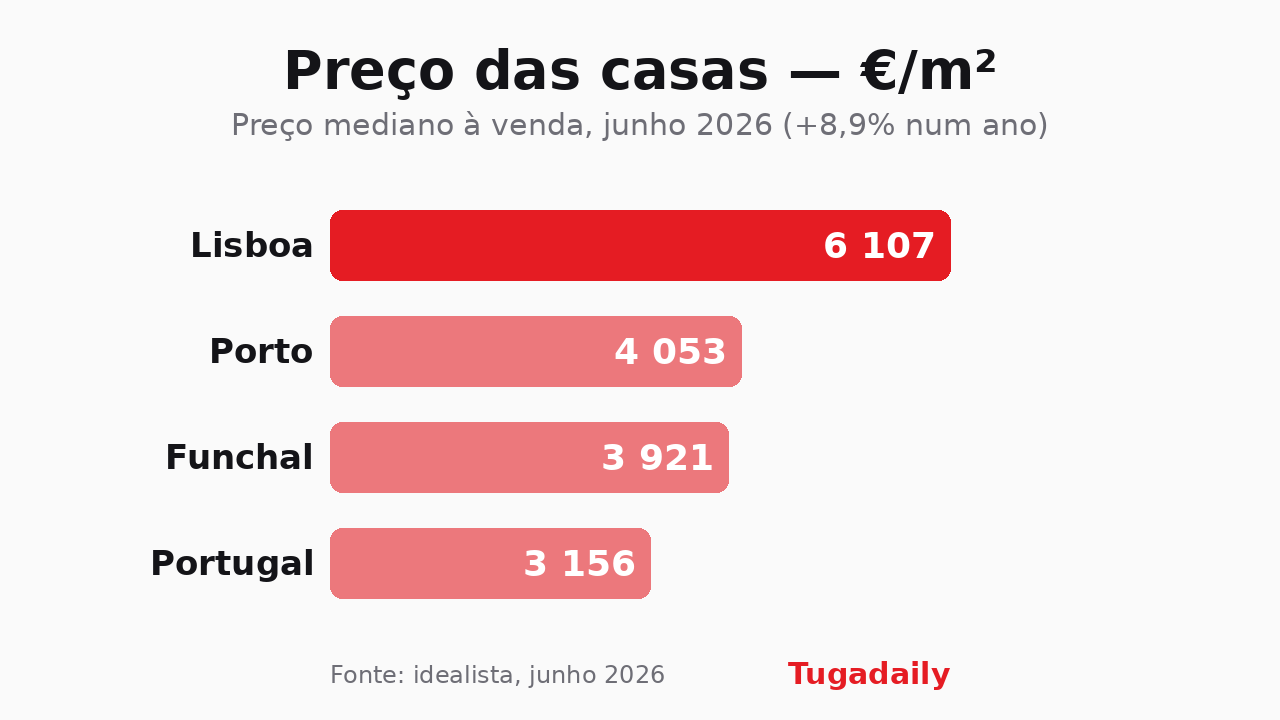
Tugadaily chart: median house asking price per square metre, June 2026
Real Estate 11 July 2026

House prices in Portugal: the tracker

A running tracker of Portugal's housing market — the INE price index, bank valuations, rents and affordability. Updated with each new data release.

We gather here, in one place, how Portugal’s housing market is moving. Instead of one article per data point, we update this page with the essentials: the INE price index, bank valuations, rents and affordability for buyers and renters. Official data is at INE.

Updates

11 July 2026

A yellow light on the supply side: Portugal’s statistics office INE counted just 6,586 licensed construction and rehabilitation projects through April, down 7% on the same period of 2025, while new-housing construction costs rose 6.9% year-on-year in May. Fewer permits plus pricier building is a recipe that usually ends somewhere familiar — more price pressure down the road.

10 July 2026

House prices rose 8.9% year-on-year in June, according to idealista — the eighth consecutive record high, with the square metre at €3,156. The pace eased (from 10.2% in May), but prices rose in all 20 district capitals and autonomous regions, led by Portalegre (+25.8%), Castelo Branco (+24.3%) and Santarém (+24.2%). Lisbon still tops the table at €6,107/m2, followed by Porto (€4,053) and Funchal (€3,921).

9 July 2026

Idealista: in May the median asking price stood at 3,142 euros/sqm and the average listed value rose to about 430,500 euros (+3.7% year on year), though sales and prices are cooling. On rentals, the national median rent reached 9.46 euros/sqm in Q1 (+9.1%), with Lisbon nearly double that (17.42 euros/sqm).

8 July 2026

Porto Vivo will put another 159 affordable-rent homes on the market by December, taking the below-market units it manages to 588 by the end of 2026. On the sales side, the average asking price hovered around 430,000 euros in May, up 3.7% year on year, while first-quarter transactions fell 8.7% — prices rising, activity cooling.

6 July 2026

The average asking price for homes reached 430,500 euros in May, up 3.7% year on year, according to Imovirtual’s price report — but the market is showing clear signs of cooling. In the first quarter, sale prices even dipped slightly while rents rose in most districts. The regional gap in mortgage payments remains huge: Aveiro has the highest average monthly payment (near 967 euros) and Viseu the lowest (around 398 euros), a difference of almost 570 euros a month.

4 July 2026

Rents have fallen for five straight months nationally, but Lisbon remains one of Europe’s least affordable capitals. Portugal is in Europe’s top three for purchase-price increases.

1 July 2026

House prices hit a new record in May: up 10.2% year on year, with the median reaching 3,142 euros per square metre, though the pace is starting to show signs of cooling.

30 June 2026

Bank valuations of homes reached a new high (2,208 euros/m²) and the INE price index confirmed the rise at the start of the year.

By Duarte Figueiredo

Infographic: Tugadaily · idealista data

View of Santiago do Cacém, the municipality of Vila Nova de Santo André
Real Estate 10 July 2026

Alentejo tourism: 339 industrialised holiday homes coming to Santo André

Portugal's dstgroup will build 339 tourist units in Vila Nova de Santo André, a 52-million-euro project using industrialised construction, ready from 2028.

The Alentejo coast is about to gain 339 holiday homes in one go — and none of them will be built the old-fashioned way. The development, in Vila Nova de Santo André in the municipality of Santiago do Cacém, was awarded to dstgroup by an international investor and will be delivered through industrialised construction via Zethaus, the Braga group’s brand dedicated to the model.

How big is the Santo André project?

Around 52 million euros, 339 units and capacity for roughly 1,200 guests, with the offer reaching the market from summer 2028. dstgroup coordinates the overall project while Zethaus develops the construction solution — modules manufactured off-site and assembled on the ground, the same road Casais and Spain’s ACR have just taken with CREE Iberia.

Who is investing in the project?

The group is not naming the developer, but Portugal’s financial press points to China’s CALB, the lithium-battery giant preparing an investment of around 2 billion euros in a factory near Sines — just up the road. The logic is straightforward: thousands of workers and visitors heading for the Alentejo coast will need somewhere to sleep.

For a region used to watching investment sail past, it is quite a signal — another case of tourism and industry pulling each other along. The Braga group’s portfolio is at the official dstgroup site. The Alentejo remains in no hurry — but the cranes, it seems, are.

By Duarte Figueiredo

Image: Xuaxo / Wikimedia Commons (CC BY-SA 3.0)

Casais Group construction site, official group image
Real Estate 10 July 2026

Industrialised construction: Portugal's Casais and Spain's ACR launch CREE Iberia

Casais Group and Spanish builder ACR have created CREE Iberia to speed up industrialised, sustainable construction across Portugal and Spain.

Build faster, waste less, emit less: that is the promise behind CREE Iberia, the company Braga-based Casais Group has just created in equal partnership with Spanish builder ACR. The new venture, owned 50-50, holds the exclusive licence for the CREE Buildings hybrid construction system across the Iberian Peninsula.

What will CREE Iberia actually do?

Bring industrialised construction — modules and components manufactured off-site, then assembled on the ground — to segments where time is money: hotels, student housing, senior living, residential and flex living. The pair had already tested the system on the B&B Hotel Madrid Tres Cantos, and the results sold them: shorter timelines, better quality, materials used with far less waste.

Why does this matter for housing in Portugal?

Because the country needs homes faster than traditional methods can deliver them. Industrialised construction is increasingly cited, at home and abroad, as part of the answer to the supply crisis — and it says something that construction is growing against the cycle while other sectors cool. With house prices still climbing, every month saved on site counts.

The system and the Braga group’s portfolio are presented on the official Casais site. Now to see whether prefabricated walls arrive in time to change the number that matters — the one on your rent or mortgage.

By Duarte Figueiredo

Image: Grupo Casais

House keys on top of loan contract documents
Real Estate 10 July 2026

Mortgage credit in Portugal: homes between 250,000 and 500,000 euros now dominate brokered loans

Over half of Portuguese mortgage lending goes through credit intermediaries, and 57.2% of brokered operations involve homes of 250,000-500,000 euros. Most cases take 31 to 60 days.

Homebuyers in Portugal now arrange more mortgages through credit intermediaries than directly at the bank counter — and the picture of what those brokers are financing says a lot about the market. According to an industry study released this week, 57.2% of brokered operations involve properties between 250,001 and 500,000 euros. The 150,000-euro house is increasingly a memory.

How long does it take to get a mortgage in Portugal?

In most cases, between one and two months: 55.3% of complete processes are wrapped up in 31 to 60 days, from first contact to deed. That is a timeline worth keeping in mind when negotiating deposits and dates — promising a deed three weeks out is still optimism. The official list of authorised intermediaries can be checked on the Bank of Portugal’s bank customer portal, which is always worth doing before handing your documents to anyone.

Why do credit intermediaries matter so much?

Because they negotiate wholesale what each family negotiates once in a lifetime. In 2025, 50.6% of all mortgage credit granted in Portugal went through intermediaries, up from 49.9% in 2024 — more than half the pie. With spreads fought over by the cent and rates on the move, having someone make three or four banks compete for the same file has become half the battle for savings.

The 250,000-500,000 figure confirms what prices were already shouting: with the square metre where it is, that is the slice of the market where financed purchases concentrate — the full price picture lives in our housing market tracker. Below 250,000, the credit exists but the product is scarce; above it, the queue just keeps growing.

By Duarte Figueiredo

Illustrative · Photo: Atlantic Ambience / Pexels

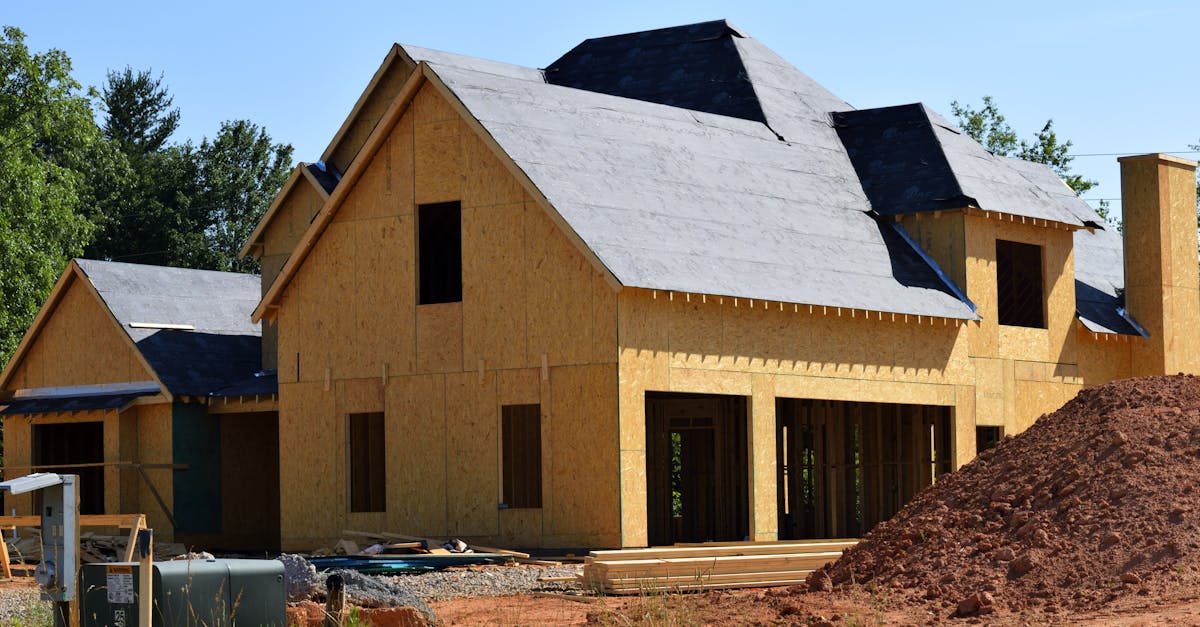
A house under construction (illustrative image)
Real Estate 9 July 2026

VAT refund on self-build homes in Portugal: how to claim from July 2026

Anyone building their own permanent home in Portugal can claim a partial VAT refund on the works, with adjustments processed from July 2026. What you need to know.

The short answer: anyone building a home for their own permanent residence in Portugal can now claim a partial refund of the VAT paid on the construction works — and adjustments for covered operations can be processed from July 2026, meaning now. The change comes from Decree-Law 97/2026 of 20 May, the same decree that cut VAT on eligible works to 6% — a regime we explained in detail when it came into force.

Who can claim the VAT refund on a self-build in Portugal?

Private individuals building a house destined for their own permanent residence. It’s the piece of the package designed for families who don’t buy from a developer but build from scratch — a huge universe outside the big cities, where self-building remains the most common route to owning a home.

How do you claim, and which documents do you need?

The claim goes through the Portuguese Tax Authority, and the golden rule is to document everything from day one: works invoices carrying the owner’s tax number, contracts with the builders, and building permits. The property must be registered as your own permanent residence. Since the eligibility requirements come with fine print, confirm the conditions on the government portal or with an accountant before counting the savings.

When does the money actually arrive?

Adjustments for covered operations can be processed from this July. On a €200,000 build, the difference between standard VAT and the new regime can be worth tens of thousands of euros — but the benefit isn’t automatic: without invoices in order, no refund survives.

The context explains the legislator’s hurry: the package lands alongside the rental measures the government approved this week in the Council of Ministers, in a market where building has never been more expensive. If you have a plot and a project in the drawer, 2026 may be the year to take them out — calculator in hand, invoice folder at your side.

By Duarte Figueiredo

Illustrative · Photo: Pixabay / Pexels

Bonfim Church in Porto
Real Estate 8 July 2026

Bonfim: Porto opens public consultation on 683-million-euro regeneration plan

Porto's city council unanimously approved sending the Bonfim Urban Rehabilitation Operation to public consultation: 683 million euros, nine flagship projects and 41 actions through 2036.

Bonfim, the Porto parish that has gone from overlooked to hotly contested in just a few years, is set to host the city’s biggest urban regeneration bet yet: a 683-million-euro Urban Rehabilitation Operation (ORU), which the city executive unanimously approved on Tuesday to send to public consultation.

What does the Bonfim regeneration plan include?

The Strategic Urban Rehabilitation Programme lays out nine flagship projects, broken into 41 concrete actions, to be delivered over ten years — between 2027 and 2036, extendable to 2041. The main intervention areas are Santos Pousada, Fernão de Magalhães, Eirinhas, Antas, Fontainhas and Nova Sintra. Of the total investment, around 61 million euros is public money, with the municipality as lead promoter, 618 million is private, and close to three million comes through public-private partnerships.

The scale says a lot about the city’s momentum: on the same day it emerged that Porto Vivo is expanding its affordable-rent stock with 159 more homes, the council set in motion a plan to make Bonfim “a reference territory” — balancing innovation and preservation, in the municipality’s words.

When does it start, and how can residents take part?

Works are scheduled from 2027; before that, the project goes to public discussion, where residents, owners and associations can submit contributions and objections. That step matters to anyone living in the parish — and to anyone worried that 618 million euros of private investment could push prices even higher in one of the country’s most pressured areas. Consultation details and deadlines are published on the official Porto municipality website.

By Duarte Figueiredo

Image: Henrique Matos / Wikimedia Commons (CC BY 2.5)

Rua de Santa Catarina in Porto
Real Estate 8 July 2026

Affordable rent in Porto: Porto Vivo adds 159 more homes by December

Porto Vivo will put 159 more affordable-rent homes on the market by December, on top of 429 already contracted. By the end of 2026 the municipal company will manage 588 below-market rentals.

Anyone hunting for a rental in Porto that doesn’t swallow their salary has one more door to knock on: Porto Vivo, the city’s urban regeneration company, will put 159 more affordable-rent homes on the market by December. Added to the 429 homes already under contract, the municipal company will close 2026 managing 588 houses and flats at below-market rents.

How do you apply for Porto’s affordable-rent homes?

Applications are made online through Porto Vivo’s revamped platform, which now includes simulators that tell you in minutes whether you meet the eligibility conditions — income, household composition, connection to the city — before you apply. Homes are allocated by draw among eligible applicants, and the programme is already on its 39th draw. All official information is on the Porto Vivo affordable rental portal.

Municipal investment in affordable housing has now reached 39.8 million euros, and this expansion doesn’t arrive alone: it joins the 331 affordable-rent homes planned for Campanhã, announced last week, set to be the largest project of its kind in the country.

Are 588 homes enough to meet demand?

Let’s be honest: no. In a city where the median rent remains among the highest in Portugal, 588 municipal homes are a drop in a very deep bucket — each draw attracts applicants by the hundreds. But the direction is right and the pace is picking up: between Porto Vivo, Campanhã and the regeneration operations under way, Porto is building a public alternative to the market, brick by brick. For anyone waiting on a home, December can’t come soon enough.

By Duarte Figueiredo

Image: Bernard Gagnon / Wikimedia Commons (CC BY 4.0)

Apartment building with balconies in Porto
Real Estate 7 July 2026

Porta 65-Jovem 2026: how much rent support young renters get

A guide to Porta 65-Jovem in 2026: ages, income limits and how much of the rent the Portuguese state pays for tenants aged 18 to 35.

Porta 65-Jovem can cover up to roughly half your rent in the first year if you are aged 18 to 35 and renting a home to live in — and since 2024 you no longer even need a signed lease to apply. With rent eating an ever bigger slice of the average wage, it is one of Portugal’s most sought-after supports, and in 2026 the government topped up the budget again to meet demand.

Who can apply for Porta 65-Jovem?

Young people aged 18 to 35 (inclusive) on the application date can apply. For a couple, one partner may be up to 37 as long as the other is no older than 35. The home must be your permanent residence, and your household’s taxable income cannot exceed the limit: in 2026 that is the top of the 6th IRS bracket, or 43,090 euros a year.

How much of the rent does the state pay?

The support can reach about 50% of the rent in the first year and tapers down after that. The exact figure depends on your assigned band and the reference maximum rent for your area — not on what your contract actually costs. For scale: by September 2025 more than 45,000 young people had used the programme, with an average benefit of 275 euros a month.

What changed since 2024?

The most practical change is that you no longer need a rental contract to apply: your application is now eligible even before you have found a place, and a rent above the ceiling no longer disqualifies you automatically — the support is calculated on the reference maximum rent instead. The benefit runs for 12 months and can be renewed up to a maximum of 60 months, or five years.

It is worth having your documents and the simulator ready before the application window opens, as it is all done online. While the cost of buying keeps hitting records — we track it in our house-price tracker and in the rents that keep cooling month after month — supports like this are, for many young people, the difference between moving out of their parents’ home or waiting a bit longer. The official rules and form are on the Portal da Habitação and the gov.pt portal.

By Duarte Figueiredo

Image: Dale Cruse - 10M views from San Francisco, CA, USA / Wikimedia Commons (CC BY 4.0)

Front façade of Porto-Campanhã station, in the parish where the project will rise
Real Estate 6 July 2026

Porto affordable housing: 331 rental homes in Campanhã from €536 a month

Portugal's largest build-to-rent project is coming to Campanhã: 331 affordable rental homes from Porto City Hall, Sonae Sierra and Solive, with studios from €536.76.

The largest affordable rental project under development in Portugal is coming to Campanhã, in eastern Porto. Called Cartes Living, it brings together Porto City Hall (through Porto Vivo, SRU), Sonae Sierra and Solive, and promises 331 homes with controlled rents — a studio from €536.76 a month at 2026 values.

How much will rents in Campanhã cost?

The 2026 table runs from €536.76 for a studio (T0) to €971.28 for a three-bedroom flat (T3), with annual updates capped by law. The homes fall under the municipal Porto com Sentido programme, which keeps values within affordable-rent ceilings. The contract between the city and the developers runs for an initial ten years, renewable up to a maximum of 25.

When will the homes be ready?

Delivery is expected in 2029. The 331 units will be spread across two buildings in the parish of Campanhã — the eastern side of the city that has drawn much of Porto’s recent public investment — and represent a €55 million investment by Sonae Sierra and Solive.

Why does this matter?

Because affordable renting in Portugal is still the exception, not the rule. In a market where the median asking rent in the Lisbon metropolitan area hovers around €19.50 per square metre, a studio under €540 in a major city is close to a mirage — and public-private build-to-rent is, for now, one of the few formulas producing new price-controlled homes at scale.

See also: rents falling for five straight months and Portugal’s 100% mortgage guarantee for young buyers. Municipal information at portovivosru.pt.

By Duarte Figueiredo

Image: Nuno Morão from Alcácer do Sal, Portugal / Wikimedia Commons (CC BY 2.0)

Keys to a new home in a buyer's hand
Real Estate 6 July 2026

Portugal's youth mortgage scheme 2026: how to buy a home with 100% financing (before it ends)

The public guarantee lets under-35s buy a first home in Portugal with no deposit — but contracts must be signed by 31 December 2026. The step-by-step guide.

If you are 35 or under and want to buy your first home in Portugal without a saved-up deposit, the clock is ticking: the public guarantee that enables 100% mortgage financing for young buyers is currently set to run only until 31 December 2026 — and the contract must be signed by then. Here is how the scheme works, who can use it and what to do now.

How does 100% financing for young buyers work?

In a standard Portuguese mortgage, the bank finances up to 90% of the property’s value and the buyer covers the remaining 10% — easily €20,000 or €30,000 that many young people simply do not have. With the public guarantee, the State steps in as guarantor for up to 15% of the property’s value, allowing the bank to lend the full 100%. The State has reinforced the guarantee fund by €350 million, a sign of how strong demand has been: young buyers have gained weight in the market and the average buyer age has fallen since the measure began.

Who qualifies for the scheme?

The essential requirements: be aged 18 to 35, buy your first permanent own home, and not own another residential property. At the branch, each bank then assesses affordability as with any mortgage — the State’s backing does not replace an income compatible with the monthly payment. Conditions help: with the ECB holding its key rates steady, banks expect a strong year for mortgage lending. Foreign residents can qualify too, provided they meet the same criteria — tax residence in Portugal included.

Which taxes are waived?

The same age group benefits from IMT (property transfer tax) and Stamp Duty exemptions on a first home, with full exemption up to a price of €330,539 — we covered the thresholds in detail in our IMT Jovem guide. Adding the tax break to 100% financing, a young buyer can now purchase a home with practically no upfront capital — exactly the design that led the IMF to warn these supports, by heating demand without creating supply, may be feeding the very price rises they try to offset.

Step by step: what to do before December

First, confirm eligibility (age, first permanent own home). Second, request simulations from several banks and say upfront that you want to use the public guarantee — not all of them offer it unprompted. Third, sort your paperwork early: pre-approval, property valuation and the deed take weeks, and by year-end banks will be swamped with last-minute applications. The contract must be formalised by 31 December 2026; barring an extension the Government has not announced, a January signing misses the boat.

Frequently asked questions

How much can I borrow with the public guarantee?

Financing can reach 100% of the purchase price or the bank’s valuation (whichever is lower), within the scheme’s price caps and your own borrowing capacity.

Does the guarantee cost anything?

The State’s backing is not a subsidy — if you default, the State answers to the bank and then recovers the debt from you. It is a way in, not a discount.

What if the home costs more than €330,539?

The IMT exemption stops being total above that price and phases out at higher brackets; the public guarantee also has a price ceiling. Luxury homes sit outside the scheme’s design.

See also: the Government’s plan to unblock housing. Official information on the supports at portugal.gov.pt.

By Duarte Figueiredo

Illustrative · Photo: Kindel Media / Pexels

View of Málaga, southern Spain, a hotspot for foreign property buyers
Real Estate 5 July 2026

Spain's 100% tax on foreign home buyers: what actually happened

No, Spain is not charging a 100% tax on foreign home buyers. Pedro Sánchez's proposal stalled in Congress and never became law. Here's what's really going on.

No, Spain is not charging a 100% tax on people buying a home from abroad. The idea made headlines everywhere, but the truth in 2026 is far simpler: the proposal stalled and never became law.

Will Spain charge foreigners a 100% tax?

Right now, no. In January 2025, Prime Minister Pedro Sánchez announced plans for a tax of “up to 100%” on property purchases by non-resident buyers from outside the European Union — people from countries such as the UK, the US or Canada. In practice, it would double the cost of the deal. But as of April 2026 no bill had been adopted, the measure was never even debated in Congress, and the government’s own January 2026 housing package quietly dropped it.

Why did Spain’s 100% tax proposal stall?

For two reasons. The first is political: the Spanish government could not gather enough parliamentary support to bring it to a vote. The second is legal: there are serious doubts that such a tax is compatible with EU law, especially the free movement of capital, and the EU Court of Justice has previously ruled against Spain over discriminatory tax measures. It is worth stressing that the proposal only targeted non-resident, non-EU buyers — residents of any nationality would be exempt.

What changes for anyone buying a home in Spain (or Portugal)?

For now, nothing new in Spain: the usual rules and taxes apply. But the episode reflects a trend running across southern Europe — political pressure to curb speculative buying by non-residents at a time when prices are squeezing locals. It is the same conversation you hear on this side of the border.

See also: the real cost of buying a home in Portugal as a foreigner. Official source at the Spanish government portal.

By Duarte Figueiredo

Image: Kiban / Wikimedia Commons (CC BY-SA 3.0)