
The LZ experiment has one dark matter event it cannot explain
A single particle interaction recorded nearly a mile underground in South Dakota has survived three years of scrutiny. It sits at 2.6 sigma, well short of a discovery, and a Coimbra team has been in the collaboration since it was founded.
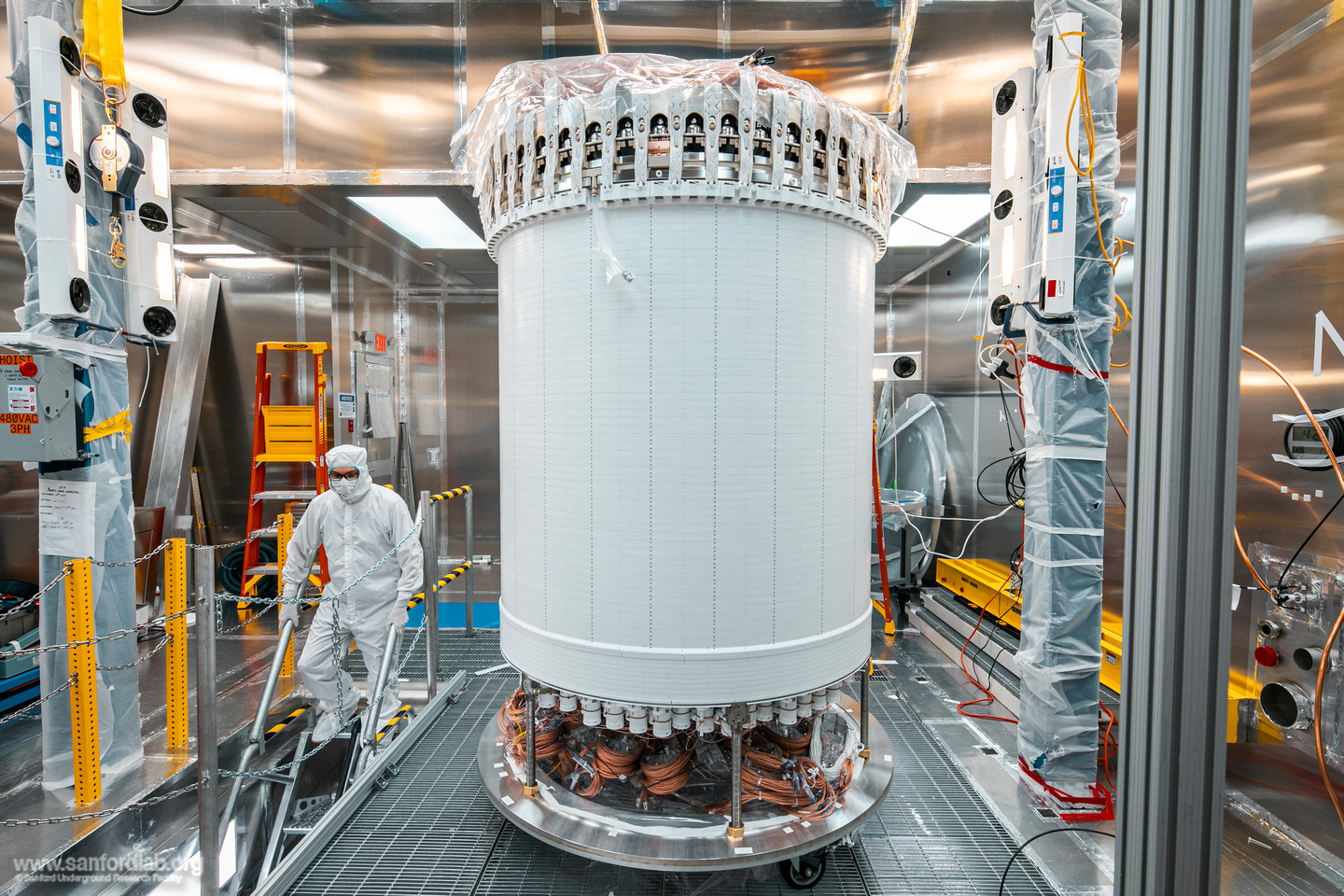
One day in June 2023, a xenon atom inside a tank buried nearly a mile down in a disused South Dakota gold mine was nudged by something. It left a faint flash of ultraviolet light and a recoiling nucleus. Three years on, the collaboration that runs the detector still cannot pin that event on any known background.
The announcement came this week at a conference in Japan. It is the strongest hint LUX-ZEPLIN has ever put forward, and the thing to say straight away is what it is not: a discovery.
What 2.6 sigma actually buys you
The analysis lands at 2.6 sigma. In plain terms, there is roughly a half-percent chance that known processes account for the signal on their own. That sounds small. The conventional bar for claiming a discovery in particle physics is five sigma, and the gap between 2.6 and 5 is not a rounding question — it is orders of magnitude of evidence.
Physics has a long memory of signals at this height that evaporated once more data arrived. What makes this one worth attention is where it came from: an experiment built specifically to have almost no backgrounds, and a team that spent months trying to demolish its own result before showing anyone.
If that event really was dark matter, the particle behind it would carry a mass of at least 200 GeV/c² and would interact with ordinary matter in a way the simplest models did not predict. That is more interesting than the standard expectation, which is another reason to be careful with it.
The Portuguese share
LZ is not an American experiment with guests. LIP-Coimbra is one of the collaboration’s founding members, with a team of seven — PhD students, postdocs and researchers — responsible for work on the optical properties of the detector’s materials, on the analysis software and on detector monitoring.
It is the same pattern as when a star swung past the Milky Way’s black hole at 8% of the speed of light and four of the authors were working in Portugal. Portuguese names rarely make the headline of the press release. They are in the author list, and that is where you see how much of what gets announced abroad was built here.
What comes next is what always comes next: more data. LZ is still collecting, and the following analysis will say whether that single 2023 event was the start of something or simply chance doing what chance does.
By Oliver Grant
Image: Sanford Underground Research Facility / Berkeley Lab