
12 fast chargers just opened on the A8, and 2 of them fit a lorry
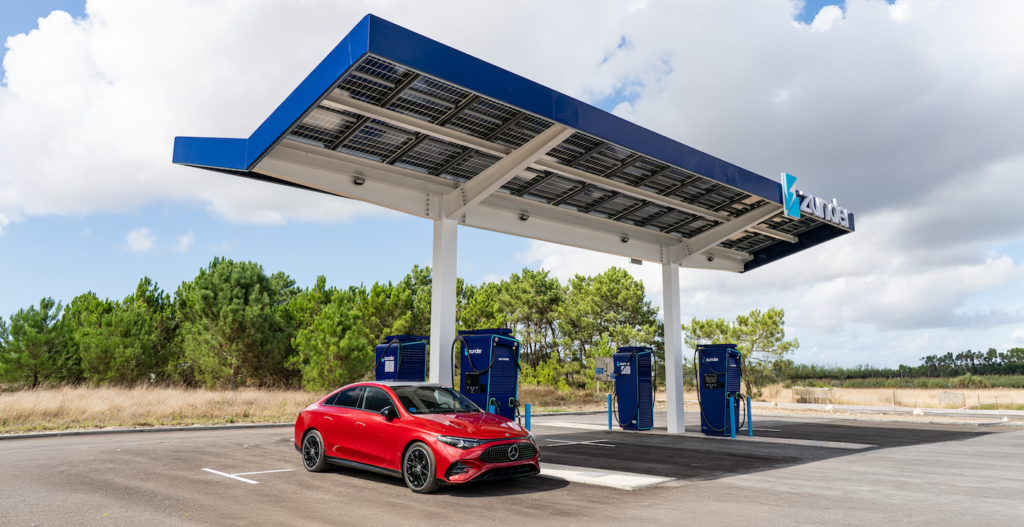
Zunder's station at junction 19, outside Caldas da Rainha, went live on 11 September with 400 kW CCS points and a solar canopy. The bays sized for heavy vehicles are the first public ones in Portugal.
If you drive an electric car between Lisbon and Porto, range has quietly stopped being a conversation. If you drive an electric lorry, it is most of the conversation, because until this month there was nowhere public in Portugal to stop halfway and put charge back into a heavy vehicle.
The station the Spanish operator Zunder opened on 11 September at Caldas da Rainha is the first answer to that, on a modest scale. It sits at junction 19 of the A8, beside the industrial estate, and carries 12 charging points rated up to 400 kW, all on CCS connectors, with an area laid out for heavy transport. Two of those twelve bays were built for trucks and coaches. The investment came to roughly a million euros.
What is actually there
The location was picked for the map rather than the town. The A8 is one of the corridors feeding traffic from the capital northwards, so a stop there costs a driver almost no detour. A photovoltaic canopy runs over the charging area, shading whoever is waiting and generating power on site. You can pay by bank card at the terminal, with no app required. Nobody works there: the site runs itself, with lighting and CCTV, and sees only maintenance crews.
Two bays are worth reading for what they are. They are not a freight charging network. They are the first point of one. Zunder says another 15 Portuguese stations are planned by 2027, and the Caldas plot was bought with room to expand.
The fleet is moving faster than the sockets
The mismatch is familiar. Battery models have taken off among private buyers, to the point where electric cars now account for roughly a quarter of the Portuguese market, while high-power charging outside the big cities has stayed thin, and for heavy goods was effectively absent.
Cristina Pinto Dias, secretary of state for mobility, attended the opening and steered the subject towards the electric-mobility legal regime approved in 2025, written to open the market to more operators, and towards the case for charging lorries and coaches away from the urban centres. The mayor, Vítor Marques, made the local argument instead: less red tape, business projects delivered sooner.
The rest of the corridor is still missing. A lorry leaving Sines or Aveiro has to plan a journey around two sockets near Caldas da Rainha, and that is not yet a replacement for diesel. It is, at least, the first place in the country where the answer stops being no.
By Oliver Grant
Image: Zunder