
The Milky Way's fastest star laps our black hole every 8.7 years. Four of the scientists who found it work in Portugal
S301 hits 25,000 km per second at its closest pass, more than 8% of light speed, and comes nearer to Sagittarius A* than any star ever tracked. It is the first that could let astronomers measure the black hole's spin directly.
There is a black hole four million times the mass of the Sun at the centre of our galaxy, and something has been skimming past it. The star is called S301, it was announced on Wednesday, and it is the fastest star known in the Milky Way, touching about 25,000 kilometres per second at its closest approach. That is more than 8% of the speed of light, or roughly a hundred thousand times the speed of an airliner.
Finding something two billion times fainter than Betelgeuse
It took four telescopes behaving as one. The detection came from the Very Large Telescope Interferometer at ESO’s Paranal Observatory in Chile, using the GRAVITY instrument, now GRAVITY+ after an upgrade. Combining the light of four eight-metre telescopes gives fifteen times the spatial resolution of any one of them, and no other observatory on Earth can do it.
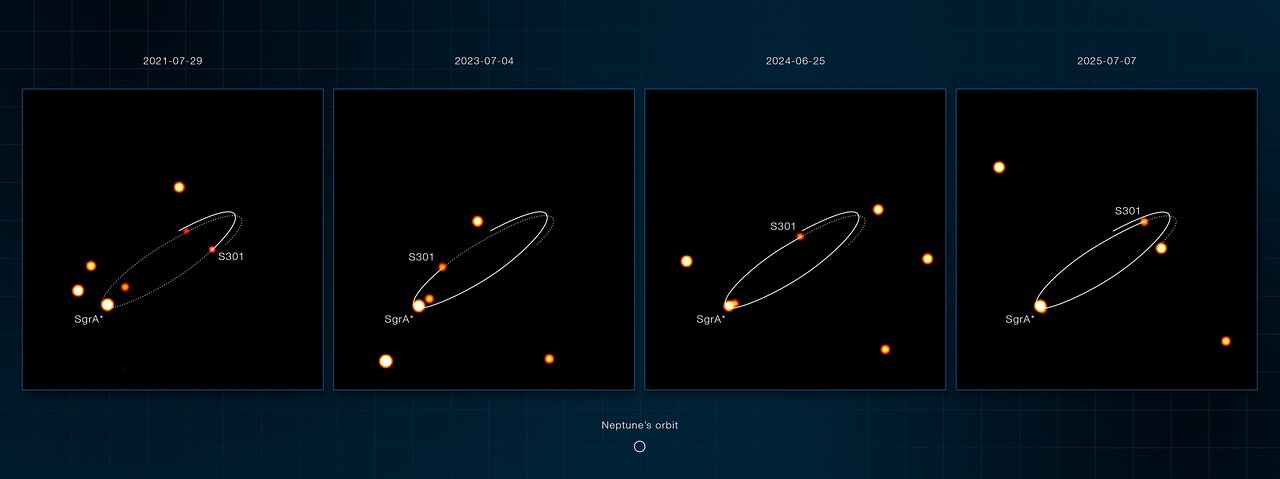
The team caught a first glimpse in spring 2023, has followed the star since, and has reconstructed its path back to 2017.
Why a record is the least interesting part
S301 completes an orbit in 8.7 years and, at its nearest, passes 1.78 billion kilometres from the black hole — about twelve times the Earth-Sun distance, roughly where Saturn sits in our own system. No star observed before has come that close.
That proximity is what makes it useful. General relativity says a spinning black hole drags spacetime around with it, and the twist is felt far more strongly close in. S301 is the first star that could allow the spin of Sagittarius A* to be measured directly, something the team hopes to do within a decade using GRAVITY+ and later the MICADO instrument on the Extremely Large Telescope. Its next close pass is due in 2031.
There is a violent backstory too. Stars do not form that near a supermassive black hole, so the orbit points to S301 having arrived as half of a binary pair that tidal forces tore apart, one star captured and the other flung out fast enough to leave the galaxy altogether.
The names from Porto and Lisbon
The paper is in Nature and the author list runs long. Four of them work at Portuguese institutions: N. Aimar, C. Correia, P. Garcia and N. Morujão, all attached to the Faculty of Engineering at the University of Porto and to CENTRA at Instituto Superior Técnico in Lisbon. Portugal is an ESO member state, and that membership is what puts researchers based here inside collaborations like GRAVITY.
If you spent an August night outdoors waiting on the Perseids, consider the contrast: the fastest thing in our sky is invisible to the naked eye and takes almost nine years to go round once.
By Oliver Grant
Image: ESO/GRAVITY collaboration (CC BY 4.0)