
The €2 carbon charge on Portuguese flights has now raised €266.6 million
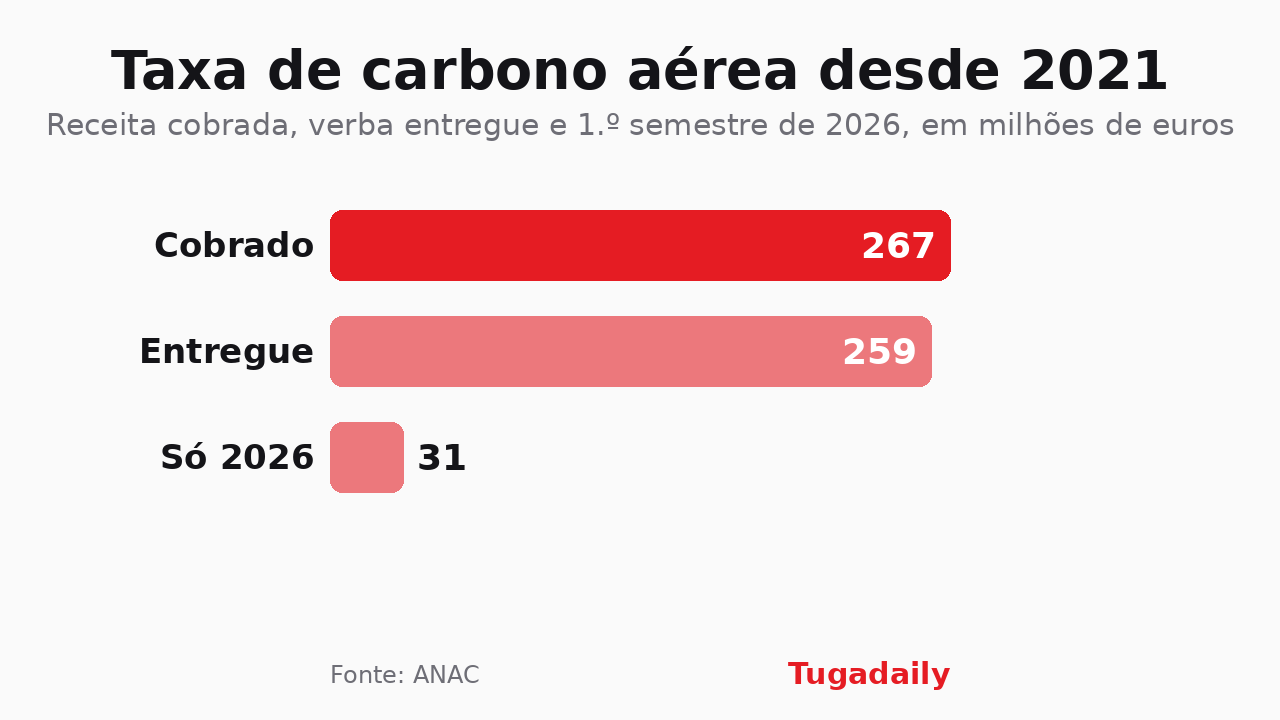
Portugal's per-passenger aviation carbon charge has collected €266.58 million since July 2021, including €31.48 million in the first half of this year. €258.58 million has reached the Environmental Fund; the €8 million gap is the share the law reserves for the aviation regulator.
It is two euros. It sits inside the ticket price, almost nobody notices it, and since July 2021 it has added up to €266.58 million.
Portugal’s aviation carbon charge is a flat amount per passenger, collected by airlines when they sell a commercial ticket and handed on to the state. In the first half of this year it brought in €31.48 million, against €30.6 million over the same months of 2025 — a rise of 2.9%, tracking traffic growth closely.
Where the money goes
The law is specific about the destination: revenue from the charge belongs to the Environmental Fund, subject to the share due to the civil aviation regulator ANAC, and is meant to fund emissions reduction. Of the total collected, €258.58 million has been transferred across.
We did the subtraction. That leaves €8 million between what passengers paid and what reached the fund. It is not missing money — it is the cut the statute itself reserves for the regulator that collects and administers the charge, plus the ordinary lag between collection and transfer. Worth knowing it exists, because it is rarely written down anywhere.
Is two euros a lot?
Depends what you want the charge to do. As a price signal meant to change behaviour, two euros on a Lisbon–London ticket changes nobody’s mind, and it was never designed to. As a funding instrument, five years at roughly €50 million a year is a real envelope for decarbonisation projects.
What the charge does not do is discriminate. Someone hopping Lisbon to Porto pays the same as someone flying eight hours, and it is levied per passenger rather than per tonne emitted. In a country where aviation is welded to tourism — which, as we found, is worth anywhere between 8.1% and 16.1% of the economy depending on the measure — that is a design choice with consequences the headline revenue does not show.
By Beatriz Mota
Chart: Tugadaily · data ANAC