
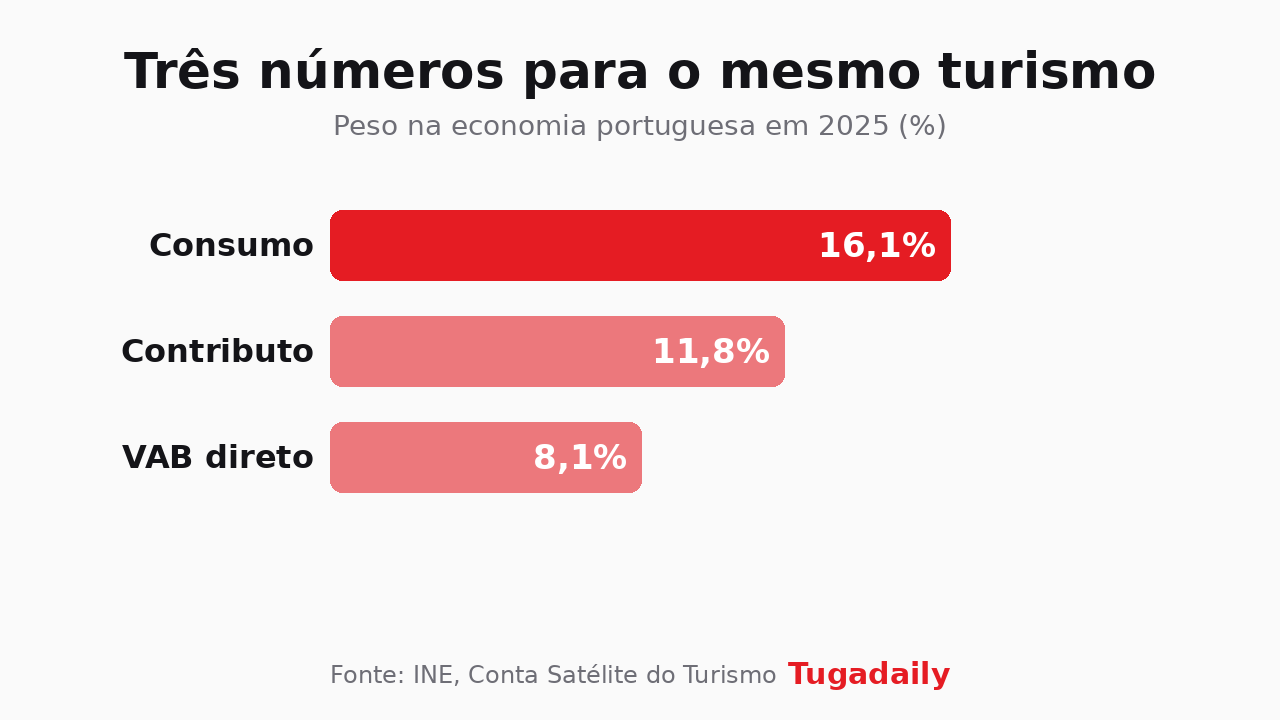
Portuguese tourism is 8.1% of the economy. It is also 16.1%
Portugal's 2025 Tourism Satellite Account gives three different readings of the same sector, which is why the headlines never agree. Only one of them measures what tourism actually adds.
If you read this month that tourism is worth 8.1% of the Portuguese economy, you read correctly. If you read 11.8%, that was correct too. And 16.1%. All three come from the same INE release, published on 3 August, and they measure different things. Worth knowing which, because mixing them up is why the argument about tourism in Portugal keeps going round in circles.
What each one counts
8.1% is direct gross value added generated by tourism, as a share of national GVA. It is the strictest measure: what hotels, restaurants, carriers and agencies add, once you strip out everything they buy from someone else. It held at 8.1% in 2025 and has sat there since 2023.
11.8% is the total contribution to GDP, direct and indirect, worked out by INE using input-output tables. That is 36.2 billion euros. It counts the laundry washing the hotel sheets and the grower selling wine to the restaurant. Industry press releases prefer this one, for obvious reasons, and it is not wrong — it measures footprint, not value created.
16.1% is tourism consumption in the economic territory as a share of GDP. That is how much gets spent here on tourism, not how much the country keeps. Some of it leaves again as imports. It is the most generous reading, and INE notes it has slipped from the 2023 record of 16.3%.
The line almost nobody quoted
It sits just below the headline figures and it is the most interesting one. Tourism contributed 0.3 percentage points to real GDP growth in 2025. The economy grew 1.9%. Do the division: roughly one sixth of last year’s growth came from tourism, and five sixths came from everything else.
This is not a collapse. Tourism consumption still rose 4.9% in nominal terms. It simply rose more slowly than the economy around it, which advanced 5.9% nominally, and a sector growing below average stops being the engine and becomes a passenger. After years of tourism pulling on its own, Portugal’s growth has been finding momentum elsewhere.
Next time one of those three numbers turns up in a headline, the useful question is the same one: does this measure what gets spent, what gets added, or what gets dragged along behind? Three different answers to the same question, and not one of them is the only true one.
By Beatriz Mota
Chart: Tugadaily · data from INE, Tourism Satellite Account 2025