
PT
Euro banknotes in a wallet
Immigration 7 July 2026

Portugal visa income requirements 2026: how much money do you actually need?

Portugal's visa means-of-subsistence rule starts at 920 euros a month (the minimum wage) in 2026: 100% for the applicant, 50% per extra adult, 30% per child. Here are the sums.

The short answer: in 2026 the reference figure is 920 euros a month — Portugal’s national minimum wage, set by Decree-Law 139/2025. That’s the number consulates use to calculate “means of subsistence”, the mandatory requirement for any long-stay Portuguese visa. Applicants must prove they can live in Portugal on their own money — or that they’ll be in a position to earn it after arriving.

How much income do you need for a Portugal visa in 2026?

The base rule is a percentage of the minimum wage (920 euros) for each household member: the first adult counts at 100%, meaning the full 920 euros; the second and subsequent adults count at 50% (460 euros each); and children under 18, plus dependent adult children, count at 30% (276 euros each). A couple with two young children, for example, needs to show around 1,932 euros a month. Salaries, employment contracts or contract offers, study grants, subsidies and service contracts all count towards the proof. The full criteria are published on the MNE visa portal.

For how long must you guarantee that amount?

It depends on the visa. For residence with professional activity, the means must cover the maximum admissible period; for investors, at least 12 months. Retirees prove their pension income and the guarantee of receiving it in Portugal; people living off assets (property, financial investments, intellectual property) present proof of the existence, amount and availability of those funds in the country. AIMA applies the same criteria when assessing residence permits inside Portugal.

Do students need to show less money?

Yes, and the difference is significant. Students must guarantee 12 months of subsistence (or the length of their exchange), but the amount can drop by half if they prove accommodation is already secured — and by up to 90% if meals are covered too, for instance in a university residence with catering. The same logic applies to professional internships and volunteering. That’s real breathing room, especially now that student visa rules have tightened for applications from September.

Is this enough if your end goal is citizenship?

Don’t mix up the stages: means of subsistence open the door to the visa and residency, but citizenship is a separate marathon with its own clocks, which changed under the new nationality law. First the visa, then residency renewed without drama — and only then does the passport countdown begin.

Quick questions

Does the money need to be in a Portuguese bank? Not mandatory for the visa, but it helps: consular practice values funds available in Portugal, and for residence without professional activity it’s recommended to have roughly 12 months of subsistence deposited, preferably in a national bank.

Will the minimum wage go up? Historically it rises every year — which means the visa reference amounts rise with it. Always confirm the value in force before submitting.

Can a couple combine income? Yes, means are assessed per household; what matters is that the total covers every member’s percentage.

By Juliana Castilho

Image: Santeri Viinamäki / Wikimedia Commons (CC BY-SA 4.0)

Aerial view of Lagos marina in the Algarve, with moored boats and the town around it
Immigration 4 September 2026

The Algarve came second in the world's retirement rankings (and the winner is in Panama)

Live and Invest Overseas put the Algarve ahead of Crete, Gascony, Puerto Vallarta and Tarragona in its 2026 index — and puts the cost for a couple at around $3,085 a month.

There is an American list that comes out every year and quietly moves people between continents. It is the Overseas Retirement Index, published by Live and Invest Overseas, and in the 2026 edition the Algarve placed second among the best places in the world to retire. Only Boquete, a town in the Panamanian highlands, finished ahead of it. What the Algarve beat is more interesting than the placing. It finished above Puerto Vallarta in Mexico, Gascony in…

Continue reading
The pink facade of the Belem Palace in Lisbon seen from the gardens in front, with the Portuguese flag flying to the left
Immigration 3 September 2026

Portugal's return law was signed on 31 August. What happens next turns on a 160-page ruling

President Seguro promulgated the decree overhauling reception, entry, removal and asylum rules three days after the Constitutional Court cleared it. The court also set out how the text must be read, and that reading now guides judges and officials.

It is signed. António José Seguro put his name to the decree on 31 August, the one that rewrites how foreign nationals and stateless people are received in temporary detention centres, how they enter, stay, leave or are removed from the country, and how asylum is granted. Three days passed between the Constitutional Court's ruling and the signature.

Continue reading
The Palacio Ratton in Lisbon, seat of Portugal's Constitutional Court, shot from below with the national flag flying and a red carnation blurred in the foreground
Immigration 30 August 2026

Portugal's return law clears the Constitutional Court, all eleven questions rejected

The seven judges who signed the ruling were unanimous: not one of the eleven provisions is unconstitutional. The President had sent the decree up on 7 August, and every objection fell.

Portugal's Constitutional Court ruled on Friday that there is nothing unconstitutional in the law on asylum, detention and the return of foreign nationals. Not one of the eleven provisions put in front of it. The seven judges who signed ruling 736/2026 were unanimous. The answer is quick to state and slow to read: the ruling runs to more than 160 pages, according to the court's president, João Carlos Loureiro.

Continue reading
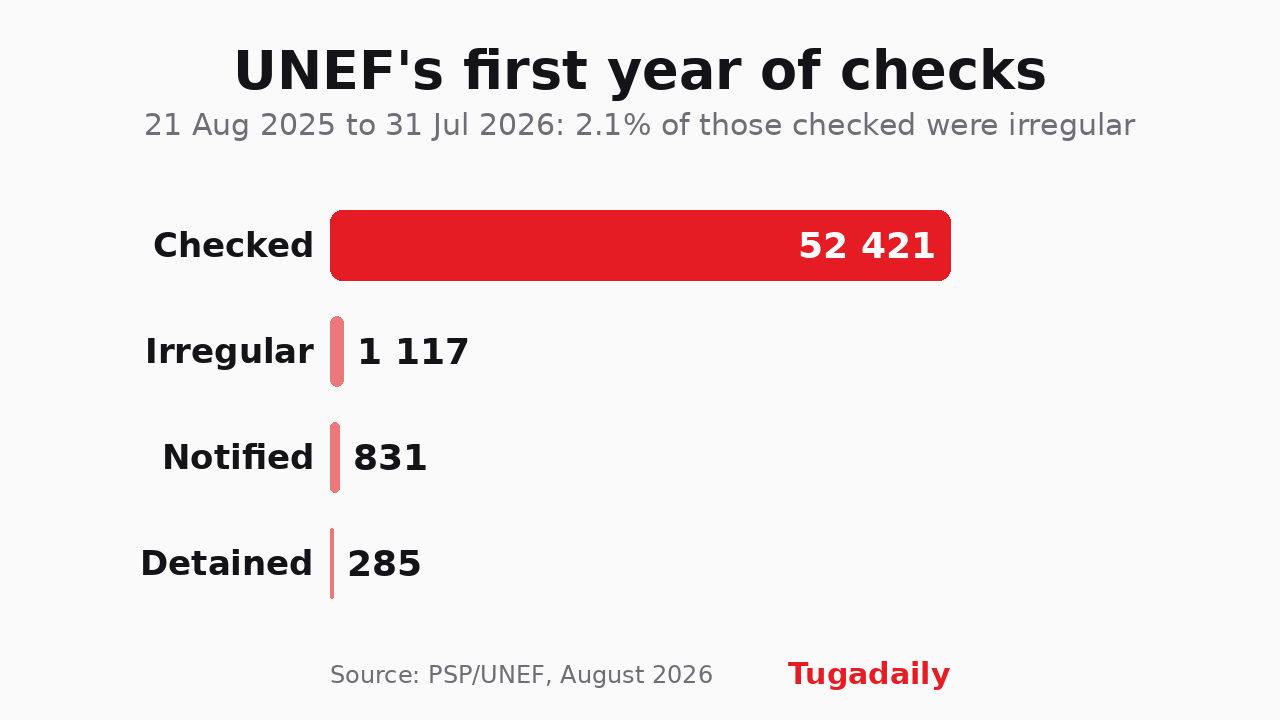
Bar chart of the UNEF's first year of checks: 52,421 foreign citizens checked, 1,117 irregular, 831 notified and 285 detained
Immigration 27 August 2026

Portugal's new border unit checked 52,421 foreigners. Just 2.1% were irregular

The PSP has released first-year figures for the UNEF: 5,397 operations between 21 August 2025 and 31 July 2026, 831 notices to leave the country and 285 arrests. Here is what that 2.1% can and cannot tell you.

Portugal's police have totted up the first year of the National Unit for Foreigners and Borders. The figure worth pausing on is not the arrests. It is the ratio. Between 21 August 2025 and 31 July 2026, the unit's foreigners and border control teams ran 5,397 inspection operations and checked 52,421 foreign citizens. Of those, 1,117 turned out to be irregular. That is 2.1%. The same operations produced 831 notices to leave the country voluntarily, 285…

Continue reading
The Loja do Cidadão public service building in Santiago do Cacém, signage above the entrance
Immigration 26 August 2026

What AIMA accepts as proof of address when your name is not on the lease

Renting a room, or living in a flat leased by someone else, means the document AIMA wants has another person's name on it. There is a route for that: a sworn declaration carrying the land-registry number and the owner's NIF, plus a tax-domicile certificate issued in the last 30 days.

One detail catches people out at an AIMA appointment, and it is not the queue. It is proof of accommodation. If you own the flat, the whole thing takes a minute. If you rent a room in a shared house, live with a relative, or hold a tenancy signed by somebody else, you have a genuine problem: the document AIMA wants to see has another person's name across the top of it. The good news is that a route exists for precisely that situation. The bad news is that…

Continue reading
Service desks at an Espaço do Cidadão government office in Portugal, with staff at the counters and people seated waiting their turn
Immigration 25 August 2026

Bringing a child to Portugal through family reunification? They have to be here on the day you file

A little-known condition on AIMA's Family Reunification of Minors platform catches a lot of families out: the child must be demonstrably on Portuguese territory on the date the application is submitted. If they are still abroad, the portal will not take it and the application has to be made in person.

If you are in Portugal and want to bring a child over through family reunification, there is a little-known condition that undoes a lot of people's planning: the child has to be demonstrably on Portuguese territory on the date the application is filed through the Family Reunification of Minors platform. It is set out in AIMA's own information note on family reunification and repeated on the Foreign Ministry's list of AIMA booking platforms, which spells…

Continue reading
People queuing at the civil registry counters in Lisbon's Campus de Justiça, with a clerk serving at counter 14
Immigration 24 August 2026

What happened to Portugal's promised nationality regulation? Eight days past the deadline, still nothing

Organic Law 1/2026 gave the government 90 days to rewrite the Portuguese Nationality Regulation. We opened the Diário da República's consolidated register on 24 August: the most recent amendment is still dated July 2025.

The government gave itself 90 days to write the instruction manual for Portugal's new nationality law. That deadline ran out on 16 August. Eight days later, the manual is still the one from 2006. We checked it the simplest way there is. We opened the consolidated register for Decreto-Lei n.º 237-A/2006, the decree that approves the Portuguese Nationality Regulation, and read the full list of instruments that have amended it since 2006. There are seven.…

Continue reading
Aerial view of the town of Carregal do Sal in the Viseu district, red-tiled houses surrounded by fields
Immigration 23 August 2026

AIMA spread its appointments around the country. Now people are paying €300 to reach them

Slots are allocated by availability rather than by where applicants live, so an Almada resident was booked into Carregal do Sal, near Viseu, for an appointment lasting minutes.

On paper it was sensible. The offices in Lisbon and Porto were overwhelmed, so spread the appointments across the country and the queues shrink. That is what AIMA did. What the plan left out was the geography of the people being seen. Slots are being handed out according to availability, not according to where the applicant lives. The result, reported by Jornal de Notícias, is people crossing half the country for procedures that take a few minutes. An…

Continue reading
The Finanças tax office building in Albufeira, with its blue tax service sign on the façade
Immigration 23 August 2026

When does Portugal start taxing your foreign income?

The 183-day rule decides whether Portugal taxes your worldwide earnings or only what you make here. What counts, what does not, and the traps in a first IRS filing.

Most people move to Portugal thinking about the lease, the school place and the NIF. The tax question surfaces the following May, when the filing window opens. By then it is too late to plan and too early to relax. Everything turns on one question: are you tax resident in Portugal? If you are, Portugal taxes your worldwide income. If you are not, it taxes only what you earned here. The main test sits in article 16 of the Portuguese Personal Income Tax…

Continue reading
The public hall of the Conservatória dos Registos Centrais in Lisbon, with people arriving, staff at the counters and rows of waiting chairs
Immigration 22 August 2026

Portugal's registries took on 47 new conservadores this month. It is the first intake in over twenty years

They started on 3 August and some were posted to the Central Registry Office in Lisbon and the Porto Central Archive, the two places where nationality applications are decided. Another 66 arrive in September. In 2025, more than 63% of registry staff were 55 or older.

If your nationality file is sitting in a Portuguese conservatória, staffing news is not usually the kind you get. This month it was. The registry and notary institute confirms that 47 new registrars started work on 3 August, the first intake into the career in more than twenty years. Twenty years is the number that matters. No conservador has been recruited in this country since before the citizen card existed, and over that period the IRN kept collecting…

Continue reading
Bar chart showing the share of expats in Portugal who rate four areas positively: safety 94, income 75, bureaucracy 20 and jobs 19
Immigration 18 August 2026

Portugal ranks 8th in the world for expats (paperwork and pay are the catch)

InterNations places Portugal eighth of 31 destinations in Expat Insider 2026. Some 94% of foreign residents feel safe and 75% say their income stretches far enough — but only 19% rate the job market well.

Every August a version of this survey lands and people forwarding it to a friend get about halfway through. InterNations has put Portugal eighth out of 31 destinations in its Expat Insider 2026 ranking, behind Singapore and ahead of Luxembourg, in a top ten built mostly from Latin America and Southeast Asia. The half most people stop reading before is the interesting one. Safety is the standout. Ninety-four per cent of foreign residents say they feel safe…

Continue reading
A Loja do Cidadão citizen shop, home to AIMA service desks
Immigration 17 August 2026

AIMA tracker: deadlines, backlog and updates

A running tracker of AIMA — case backlog, renewal deadlines, biometrics, golden visa and service changes. Updated whenever there is news.

If you are dealing with residence or nationality, this is the page to bookmark. Instead of one article per announcement, we gather the essentials of AIMA here: case backlog, renewal deadlines, biometrics, golden visa and service changes. For the citizenship rules, see the new nationality law. Official information is at AIMA. AIMA's renewals portal is taking applications for residence permits expiring in November and December 2026, in a window that opened…

Continue reading
Tugadaily chart with three bars: seven provisions sent to the Constitutional Court in 2025, five struck down, and eleven provisions sent in 2026
Immigration 16 August 2026

The court about to rule on Portugal's immigration law is not the court that ruled last year

Eleven provisions, a deadline of 31 August, and four judges who were not on the bench for the 2025 decision that struck down five out of seven.

Portugal's Constitutional Court has until 31 August to rule on the new foreigners law. It is the second summer running that the judges spend their recess on the same subject, and setting the two occasions side by side tells you more than any forecast would. Last August it was seven provisions, referred by the then president, Marcelo Rebelo de Sousa. The court struck down five of them. Ruling 785/2025 blocked, among other things, the two-year residence…

Continue reading
Bar chart: 295 days since Portugal's qualified job-seeker visa was created, against the 120 days it would last
Immigration 14 August 2026

Portugal created a qualified job-seeker visa in October. Almost ten months on, nobody can apply for it

Law 61/2025 suspended the old job-seeker visa and created a narrower one for skilled workers, conditional on a joint order from four ministries. That order has still not been published, so no applications can be filed.

On 23 October 2025, the day Portugal's new foreigners law took effect, consulates stopped accepting job-seeker visa applications. That category — the one that let you come to Portugal with 120 days to find work — ceased to exist in the form it had. In its place, Law 61/2025 created a different one: a job-seeker visa restricted to people with specialised technical skills or heading into highly qualified work. Valid only inside Portugal, granted for 120…

Continue reading