
Portugal's bottle-deposit petition has nearly five times the names it needs (and it is still in committee)
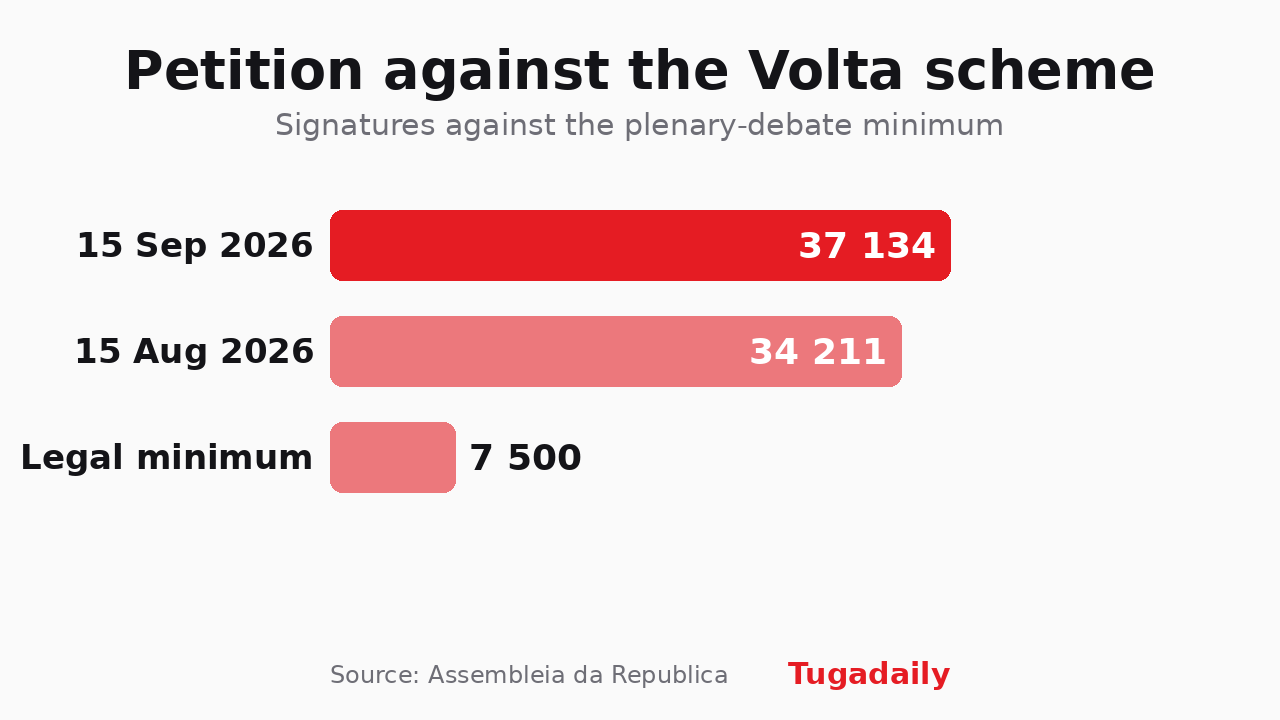
The petition to scrap the Volta deposit-return scheme reached parliament on 15 August with 34,211 signatures, against a legal minimum of 7,500 for a plenary debate. A month on it stands at 37,134 and is still waiting to be ruled admissible.
The petition calling for an end to Portugal’s Volta scheme has 37,134 signatures. That is the figure that went round the press this week, and it is a big one. It is also not the figure that decides anything.
For a petition to be considered in plenary, Portugal’s right-of-petition law sets a minimum of 7,500 subscribers. When this one arrived at the Assembleia da República on 15 August it already carried 34,211 — four and a half times what it needed. The 2,923 names added since change its procedural standing not at all. Names are not what is missing.
What it is actually waiting for
The petition, titled “Pelo Fim do Sistema Volta e pela Criação de um Modelo Justo de Gestão de Embalagens”, was passed four days later to the parliamentary environment and energy committee. There it awaits a ruling on admissibility, the step that comes before consideration. Its first signatory is João Pontes, and the initiative is tied to no party and no organisation.
It asks for three things: immediate suspension of the deposit-return scheme in its present form, replacement by a model the signatories describe as transparent and fair, and an independent audit of the financial, operational and environmental model of SDR Portugal, the body that runs it.
What Volta is, briefly
The scheme started on 10 April, with a transition period that ended on 9 August. It covers single-use beverage containers in plastic, aluminium and steel up to three litres, and adds a 10-cent deposit per container that shoppers get back when they return it to a collection point. It applies on the mainland, in the Azores and in Madeira.
Look at the date the petition was filed: 15 August, six days after the transition period closed. That is the moment the deposit stopped being an announcement and became ten cents charged on every bottle bought.
The friction that follows is the familiar one for schemes like this. Returning means storing, carrying and finding a machine that works. Not returning means paying the ten cents and never seeing them again, which turns a refundable deposit into a levy for part of the population. That everyday irritation, rather than any technical argument about collection rates, looks like what is filling the list.
Set against that is what the scheme has been doing. In five months it took in more than 305 million bottles and cans, at a rate that tripled between month three and month five — containers that would otherwise end up where they should not, alongside the seahorses and shopping trolleys pulled out of the Tagus. Whether the Portuguese version is well designed is a fair argument to have. What the petition has already won is the right to have it in plenary, and it won that on the day it arrived.
Chart: Tugadaily · Data: Assembleia da República