
Portugal's 63-item shopping basket now costs 253.55 euros, up 11.73 since January
Deco Proteste's weekly count rose 1.48 euros in seven days. Tinned tuna, cake flour and butter beans did most of the pushing.
Some sums do not wait for the end of the month. They happen at the supermarket till. This week the trolley of 63 essential goods that consumer body Deco Proteste has tracked since 2022 costs 253.55 euros, 1.48 euros more than a week ago, according to the analysis the association published on Wednesday.
A weekly move that small is easy to shrug off. What it does when it accumulates is harder to ignore. At the start of this year the identical basket cost 11.73 euros less, a gap of 4.85%. A year ago it was 12.25 euros cheaper. Go back to the beginning of 2022, before Russia invaded Ukraine, and the saving was 65.85 euros — roughly a third of today’s bill.
This week’s movers
Between 12 and 19 August three products did most of the damage, and none of them is a luxury. Tinned tuna steak in vegetable oil rose 16% to 1.59 euros. Cake flour went up 10% to 1.83 euros. Butter beans matched that 10%, landing at 1.50 euros.
Compare with a year ago and a different cast appears. Sweetheart cabbage is 24% dearer at 1.94 euros a kilo. Large salt cod rose by the same proportion and now sits at 19.56 euros a kilo — a figure worth filing away if you are already thinking about Christmas. Sea bass is 22% more expensive, at 10.06 euros a kilo.
The rises that never came back down
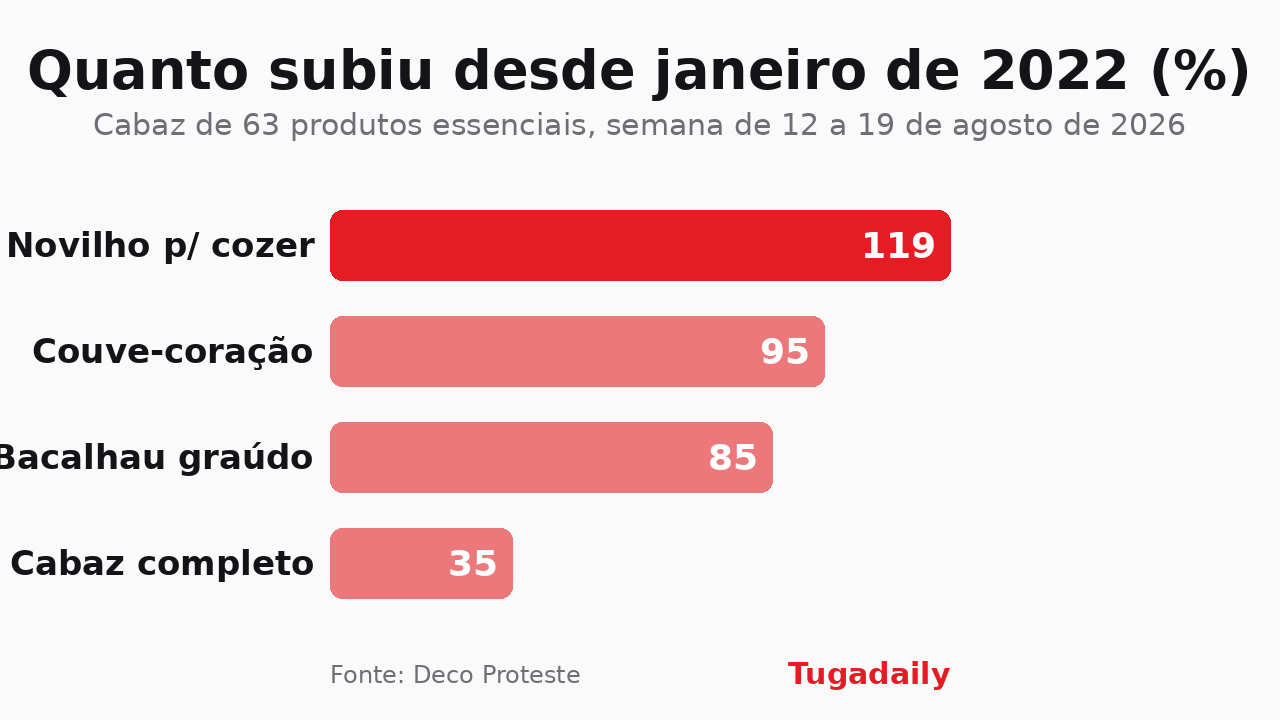
The long view is the bleak one. Since Deco Proteste started counting on 5 January 2022, stewing beef has climbed 119% to 12.76 euros a kilo. Sweetheart cabbage is up 95%. Large salt cod, 85%.
Three very different products, one thing in common: none of them returned to its old price. The occasional weekly dips — the basket fell 1.53 euros the week before this one — behave like pauses rather than reversals.
For anyone budgeting at home, that means savings have to come from comparing shops and brands rather than from waiting for broad relief. Worth remembering that average pay rose 5.1% in the second quarter to 1,835 euros, though in real terms the gain was 1.8% — a thin margin against increases of this size.
Chart: Tugadaily · data Deco Proteste