

Portugal's second-phase university applications open 24 August and close 2 September
Second-phase applications to Portuguese public higher education run from 24 August to 2 September 2026, with results on 13 September. Deadlines, places and who qualifies.
Apply / Learn moreThe second phase of Portugal’s national competition for public higher education runs from 24 August to 2 September, with results on 13 September. That is ten days to decide something a lot of people will then spend three years living with.
The second phase exists for two groups: those who were not placed in the first round, and those who were placed on a course that, on closer inspection, was not the one. It is that second group that tends to hesitate more than it should.
Who can apply in the second phase?
Students who were not placed in the first phase, and those who were placed but did not enrol — and that last point is where most people get caught. Enrol in the first phase and you are, as a rule, out of the next round. Which means the choice to accept or decline a first-phase placement is, in practice, the choice of whether to enter the second phase at all.
Anyone tracking the tight calendar already knows that first-phase results land on 22 August and enrolment lasts only four days — so the two decisions all but overlap.
How many places are left in the second phase?
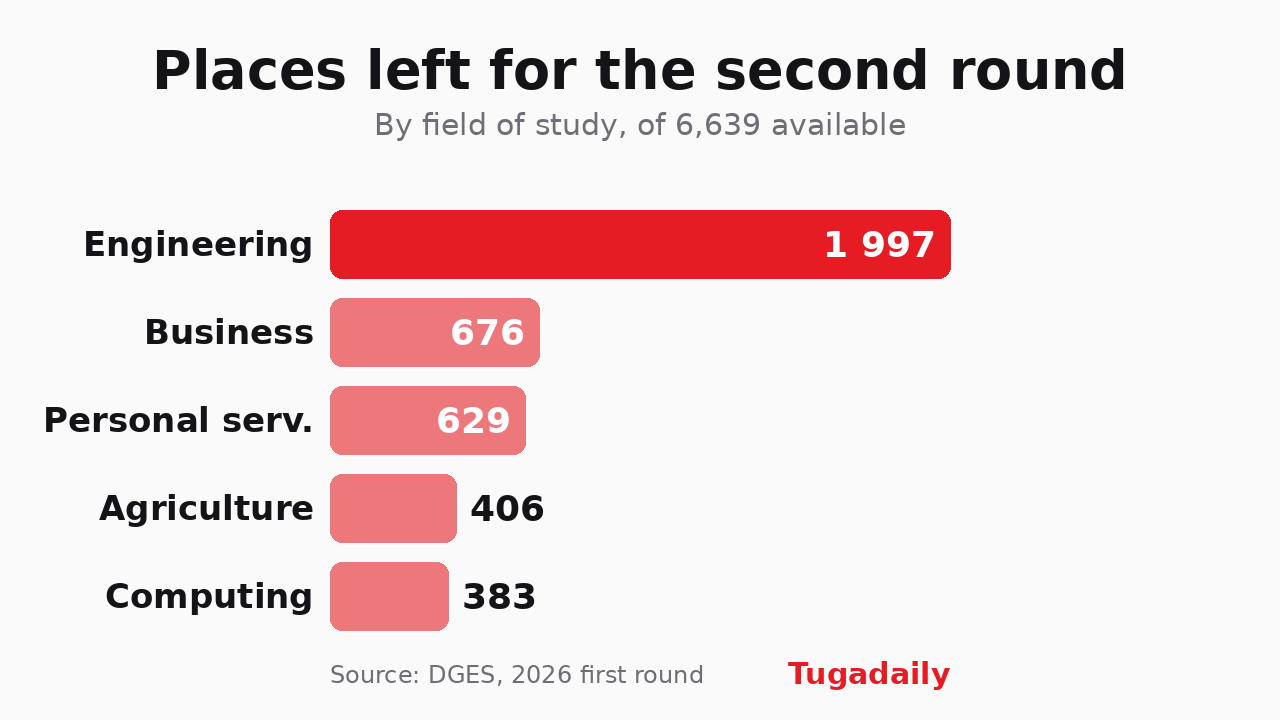
Entirely depends on the course and the institution. Second-phase places are whatever the first round left over, plus any freed up by students who did not enrol. In practice, high-entry-grade courses at the big universities often come into the second phase with very few places or none, while institutions outside the major cities and less oversubscribed courses open up real room.
That is not necessarily bad news. Plenty of people who got in on the second phase in a city they had not considered discovered the experience was better and the cost of living rather more survivable — not least because finding a room in Lisbon or Porto in September is an extreme sport.
What should you do before 24 August?
Three concrete things. Review last year’s entry grades by course and institution, so you calibrate rather than gamble. Confirm the entrance exams each option requires, because not every combination works. And have the application ready on the platform before the opening day, so you do not spend day one hunting for a password.
Deadlines, places and the course list are published by the Directorate-General for Higher Education, which is the official source and the only one that matters when someone in the group chat swears they heard otherwise.
Ten days. Plenty of time to think it through — as long as the thinking starts before the 24th.
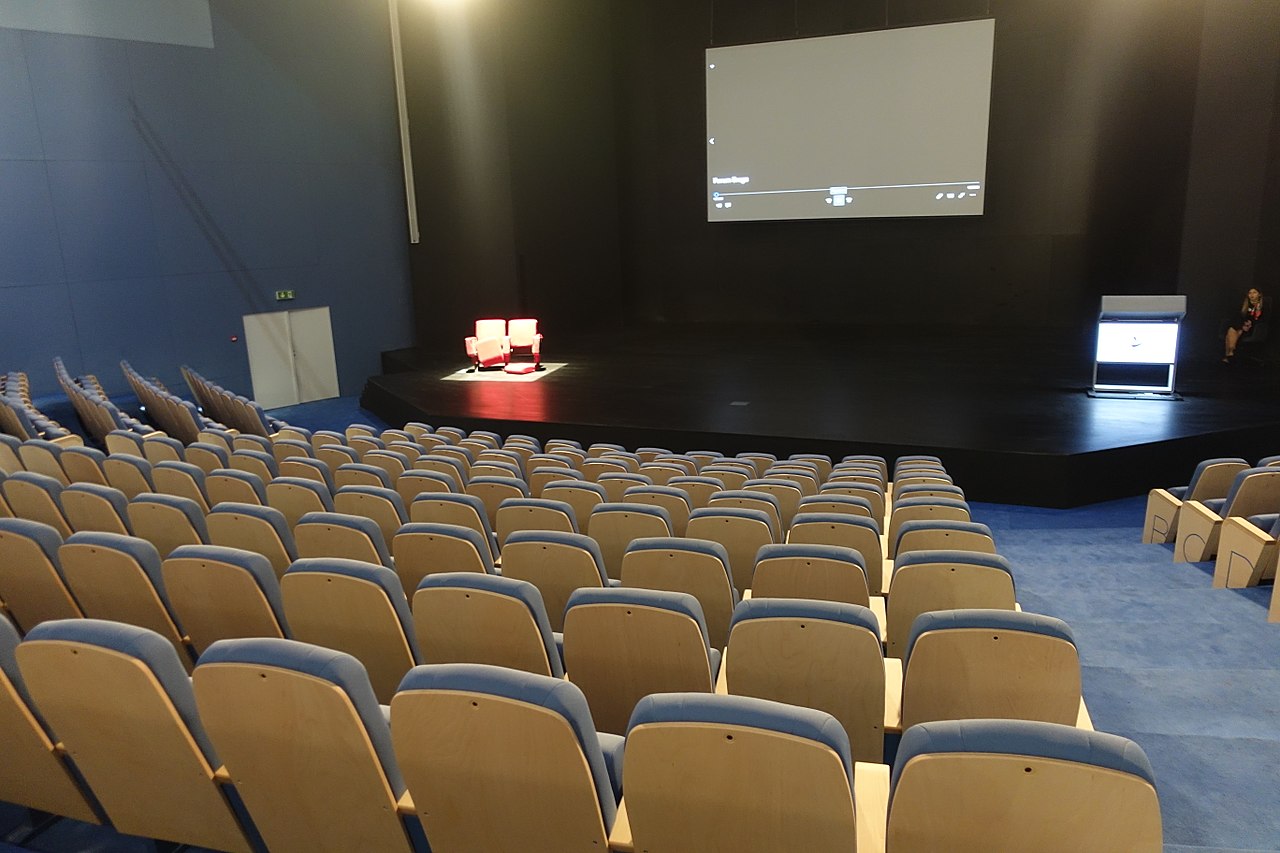
Image: Gerd Eichmann / Wikimedia Commons (CC BY-SA 4.0)