
Is your Portuguese bonus tax-free? Only if your employer raised pay this year
Up to 6% of annual base salary escapes both income tax and social security in 2026. The ceiling counts fourteen months rather than twelve, and tax is withheld anyway when the bonus lands.
A performance bonus in Portugal can reach you without a cent of income tax on it. Whether it does is largely out of your hands.
The rule works like this: up to 6% of annual base salary, productivity and performance bonuses, profit shares and balance-sheet gratuities are exempt from IRS and sit outside the social security contribution base, provided they are paid voluntarily and without regular character. Anything above the 6% line is taxed the way it always was.
Fourteen months, not twelve
So what is that ceiling actually worth? This is the part that rarely gets spelled out.
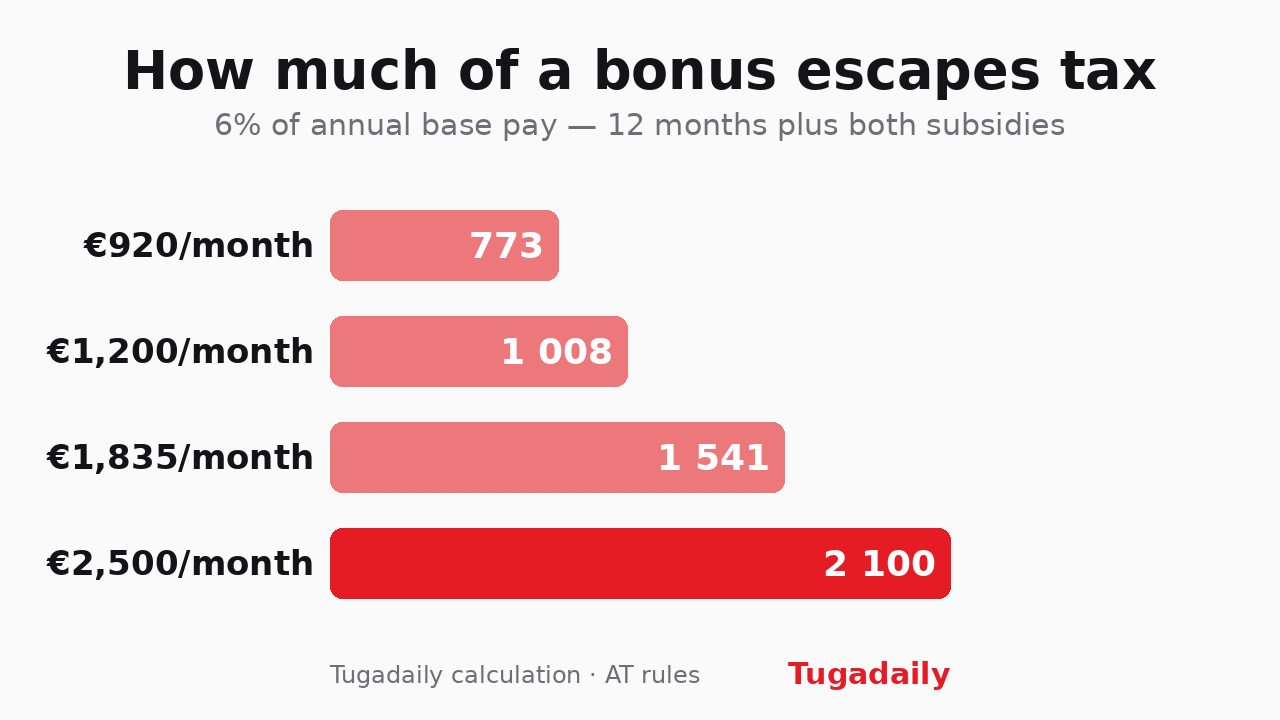
The tax authority has clarified that “annual base salary” is not twelve months of pay. It is fourteen — base salary across the year plus the Christmas and holiday subsidies, both of which are compulsory in Portugal. On a base of 920 euros, the minimum wage in force this year, that comes to 12,880 euros of annual base pay and a tax-free ceiling of 773 euros. Someone near the average pay of 1,835 euros has a ceiling of 1,541 euros.
The authority itself, quoting the government programme the measure came from, describes it as the equivalent of a fifteenth month.
The condition sits with your employer
Here is what decides it. The exemption applies only if, in that same year, the employer made a qualifying pay rise under article 19.º-B of the tax benefits statute.
Raising your salary alone does not do it. The article asks for two things at once: the company’s average annual base pay has to rise against the end of the previous year, and the staff who were earning below that average have to get a rise too. In 2025 the bar was 4.7% on both counts. For 2026 it eased slightly, to 4.6%.
Which means two people doing the same job for the same bonus at different companies can end up on opposite sides of the line. One pays nothing. The other pays in full.
One clarification did loosen things. The social concertation agreement that created the measure referred to employers covered by a collective bargaining instrument signed or updated within the previous three years. In 2026 the tax authority said the income-tax exemption does not depend on that.
You will still see the deduction
Brace yourself for the payslip. Even where the bonus ends up exempt, tax is withheld in the month it is paid, at the rate applying to that month’s employment income.
The reason is mundane. Paying a bonus in March, a company cannot yet know whether it will finish the year having cleared 4.6%. It only knows at year end. If it did clear the bar, it then files replacement declarations marking the exempt amounts under code A41 — and the authority states plainly that no penalty attaches to that correction.
The money comes back later, in the annual tax settlement.
FAQ
Does the bonus have to be in my contract to qualify?
No, and the opposite is closer to the truth. It has to be paid voluntarily and without regular character. If it is something you are contractually entitled to, or awarded on preset criteria you can count on, it falls outside the exemption.
How do I know whether my employer met the condition?
The annual income statement your employer gives you has to say expressly that the qualifying pay rise was met, and identify how much of what you received is covered. If that statement is missing, the exemption did not apply.
What if the bonus is worth more than 6%?
Only the portion up to the ceiling is exempt. The excess stays employment income and is taxed normally.
Does the exemption cover social security too?
Yes. Amounts within the limit are excluded from the contribution base, so no social security is deducted on them either.
Chart: Tugadaily · own calculation on the Portuguese tax authority's rule