
Portugal's fishing fuel rebate is open, and your gear and boat length set the rate
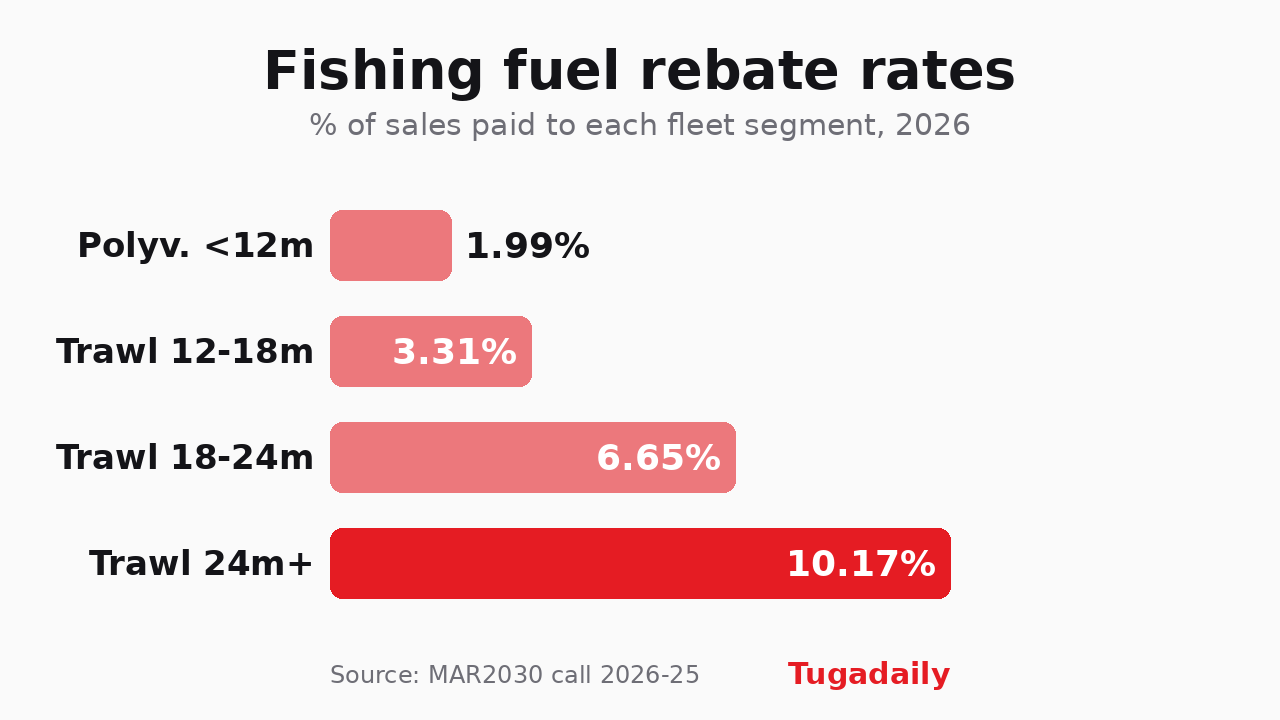
The pot is 18 million euros and applications close at 6pm on 12 October. The rate runs from 1.99% of sales for a polyvalent boat under 12 metres to 10.17% for a trawler of 24 metres or more.
Apply / Learn moreIt opened on 11 September and closes at 6pm on 12 October. In between, fishing, aquaculture and fish-processing companies operating on the Portuguese mainland can claim compensation for this year’s jump in fuel prices. The government announced 18 million euros and said the amount depends on the fleet segment and the size of the vessel. It is worth spelling out what that means, because the gap between one boat and another is fivefold.
The sum is not based on the fuel you bought
This is the part that catches people out. The rebate is not worked out from your fuel invoices. It is a fixed rate applied to the sales you recorded during the eligible window, which runs from 28 February to 31 December 2026.
That rate comes from two numbers multiplied together: the historic weight of fuel in the sales of your fleet segment, and the official price increase measured by the energy regulator DGEG between March and June, which was 27.9% for marked diesel, 23.3% for ordinary diesel, 14.5% for petrol and 10.7% for LNG.
The output is a table of four length bands and three gear types. A polyvalent boat under 12 metres gets 1.99% of sales, because fuel is 7% of that segment’s turnover. A trawler of 24 metres or more gets 10.17%, because there fuel is 36%. In between, trawlers of 12 to 18 metres get 3.31% and 18 to 24 metres 6.65%. Purse seiners sit between 2.46% and 3.63% whatever their size.
Where the 18 million goes
The pot splits into 13 million for fishing, 4.5 million for processing and marketing and 500,000 euros for aquaculture. Of that total, 12.6 million comes from the EU’s EMFAF fund and 5.4 million from the national budget.
That 70% appears in the call as the maximum co-financing rate, and it is easy to read backwards. It is not a rate that leaves the company to fund the other 30%: it is Brussels’s share of the public money. The public support rate is 100%.
Who is left out
There is one application per company and it has to cover every vessel the company operates on the mainland, provided they held a 2026 fishing licence. Among aquaculture businesses, only those running fossil-fuel boats qualify. Among processing plants, only those with their own combustion-engine transport fleet or that use LNG. The Azores and Madeira get their own separate calls.
Payments come in stages. The first, due at the end of November, covers the March to June increase; the second, for July to September, is recalculated by the managing authority using the price rise actually recorded in those months. Applications go through the Balcão dos Fundos portal.
It is the same design as the farm-diesel scheme, and it carries the same limitation: Portugal also cut fuel duty this month and stopped collecting 9.8 cents a litre on diesel, but none of these measures changes the price on the pump display. They are refunds, calculated afterwards, for whoever remembers to claim them.
Chart: Tugadaily, with data from call MAR2030-2026-25