
PT
The Calouste Gulbenkian Foundation headquarters in Lisbon, seen from the garden
Opportunities 18 September 2026

The Gulbenkian New Talents grant closes on 30 September (your referees get another week)

Applications shut at 15:00 Lisbon time on 30 September, while recommendation letters are due on 6 October. The entry bar is a 16.5 average with no rounding.

Organizer
Calouste Gulbenkian Foundation
Deadline
30 September 2026
Apply / Learn more

One detail about the Gulbenkian New Talents scholarships rescues a good share of the late applications every year, and hardly anyone says it out loud. There are two deadlines, not one.

The applicant’s own form closes at 15:00 Lisbon time on 30 September. Recommendation letters work differently: the Foundation requests them directly from whoever you name in the references field, and they are not due until 15:00 on 6 October. So if you are putting off applying because you have not yet asked the lecturer who will vouch for you, you are putting it off for the wrong reason. Submit first. Ask afterwards.

Who qualifies

The programme looks for unusually strong undergraduates in Portuguese higher education, and the gate is a number. You need a 16.5 average or better, with no rounding, across the units you have already completed. You also need to be enrolled in 2026/27 in the second, third or fourth year of a licenciatura or integrated master’s, or in the first year of a master’s, at an institution in Portugal.

The fields are wide. Basic sciences on one side, meaning biology, geology, physics, mathematics and chemistry, and then any area of the humanities, the arts or the social sciences. You may apply to one of them, not two. International students are eligible if they are enrolled at a Portuguese institution and speak Portuguese, because the programme runs in that language. Students here on exchange are not.

What it pays

The scholarship runs for 12 months, usually starting in November and ending a year later at a public science event. The annual figure comes in three parts, and not everyone gets the third: 1,000 euros towards training and research costs tied to continuing study; 1,500 euros for talent enrichment, covering advanced training, conferences, summer schools, placements or lab materials, each signed off by the scientific committee; and 2,000 euros of supplementary social support, restricted to households with annual per-capita income up to 14,000 euros and evidenced by an application to the DGES social-action grant.

The money is not really the point. What comes with it is a tutor, a scientific committee of established academics, and retreats at the Foundation’s own premises that mix research work with a cultural programme. For an undergraduate, it is usually the first time anyone has treated them as a researcher.

Before you hit submit

The application is online and in Portuguese, and you have to create an account on the Foundation’s site first. Read the regulations before you start rather than after. You will need a screenshot of your university student platform with your name visible, not a certified declaration, which saves a trip to the registry office. Letters may be written in English and must come from university lecturers or researchers, never from secondary-school teachers.

If this is not your call, the Foundation keeps other lines open through the year, including the internationalisation grant that pays up to 5,000 euros to take your work abroad, which runs on very different rules.

Quick questions

Can I apply to two fields? No. One only, chosen on the form.

What if my average is 16.4? You are out. The regulations say explicitly that there is no rounding.

Do I need a social-action grant? Only for the 2,000-euro component, and then you must show your DGES application.

When do I hear back? The scholarship normally starts in November 2026, so the decision lands before then.

By Miguel Sarmento

Image: Gabriel de Andrade Fernandes / Wikimedia Commons (CC BY-SA 2.0)
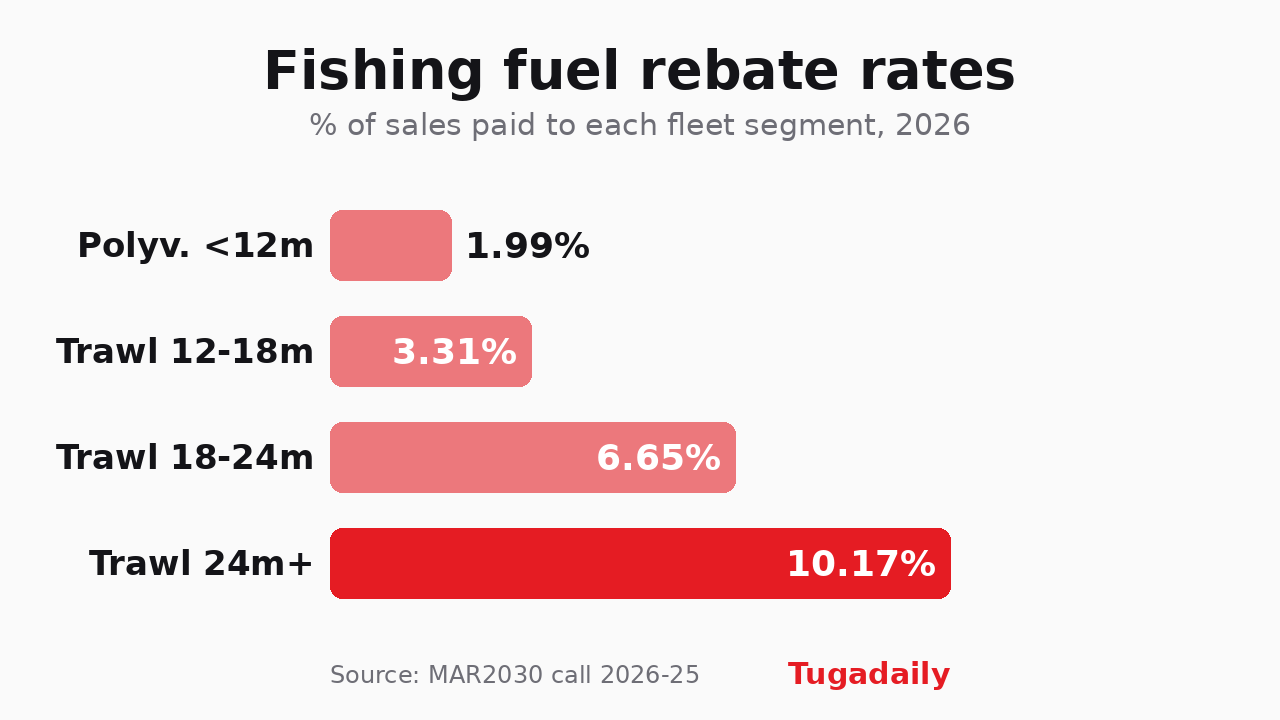
Bar chart of the percentage of sales paid to each segment of the Portuguese fishing fleet under call MAR2030-2026-25, from 1.99% for a polyvalent boat under 12 metres to 10.17% for a trawler of 24 metres or more
Opportunities 15 September 2026

Portugal's fishing fuel rebate is open, and your gear and boat length set the rate

The pot is 18 million euros and applications close at 6pm on 12 October. The rate runs from 1.99% of sales for a polyvalent boat under 12 metres to 10.17% for a trawler of 24 metres or more.

It opened on 11 September and closes at 6pm on 12 October. In between, fishing, aquaculture and fish-processing companies operating on the Portuguese mainland can claim compensation for this year's jump in fuel prices. The government announced 18 million euros and said the amount depends on the fleet segment and the size of the vessel. It is worth spelling out what that means, because the gap between one boat and another is fivefold.

Continue reading
Official card for Portugal's National Entrepreneurship Strategy 2030, carrying the Startup Portugal ENE 2030 logo.
Opportunities 14 September 2026

Run a startup in Portugal? The policy agenda to 2030 is being written right now

Startup Portugal has two questionnaires open, one for startups and one for incubators, and the answers feed straight into the ENE 2030 diagnosis. The final strategy lands at the end of this year.

There is a practical difference between complaining about stock-option taxation at a conference and having that complaint land inside a document that later sets policy. Right now, and not for long, the second route is open. Startup Portugal is building the National Entrepreneurship Strategy 2030, the document that will set the public-policy agenda for entrepreneurship in Portugal across 2026-2030. The process is currently in its diagnosis phase, which…

Continue reading
A CGTP national demonstration in Lisbon, retail, office and services workers marching behind banners demanding decent working hours
Opportunities 12 September 2026

The figure the CGTP now wants for 2027 is the government's own target for 2029

Portugal's tripartite agreement puts the minimum wage at 970 euros in 2027 and 1,020 in 2028. The CGTP wants 1,100 from 1 January 2027, and has called a national demonstration for 17 October.

Back in July, when we last wrote about this, the CGTP was asking for a 1,050-euro minimum wage in 2027. Its national council met on Friday and the number moved up: it is now 1,100 euros, from 1 January 2027. Fifty euros does not sound like much of a shift in a union demand. But 1,100 is not a round figure picked at random, and that is where it gets interesting. It is the number the government itself wrote into its programme as the target for 2029.

Continue reading
Entrance sign of Taguspark, the science and technology park in Oeiras where the PME Pitch final is held
Opportunities 10 September 2026

Portugal's SME pitch prize gives you three minutes and €5,000. Entries close on 16 October

The second PME Pitch awards are open to startups incorporated in Portugal within the last ten years, and to teams whose project exists only on paper. The final is at Taguspark on 28 October.

Three minutes is not long to explain a business to people who have never heard of it. That constraint is the whole point of the second edition of the PME Pitch awards, which take applications until 16 October. The winner gets €5,000, handed over as a symbolic cheque at the closing ceremony of the Fórum PME Magazine. The final runs on 28 October at Taguspark in Oeiras, and each finalist walks on stage with those three minutes and nothing else. Slides,…

Continue reading
Entrance to the EUIPO headquarters in Alicante, with the row of EU member state flags lined up in front of the building
Opportunities 8 September 2026

The EU's SME Fund has run out of trade mark money. Patents are still open

The EUIPO has closed its two most popular vouchers — IP Scan, and trade marks and designs — because the money ran out. Patents and plant varieties still take applications until 4 December, or until they go the same way.

Small firms put off registering a trade mark for the same reason every time: it looks like something you do once you already have money. The European scheme built to undo that calculation has just closed that particular door. The EU SME Fund, the grant scheme the EUIPO runs for small and medium businesses, has stopped taking applications for IP Scan and for trade marks and designs — its two most popular vouchers — because the money set aside for each of…

Continue reading
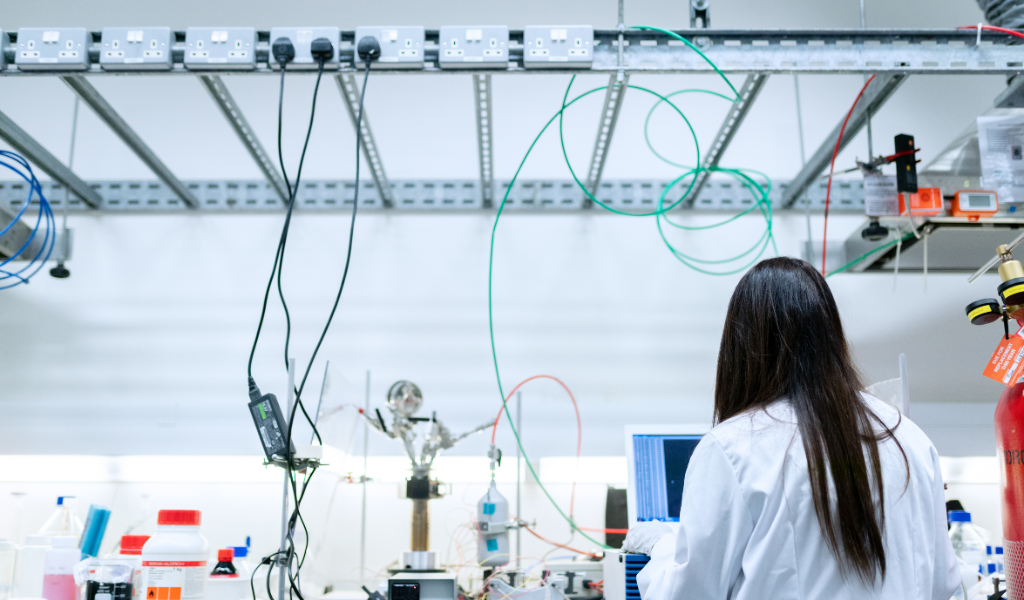
A researcher in a white coat at work in an industrial laboratory, in the image Portugal 2030 published with its productive innovation call
Opportunities 6 September 2026

€182.5m is on the table for Portuguese SMEs, and the window shuts on 30 September

Portugal 2030's MPR-2026-6 call closes at 5pm on 30 September. Of the total, €71m is ring-fenced for low-density areas and €111.5m for the rest of the mainland. Applications go through the Balcão dos Fundos.

There is a Portugal 2030 call closing on 30 September, and the pot is one of the year's biggest for companies: €182.5 million in non-repayable funding for innovative productive investment by micro, small and medium-sized firms. It is called notice MPR-2026-6, it sits inside the SICE incentive system, and it is a joint call from COMPETE 2030 and the mainland regional programmes. It opened on 15 June and applications close at 5pm on 30 September.

Continue reading
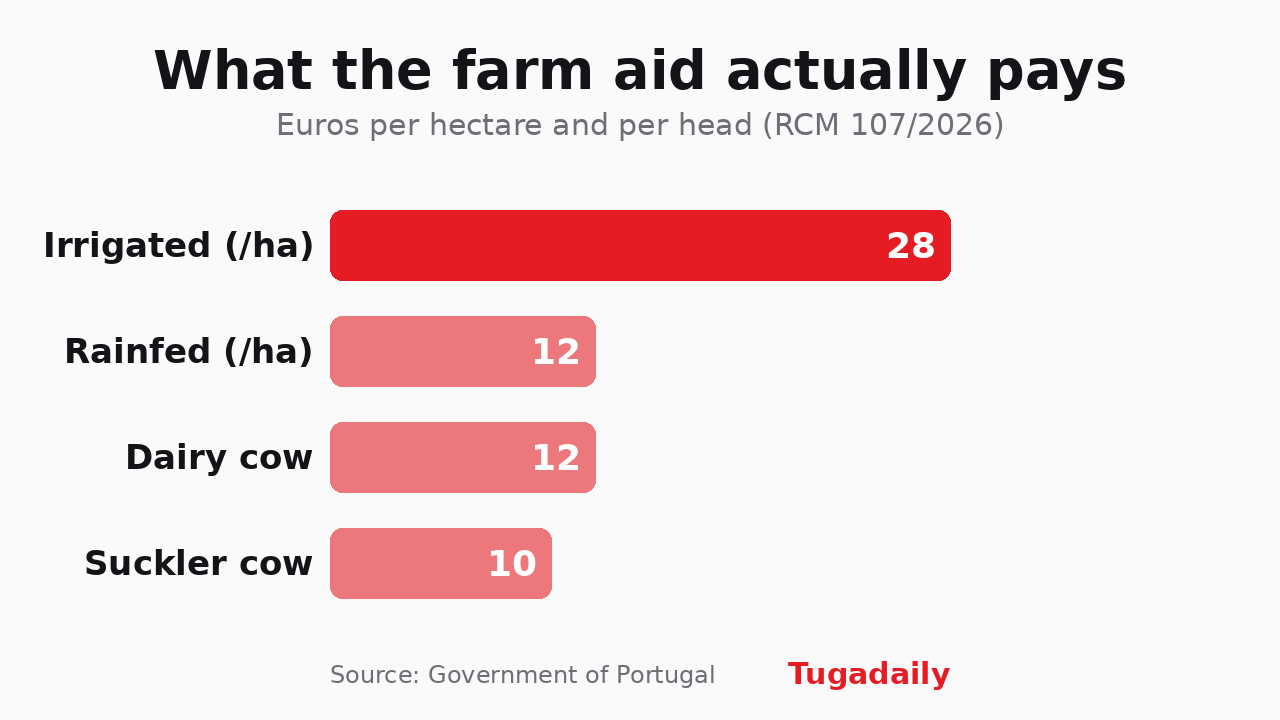
Tugadaily chart: €28 per irrigated hectare, €12 rainfed, €12 per dairy cow and €10 per suckler cow
Opportunities 2 September 2026

Farming in Portugal? Brussels just cleared the aid that pays €28 a hectare

The European Commission approved a €30 million Portuguese scheme for farming, fishing and aquaculture on Wednesday. IFAP has to pay every cent of it by 31 December.

The European Commission signed off on Wednesday on a €30 million Portuguese state aid scheme for farming, fishing and aquaculture businesses. It was the last formal step, taken under the temporary framework created in response to the Middle East crisis and the fuel and fertiliser prices it pushed up. For anyone actually working the land, the approval is not the interesting part. The rates are. The farming side has been mapped out since June, in Council of…

Continue reading
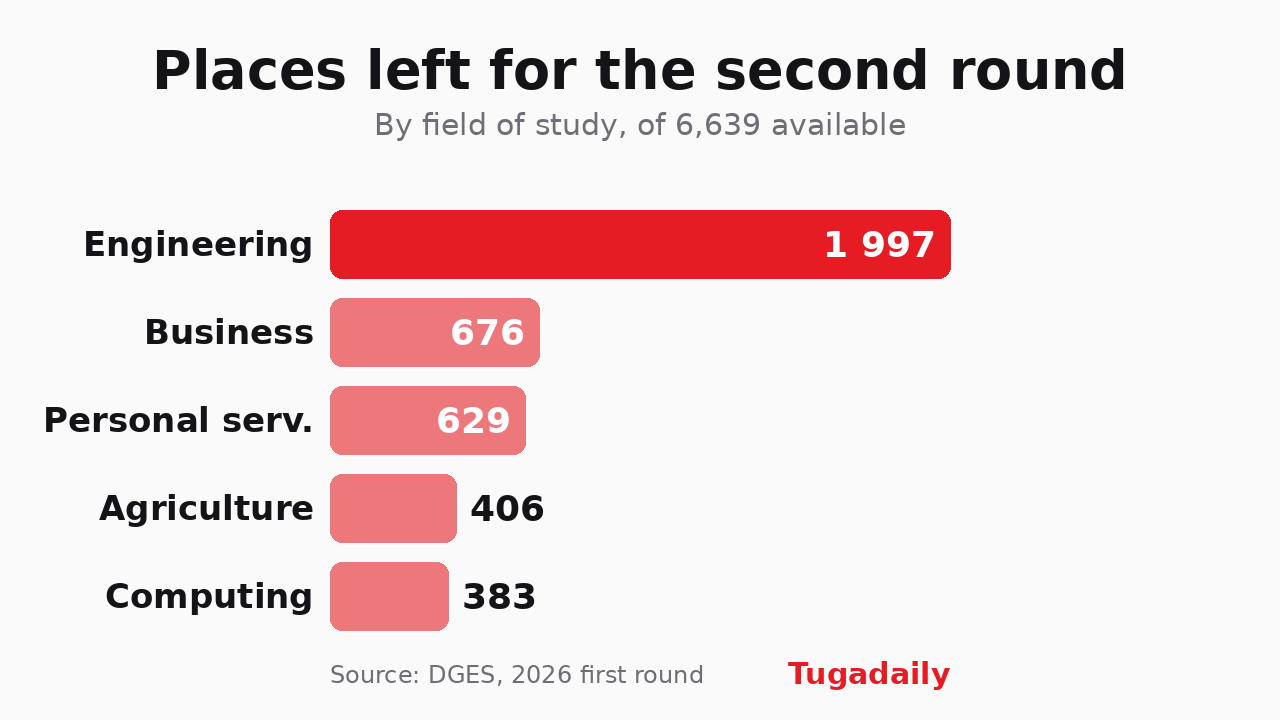
Bar chart of first-round places left over by field of study: engineering 1,997, business 676, personal services 629, agriculture 406, computing 383
Opportunities 1 September 2026

1,997 of Portugal's 6,639 leftover university places are in engineering

The second-round total everyone quoted is not the final one. DGES publishes today the first-round seats nobody enrolled in, and applications stay open until 20 September.

Everyone printed the same figure: 6,639 places going into the second round. It is accurate and it is incomplete. The DGES note itself says the September round also takes in the seats that were awarded in August but never enrolled against, and that those numbers are only published today, 1 September, on the agency's website. Which means anyone weighing up whether to apply spent last week looking at a total that is about to grow. Once today's list is out,…

Continue reading
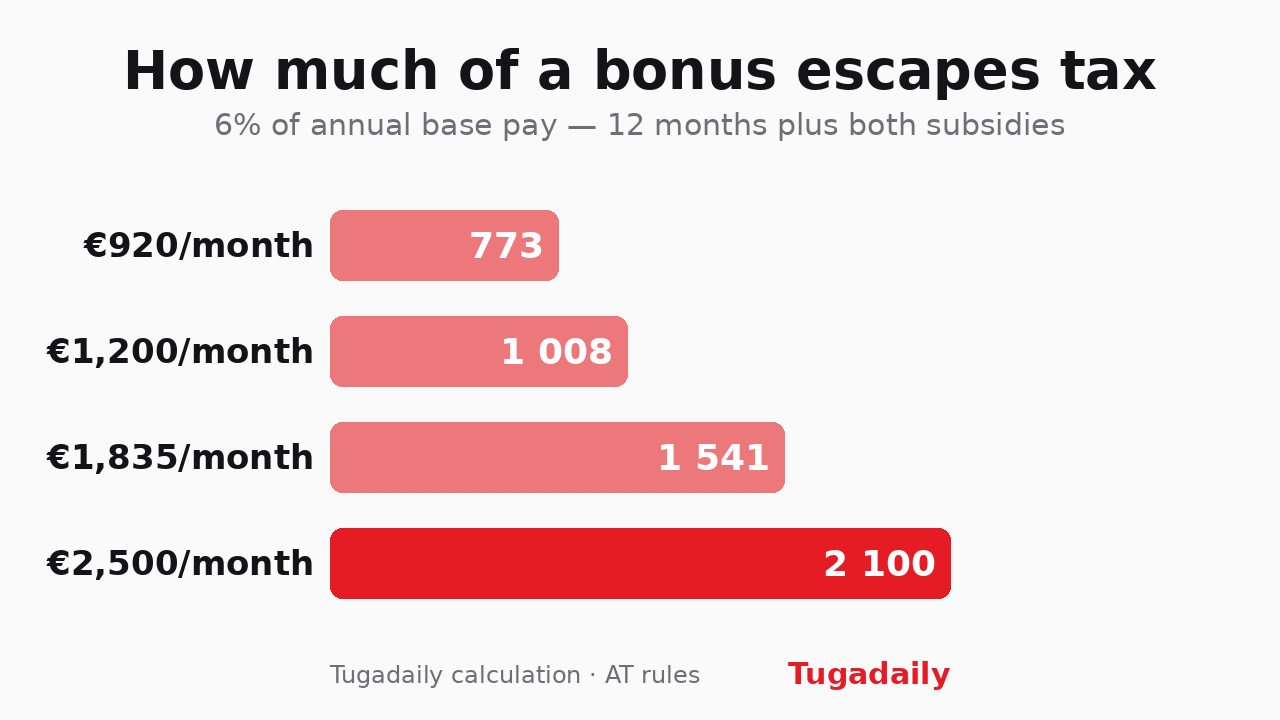
Bar chart of the tax-free bonus ceiling by monthly base salary in Portugal: 920 euros a month gives 773 euros exempt, 1,200 gives 1,008, 1,835 gives 1,541 and 2,500 gives 2,100
Opportunities 29 August 2026

Is your Portuguese bonus tax-free? Only if your employer raised pay this year

Up to 6% of annual base salary escapes both income tax and social security in 2026. The ceiling counts fourteen months rather than twelve, and tax is withheld anyway when the bonus lands.

A performance bonus in Portugal can reach you without a cent of income tax on it. Whether it does is largely out of your hands. The rule works like this: up to 6% of annual base salary, productivity and performance bonuses, profit shares and balance-sheet gratuities are exempt from IRS and sit outside the social security contribution base, provided they are paid voluntarily and without regular character. Anything above the 6% line is taxed the way it…

Continue reading
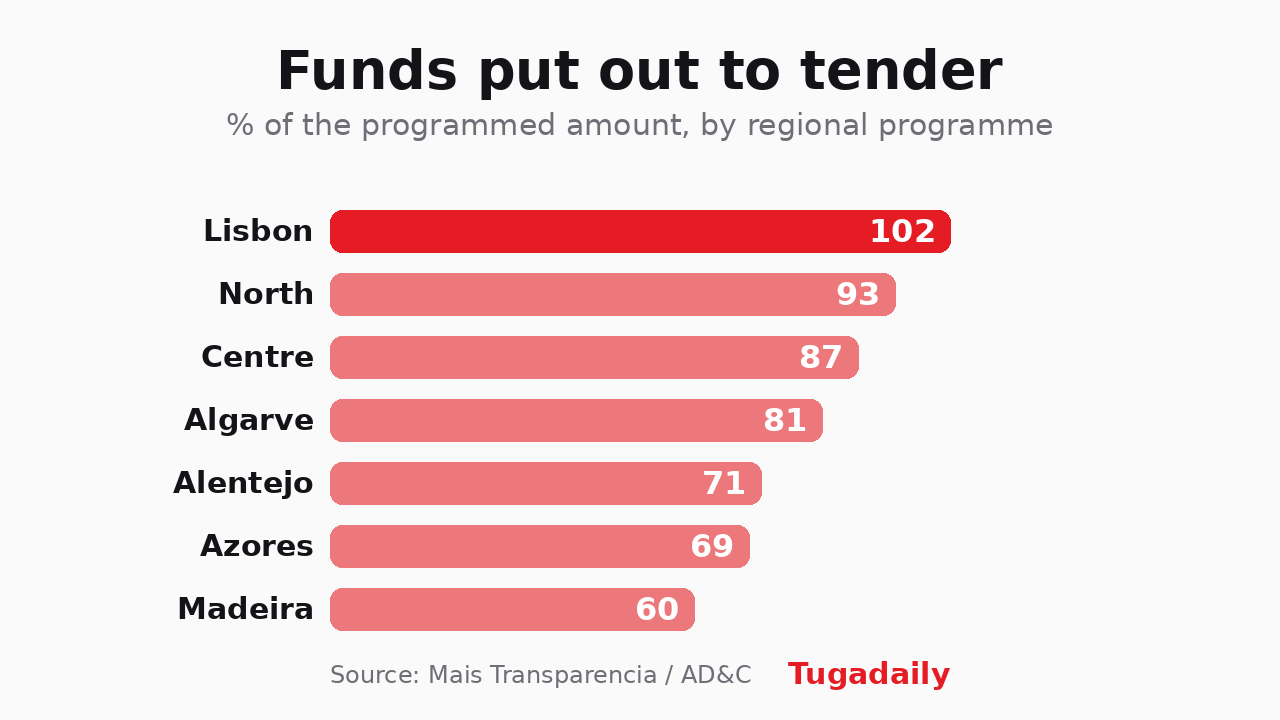
Bar chart of the share of programmed Portugal 2030 money already put out to tender by regional programme: Lisbon 102%, North 93%, Centre 87%, Algarve 81%, Alentejo 71%, Azores 69%, Madeira 60%
Opportunities 27 August 2026

€2.5bn of Portugal 2030 money has not been put out to tender yet

Government transparency data shows 20.5 of 23 billion euros advertised across 1,467 calls. Madeira sits at 59.57% of its programmed envelope and the Azores at 68.95%, against 101.83% in Lisbon.

Every time another Portugal 2030 call opens, one question goes unasked: how much of the total has actually been advertised, and how much is still sitting there. The government's own transparency portal answers it. Of the 23 billion euros programmed under Portugal 2030, 20.5 billion has been put out to tender across 1,467 published calls. That leaves roughly 2.5 billion that has not yet reached an application form. The figures come from AD&C and are…

Continue reading
Copernicus Sentinel-2 satellite image of the Portuguese coast on 31 January 2026, marking sediment plumes and flooded areas after Storm Kristin
Opportunities 26 August 2026

Portugal just widened the Kristin overtime rules to cover all five months of the emergency

A decree approved on 20 August extends the exceptional overtime regime to the entire Kristin calamity period, 28 January to 28 June, and puts central government, municipal and state-owned company staff under one set of rules.

If you spent January nights clearing drains, reopening roads or answering phones in a council office while the water rose, you worked well past your hours. What stayed unresolved for months was how those hours would be paid — and whether the answer changed depending on which employer's badge you happened to be wearing. The Council of Ministers settled it on 20 August. A decree-law was approved amending the regime for overtime worked in response to Storm…

Continue reading
The flag of Australia
Opportunities 25 August 2026

Australia has paused Work and Holiday visas for Portuguese applicants

The subclass 462 visa now shows as paused on the Australian Home Affairs site, with Portugal one of 24 countries affected. A pause is not a closure, and the annual quota for Portugal is only 500 places.

Anyone planning a year in Australia got unwelcome news this week. The Work and Holiday visa for Portuguese citizens now shows as paused on the Australian Department of Home Affairs website. Portugal is one of 24 countries whose subclass 462 has been put on hold, a status published on the official country caps page. The Australian embassy in Lisbon confirmed it and pointed to the number that explains most of it: the annual quota for Portuguese applicants…

Continue reading
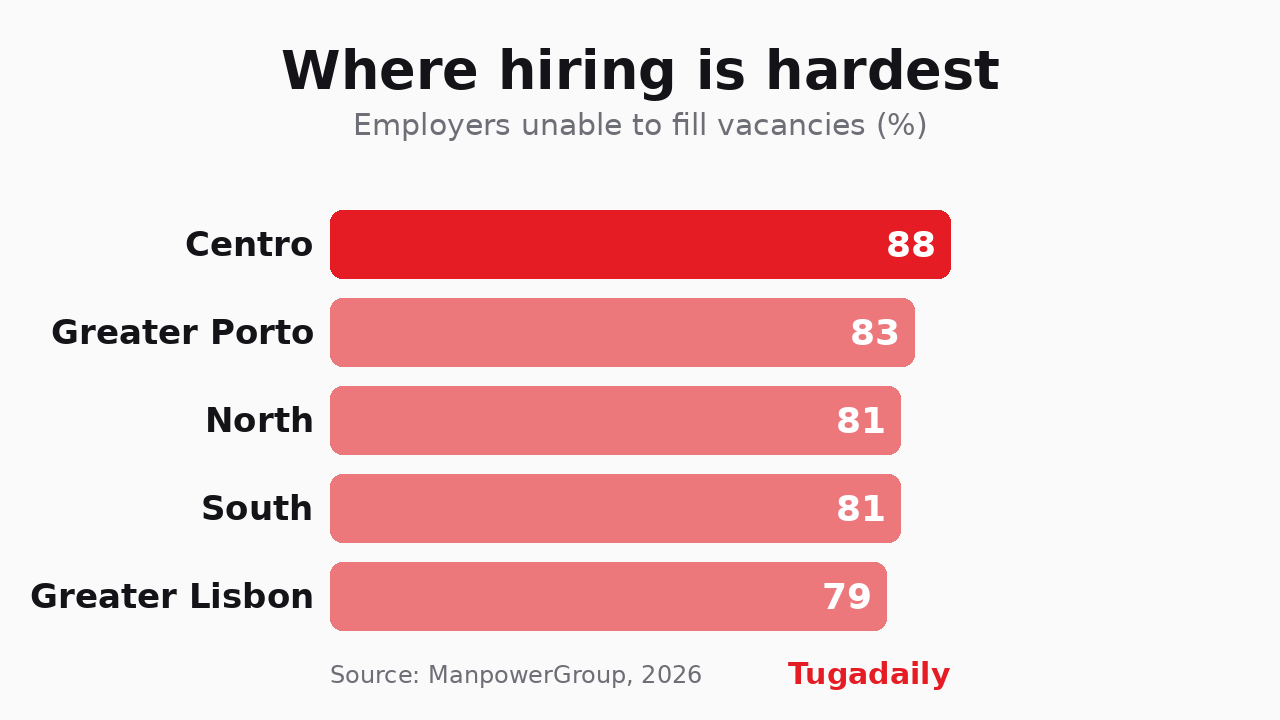
Tugadaily chart of the share of employers unable to fill vacancies by region: Centro 88, Greater Porto 83, North and South 81, Greater Lisbon 79
Opportunities 25 August 2026

Where in Portugal is it hardest to hire? Not Lisbon, and not Porto either

ManpowerGroup's 2026 talent shortage study puts the Centro region at 88% of employers unable to fill vacancies, against 79% in Greater Lisbon. Nationally the figure is 82%, the fifth highest in the world.

Job hunters tend to assume the openings are all in Lisbon. Employers report something close to the opposite. Companies in central Portugal complain hardest about not finding people, and the gap to the capital runs to nine percentage points. The figures come from ManpowerGroup's 2026 talent shortage study, built on a survey of more than 39,000 employers across 41 countries. In the Centro region, 88% of organisations say they cannot fill their vacancies.…

Continue reading
The front of a CTT post office on a cobbled street in a Portuguese town, the red postal sign clearly visible
Opportunities 24 August 2026

Your Portuguese savings certificates are about to stop following Euribor upwards

The Series F base rate tracks three-month Euribor, but the IGCP term sheet caps it at 2.5%. Three-month Euribor traded at 2.507% on 22 August, which puts it above the ceiling for the first time.

Portugal's most popular savings product has a brake written into its own term sheet. Euribor has just reached it. Nobody sits in a room deciding the base rate on Series F savings certificates. It is the average of three-month Euribor over the previous ten business days, rounded to three decimal places. But the same IGCP term sheet that sets out that formula adds a line that rarely makes the coverage: the base rate may not be higher than 2.50% or lower…

Continue reading