
Working this Saturday's public holiday in Portugal? Your employer picks how you get paid back
15 August falls on a Saturday this year. Anyone working it at a company that stays open is owed either compensatory rest worth half the hours or a 50% pay uplift, and article 269 of the Labour Code hands the choice to the employer, not the worker.
The Feast of the Assumption, 15 August, is one of Portugal’s mandatory public holidays, and this year it lands on a Saturday. For plenty of people that changes nothing at all. For anyone who works Saturdays it changes quite a lot, and what the law actually hands you is thinner than most people assume.
Start with the misunderstanding that causes the most office arguments. A public holiday falling on a day you would not have worked anyway does not buy you a day off somewhere else. Nothing rolls over to Monday. If your weekly rest days are Saturday and Sunday, 15 August passes you by with no practical effect, unless your individual contract or your sector’s collective agreement says otherwise in writing. Some of them do, so it is worth reading yours.
What if I actually work that day?
Here the law is short and unambiguous. The default on a mandatory holiday is that companies close, with an exception for sectors whose activity cannot stop, which in practice covers healthcare, transport, restaurants, hotels, pharmacies, security and a good slice of summer retail.
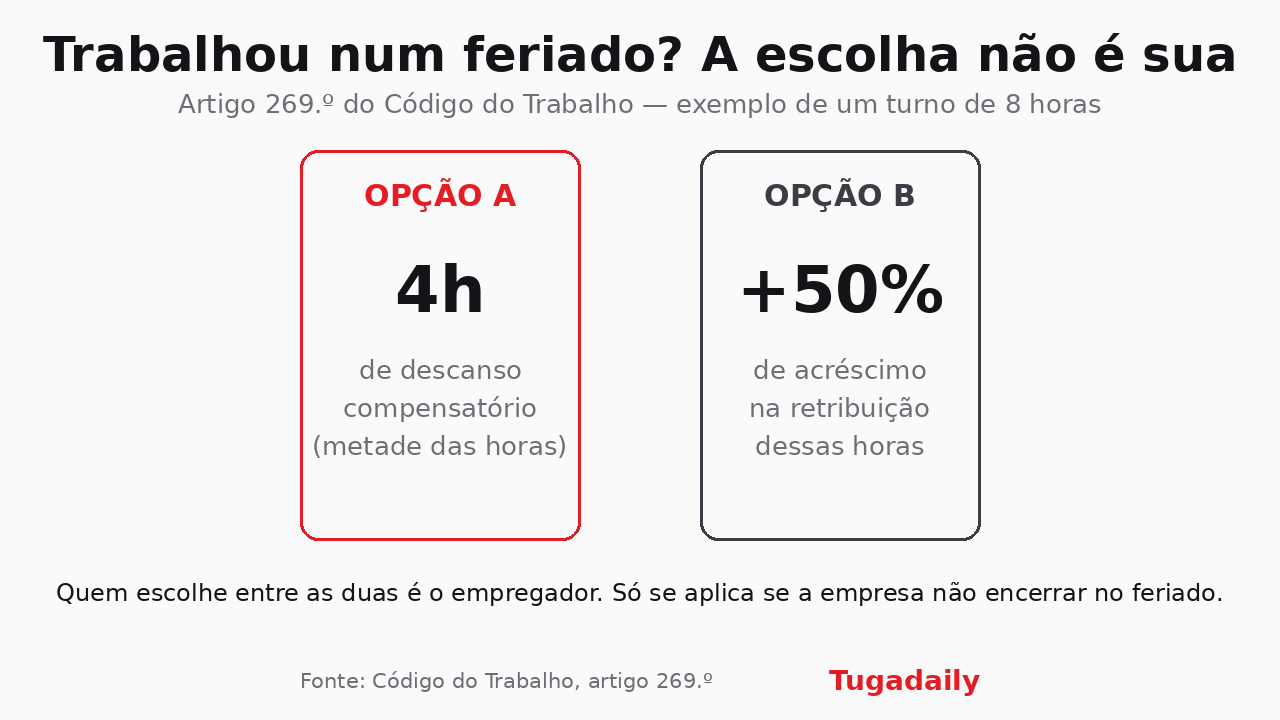
If you work a holiday at a company that is not required to shut, article 269 of the Labour Code gives you one of two things: compensatory rest lasting half the hours you worked, or a 50% uplift on the pay for those hours.
On an eight-hour shift that means four hours off to take later, or those eight hours paid with half again on top.
Then comes the part almost nobody knows. The choice between the two belongs to the employer. It is not the worker’s option, it is not negotiated shift by shift, and it does not depend on which suits you better. The company decides, and its decision stands as long as it applies one of the two.
What your employer cannot do
It cannot dock the holiday. You are entitled to pay for a public holiday, and your employer may not offset that pay against extra work, which in plain terms means nobody can ask you to make the hours back on another day as though you owed them.
It also cannot simply ignore the article. Breaching 269 is classed as a serious administrative offence, and that is the basis on which you complain to the Autoridade para as Condições do Trabalho, the labour inspectorate.
One boundary worth marking. Everything above concerns normal work performed on a holiday. If the hours you worked that day were also overtime, the separate overtime rules apply on top of these, not instead of them. If that is your situation, check your payslip for which of the two you were actually given, because it is common for only one to show up.
And if the weekend is rest rather than rota, there is a great deal going on around the country across the three days.
Chart: Tugadaily · data from the Portuguese Labour Code, article 269