
PT
The debating chamber of Portugal's parliament in the São Bento Palace
Politics 10 July 2026

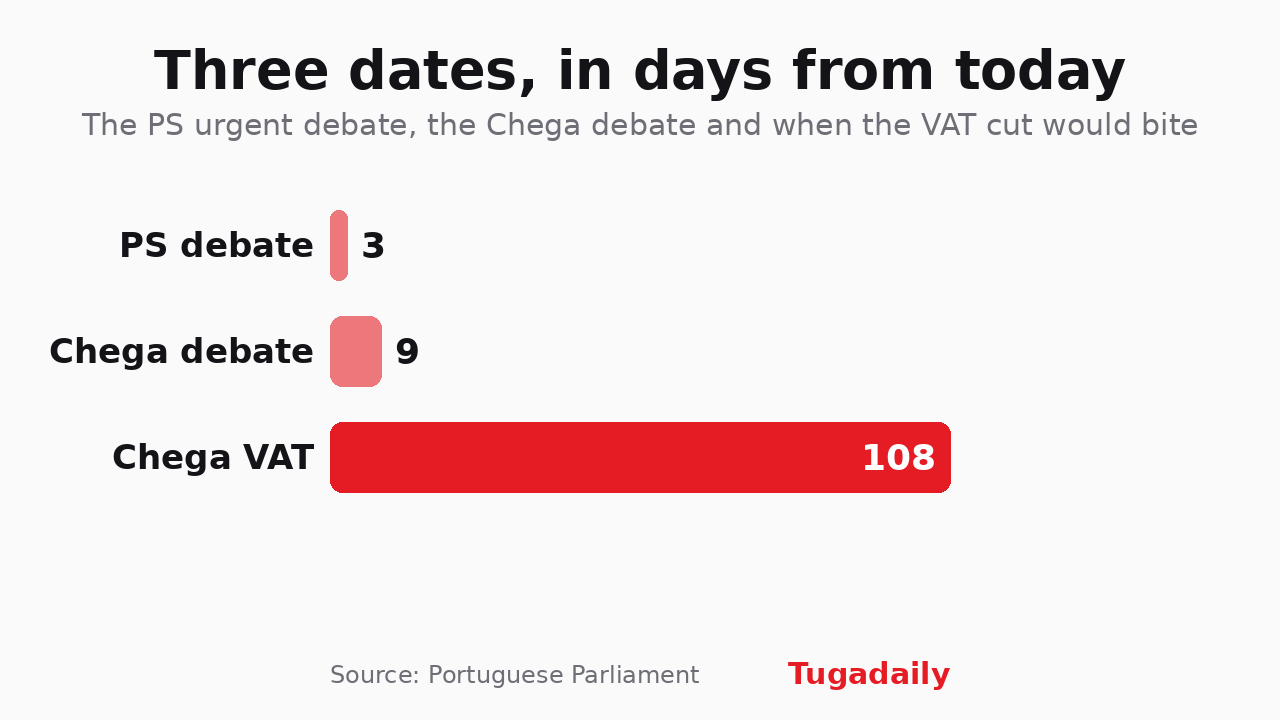
State of the Nation debate: Portugal's parliament sets its big showdown for July 16

Portugal's state of the nation debate takes place on July 16 — the last major political clash in parliament before the summer recess. Here's what to expect.

Portugal’s state of the nation debate is set for July 16, and it’s the last major political clash in parliament before the summer recess. In a week when the country is split between the heatwave and the World Cup, São Bento is gearing up for the moment when government and opposition tally up the political semester — out loud, with the country watching.

When is the state of the nation debate?

Thursday, July 16, in parliament. It’s an annual ritual set out in the house rules: the prime minister presents the government’s reading of where the country stands, then takes questions from every parliamentary group, largest to smallest. No votes can bring down a government here — what’s at stake is the most-watched political scorecard of the parliamentary year.

What’s at stake this year?

The tone was set during the warm-up. The governing AD coalition arrived via parliamentary away-days under the banner “Governing with results”, with Montenegro praising the “serenity” of the PSD and CDS benches and accusing the opposition of “reckless” decisions. On the other side, the Socialists and Chega will try to turn the scorecard into a trial — from EU recovery-fund execution to housing and health, plus Montenegro’s second-term agenda, which includes the pledge to hit 3.1% of GDP in defence spending this year.

If you want to follow along, the debate is streamed on parliament’s channel and the agenda is published on the official parliament website.

After the 16th, MPs pack up and the chamber empties until September. That’s exactly why this debate tends to deliver: it’s the last chance to score points before the break — and nobody likes going on holiday while losing.

By Tomás Vasconcelos

Image: José Artur Leitão Bárcia / Wikimedia Commons (public domain)

Isabel Mendes Lopes, LIVRE co-spokesperson
Politics 12 July 2026

LIVRE elects Mendes Lopes and Jorge Pinto: new co-leaders want the party in power

Isabel Mendes Lopes and Jorge Pinto were elected LIVRE's co-spokespeople with 432 votes at the Sintra congress. Rui Tavares steps back from the top, not from politics.

LIVRE has a new leadership. Isabel Mendes Lopes and Jorge Pinto were elected co-spokespeople at the party’s 17th Congress, which closed in Sintra on Sunday, with the current internal majority’s list taking 432 votes — 67.9% — and 11 of the 15 seats on the Contact Group, the party’s collective leadership body. It is the first time Portugal’s green-left party has chosen a leadership without Rui Tavares at the top of the list.

Who runs LIVRE now?

The Mendes Lopes-Pinto duo, long trailed as the continuity ticket. List S, headed by Rodrigo Brito, won three seats with 132 votes, and List V, led by Tiago Mota, elected one representative with 60. Rui Tavares stays on the Contact Group — he slid to third on the list, part of a summer in which other Portuguese parties have also renewed their leaderships. For the Assembly, the party’s highest body between congresses, 50 members were elected, with MP Filipa Pinto topping the individual vote at 348.

What does the new leadership want?

Ambition, plainly stated: Jorge Pinto said he wants LIVRE “in power in the next electoral cycle”. The message is clear — the party no longer sees itself as a parliamentary complement and wants to compete for government, at a moment when the Portuguese left is regrouping ahead of this week’s State of the Nation debate. The approved documents and the full composition of the party bodies are published on the party’s official site.

The transition happened without drama and with comfortable arithmetic. But the bar the new leadership set for itself — power, and soon — is now the measure it will be judged by.

By Tomás Vasconcelos

Image: Partido LIVRE / Wikimedia Commons (CC BY-SA 4.0)

José Luís Carneiro, secretary-general of Portugal's Socialist Party
Politics 12 July 2026

Portugal exams crisis: Socialists demand answers from Montenegro and float parliamentary inquiry

PS leader José Luís Carneiro wants Montenegro to explain the chaos in Portugal's national exam grading — and says a parliamentary commission of inquiry is on the table.

Portugal’s national exams crisis turned up a notch this weekend: José Luís Carneiro, secretary-general of the Socialist Party (PS), demanded direct explanations from Prime Minister Luís Montenegro over the grading process and said a parliamentary commission of inquiry is on the table if the answers don’t convince. Speaking at the party’s National Commission in Lisbon, the opposition leader went further, accusing the prime minister of “working to be one of the worst prime ministers since the 25th of April”.

What went wrong with Portugal’s national exams?

The list of failures the PS points to is specific: maths teachers receiving Portuguese exams to grade (and vice versa), and instructions to score incomplete papers — a process Carneiro describes as a credibility crisis for the whole assessment model. It caps a summer in which the story has refused to die: parliament already held an emergency debate on the exams chaos, and figures out this Sunday show that among the few students who request a re-mark, 76% see their grade rise.

What is the PS demanding from Montenegro?

First, answers: how the government intends to guarantee the reliability of the grades that will decide university access for thousands of students. If those fall short, the PS won’t rule out a commission of inquiry in the Assembly of the Republic — parliament’s heaviest tool, whose rules are set out on the parliament’s website. Carneiro also added the prime minister’s absence during the wildfires, and his trip to the World Cup, to the charge sheet, in a weekend designed to position the PS as the alternative.

The government gets its chance to respond within days: the State of the Nation debate is set for July 16, and the exams are certain to be the main course. Until then, the grading goes on — with public confidence itself under review.

By Tomás Vasconcelos

Image: Wikimedia Commons (CC BY 3.0)

Luís Neves, Portugal's interior minister and former national director of the Polícia Judiciária
Politics 11 July 2026

Luís Neves under pressure: PJ police contractor did private works on minister's estate

Portugal's interior minister hired the builder behind €1.9m in police contracts for private works in Odemira. Chega wants an audit; invoices reach €27,000.

Portugal’s interior minister, Luís Neves, is at the centre of a controversy mixing public contracts, private renovations and a builder he calls a friend. At issue: the man hired for works on the minister’s family estate in Odemira is the same contractor who billed around €1.9 million in contracts with the Polícia Judiciária (PJ) — several signed while Neves ran the criminal police force.

What do we know about the works on Luís Neves’ estate?

Builder João dos Santos Carvalho, of Construbarcelos, carried out the renovations of the PJ’s Guarda and Évora headquarters between 2020 and 2025, some awarded without a tender and at least two signed by Neves himself as national director. The same businessman also did private work on the minister’s property. Known invoices reach €27,000, but the minister has refused to show proof of payment.

How has the minister responded, and what does the opposition want?

Neves confirms the hiring and argues the company holds national security clearance, a requirement for PJ tenders. The far-right Chega party has requested an audit to establish whether all private works were fully invoiced and paid at market rates. The affair caps a rough week for the government on public trust, coming right after the row over how SNS hospital waiting lists are counted; the government’s structure and remits are set out on the official portal.

The essentials remain unanswered: who paid what, when, and at what price. Until receipts appear, the question will not go away — and in the ministry that oversees internal security, the appearance of a conflict of interest weighs as much as the conflict itself.

By Tomás Vasconcelos

Image: Agência Lusa / Wikimedia Commons (CC BY 3.0)

Flag of the United States of America
Politics 11 July 2026

Trump threatens Iran with '1,000 missiles' over any assassination attempt

Trump warned the US has 1,000 missiles aimed at Iran if Tehran tries to assassinate him, after Friday sermons called for revenge over Khamenei's death.

Donald Trump has raised the stakes with Tehran again. In a Truth Social post, the US president warned that the United States has “1,000 missiles” ready and aimed at Iran, to be fired if the regime carries out an assassination attempt against him — vowing to “decimate and destroy” the country if it happens.

What exactly did Trump say?

That the missiles are “locked and loaded”, that orders have already been issued, and that US forces will stay on alert for a year, extendable, to respond to any attempt on his life. The same day, the US Treasury announced sanctions on an alleged Iranian financier — the official sanctions lists are published by the Treasury Department.

Why now?

The threat follows coordinated Friday sermons in Iran, where the Friday Prayer Policy Council called for revenge over the killing of Supreme Leader Ali Khamenei. It is another step in an escalation that has been building for weeks: the ceasefire between the two countries has been fragile since June and talks remain suspended, with no stable diplomatic channel in sight.

For now, the rhetoric is moving faster than events — there is no record of a fresh strike by either side. But with vows of revenge on one side and missile counts on the other, the margin for miscalculation in the Gulf remains uncomfortably thin.

By Tomás Vasconcelos

Image: Vector file created by Dbenbenn, Zscout370, Jacobolus, In… / Wikimedia Commons (public domain)
Facade of Hospital de Santa Maria in Lisbon
Politics 11 July 2026

SNS waiting lists: Portugal pulls minor surgeries from the count as doctors cry foul

A new ordinance removes minor surgeries from Portugal's official surgical waiting list, and new payment rules have led hospitals to cancel extra operating sessions. Doctors call it artificial; the government denies it.

Surgical waiting lists in Portugal’s national health service are at the centre of a fresh clash between the Health Ministry and the medical profession — and this time the argument is not just about how long people wait, but about who officially counts as waiting.

What changed in the SNS waiting lists?

An ordinance published in late June rules that procedures classified as minor surgery no longer require registration on the official surgical waiting list, known as the LIC. In practice, around 300,000 patients awaiting a minor operation could vanish from the official list without having been treated. The Medical Association accuses the government of engineering an artificial reduction: the numbers shrink on paper while patients keep waiting, now outside the formal circuits of scheduling and prioritisation. The government insists there will be no cosmetic trimming of the lists and that patients will still be operated on, with these procedures paid as day-hospital or outpatient sessions.

Why are hospitals cancelling surgeries?

At the same time, the payment rules for so-called additional production — the extra surgery sessions run outside normal hours to shorten queues — have changed. In operations involving implantable devices such as prostheses, the cost of the material no longer counts towards the reference value used to calculate what surgical teams are paid. The result: since 1 July, several hospitals have cancelled additional surgery sessions, and doctors’ unions warn that patients are the ones footing the bill. The ordinance itself can be consulted in the official gazette, the Diário da República.

The standoff lands in a summer when the SNS was already under strain, with more than 1.6 million users lacking a family doctor. Between numbers that fall by decree and surgeries halted over the price of a prosthesis, this fight will be settled where it always is: in how long a patient actually waits for an operation.

By Tomás Vasconcelos

Image: Ivendrell / Wikimedia Commons (CC BY-SA 3.0)

The United Nations Security Council chamber in New York
Politics 11 July 2026

Ukraine civilian casualties: UN says June was the deadliest month in four years

The UN verified 265 civilians killed and 1,816 injured in Ukraine in June — the worst combined toll since the first months of Russia's 2022 invasion.

Russian strikes killed at least 265 civilians in Ukraine in June and injured 1,816 — the worst combined toll since the first months of the full-scale invasion in 2022. The figures come from the UN’s human rights office (OHCHR) and were presented to the Security Council this week.

The trend is what worries New York most: May had already been the deadliest month in four years, June surpassed it, and the UN’s political affairs chief, Rosemary DiCarlo, warned that July could be worse still. Intensifying drone and missile attacks on cities far from the front line have stretched the map of risk well beyond the country’s east.

How many civilians have died in the war in Ukraine?

Since February 2022, OHCHR has verified at least 16,402 civilians killed, including 802 children, and more than 48,000 injured — stressing, as always, that the real figures will be higher, because verification is impossible in occupied areas. The full reports are published by the UN human rights monitoring mission in Ukraine.

The picture darkens a summer in which the pressure on Ukrainian civilians has become the centre of the diplomatic conversation — in the same week the OSCE accused Russia of indoctrinating and militarising 1.6 million Ukrainian children in occupied territory. Four and a half years in, this war is not getting cheaper for the people who don’t fight it — it is getting more expensive.

By Tomás Vasconcelos

Image: UNSOM Somalia / Wikimedia Commons (CC0)

Patriot missile battery operated by US service members
Politics 10 July 2026

NATO summit ends with license for Ukraine to build Patriot missiles

The NATO summit in Ankara closed with Trump promising Zelensky a license for Ukraine to manufacture Patriot systems, plus 70 billion euros in support for 2026.

NATO’s 36th summit closed its doors in Ankara with a result Kyiv had chased for years. In his bilateral meeting with Volodymyr Zelensky, Donald Trump announced the United States will grant Ukraine a license to produce its own Patriot air defence systems — «make them yourself», as the US president put it.

What was decided at the NATO summit in Ankara?

Two things with real weight. First, the Patriot production license — the air defence system Zelensky has long begged for in bigger numbers. The interceptors are expensive, scarce and slow to build, and making them on Ukrainian soil changes the arithmetic of the country’s air defence. Second, the summit declaration, in which allies pledge 70 billion euros in military equipment, assistance and training for Ukraine in 2026.

Why does the Patriot license matter so much?

Because Russian attacks are not easing — and every available Patriot battery literally decides what gets intercepted and what lands. Depending on allied deliveries has been Ukraine’s Achilles heel; a production line of its own is the kind of structural commitment that outlives electoral cycles.

The closing mood contrasted with the tense opening, when the summit began with the 5% of GDP bill on the table. Erdogan declared the summit a success, Trump praised the alliance’s «unity», and the final declaration is up on NATO’s official site. Whether the promises survive each leader’s flight home — that is the next summit’s problem.

By Tomás Vasconcelos

Image: DoD Photo By Glenn Fawcett / Wikimedia Commons (public domain)
Hofburg Palace in Vienna, seat of the OSCE
Politics 10 July 2026

Ukrainian children: OSCE accuses Russia of indoctrinating 1.6 million

An OSCE report accuses Russia of systematic indoctrination and militarisation of around 1.6 million Ukrainian children in the occupied territories.

The number is hard to digest: around 1.6 million Ukrainian children are being subjected to indoctrination and militarisation by Russia in the occupied territories. The accusation does not come from Kyiv — it comes from a report by the OSCE, the Organization for Security and Co-operation in Europe, released this Friday, describing a process carried out «systematically».

What does the OSCE report say about Ukrainian children?

That the indoctrination is not an accident of war but state policy: russified school curricula, military-styled youth organisations, weapons training and a propaganda machine aimed squarely at minors — all designed to erase the Ukrainian identity of an entire generation and, at the limit, prepare it to wear the uniform of the country occupying theirs.

Why could this amount to a war crime?

Because international law specifically protects children in occupied territories: transferring them, forcibly re-educating them or recruiting them is matter for international courts — and reports like this one, from a 57-state organisation, are precisely the kind of documentation that underpins future prosecutions. The war, meanwhile, grinds on, and on the diplomatic front NATO has just reinforced military support for Ukraine.

The full document and the organisation’s work are available on the official OSCE site. Reading it hurts; looking away costs more.

By Tomás Vasconcelos

Image: C.Stadler/Bwag / Wikimedia Commons (CC BY-SA 3.0 at)

Lisbon Justice Campus, where the trial is taking place
Politics 10 July 2026

Portuguese Navy clashes with court: judge threatens new fine for Chief of Naval Staff

The judge in the NRP Mondego state-secrets trial has again reprimanded the Portuguese Navy for obstructing proceedings and threatens Admiral Jorge Nobre de Sousa with a new fine.

The standoff between Portugal’s courts and its Navy escalated another notch this Friday. The judge presiding over the trial of three military personnel accused of violating state secrets, in the case linked to the NRP Mondego, once again reprimanded the branch for obstructing proceedings and warned that the Chief of Naval Staff, Admiral Jorge Nobre de Sousa, risks a fresh fine if witnesses fail to appear again.

Why does the Navy chief risk another fine?

Because the court no longer trusts the Navy’s notification chain. In June, the admiral was ordered to pay 816 euros after the branch failed to notify two military witnesses — a failure the Navy itself admitted was internal, while denying any disrespect towards the court. Now the judge has decided not to take chances: witnesses will be summoned by letter, by telephone and through the Military Judicial Police, with the hearing set for 23 September. If the machine jams again, the sanction repeats.

Who paid the 816-euro fine?

That is the second front of the controversy. Lawyer Garcia Pereira maintains the fine was paid through an account at the IGCP — the agency that manages the state treasury — which would mean public money settling a personal sanction. The Navy insists the opposite: the payment came from the admiral’s personal bank account, and he denies any use of public funds. The doubt, however, hung over the courtroom and is unlikely to evaporate on its own.

For the government and parliament, the case is one more institutional headache in an already loaded political season — the State of the Nation debate is set for the 16th, and friction between the courts and the armed forces is not a headline any executive wants. Between military discipline and judicial authority, September will tell whether the Navy has learned to deliver letters.

By Tomás Vasconcelos

Image: Rakoon / Wikimedia Commons (CC0)

Cyril Ramaphosa, president of South Africa, in 2026
Politics 10 July 2026

Ghana defers Ramaphosa visit as anti-migrant violence opens a diplomatic rift with South Africa

Ghana has asked to postpone Cyril Ramaphosa's visit after a wave of xenophobic violence in South Africa that has already sent around 1,000 Ghanaians home.

A presidential visit that isn’t happening — for now — is exposing one of Africa’s most sensitive crises: violence against migrants in South Africa. Ghana has asked to postpone Cyril Ramaphosa’s trip to Accra, where the two presidents were due to co-chair the bi-national commission that coordinates cooperation between the two countries.

Why was Ramaphosa’s visit deferred?

Security, and politics. In recent weeks a wave of xenophobic demonstrations and attacks on African migrants has spread across parts of South Africa, and the Ghanaian community has been hit directly: a Ghanaian national was killed on 30 June during the protests, around 1,000 Ghanaians have already returned home and close to 900 more are registering for repatriation. With tempers running hot, Accra feared Ramaphosa’s presence could trigger a hostile public reaction — a risk it chose not to take.

What is Ghana demanding from South Africa?

Concrete action to stop the attacks, and firm guarantees of safety for Ghanaians living in the country. Only then, Accra says, will a state visit go ahead. Pretoria disputes the story altogether: the South African presidency denies any visit request was rejected and talks of disinformation — its official line is published on the South African presidency’s website. Amid the duelling statements, the bi-national commission is left without a date.

The backdrop is familiar: migration pressure, high unemployment and anti-immigrant movements gaining ground in South Africa. It’s a reminder that tension over migration is not a European monopoly — in Europe the borders changed rules too, with the EU’s new entry-exit system, but there the fight happens at counters and biometrics, not in the streets.

By Tomás Vasconcelos

Image: Lula Oficial / Wikimedia Commons (CC BY-SA 4.0)

Álvaro Santos Pereira, governor of the Bank of Portugal
Politics 9 July 2026

Bank of Portugal HQ: Centeno and Santos Pereira face Parliament over the €192M building

Portugal's former and current central bank governors were grilled over the purchase of a new headquarters valued at €192 million. What was — and wasn't — cleared up.

It was one of the most anticipated sessions on Portugal’s parliamentary calendar: Mário Centeno, former governor of the Bank of Portugal, and Álvaro Santos Pereira, the current one, sat before MPs on Thursday to explain the purchase of the central bank’s new headquarters — a deal valued at around €192 million that has already triggered audit requests and months of political controversy.

How much does the new Bank of Portugal headquarters cost?

According to Centeno, the €192 million corresponds to the purchase of the building itself, and on that component, he insisted, there are no uncertainties. What remains open is the bill for the interior: furniture, fittings and equipment depend on decisions still to come. The former governor admitted a maximum budget exists for that phase — but refused to disclose the figure, leaving part of the chamber visibly unimpressed.

Santos Pereira, who took over the bank in October 2025, defended the logic of the project: concentrating the institution’s services in a single building allows savings and improves operational efficiency. The governor also used the session to close another controversy, calling a share purchase a “misunderstanding” and reaffirming that the capital gains in question were donated.

Why is the headquarters controversial?

The argument isn’t (only) about concrete: it’s about timing and transparency. The purchase decision straddled the transition between two governors, the final costs remain open, and Thursday’s hearing had already been postponed twice — which only raised the stakes. The opposition wants to know whether a central bank should make an investment of this size without tighter prior scrutiny; the bank answers that the operation pays for itself by exiting scattered, expensive-to-maintain buildings.

This story won’t end here. With an audit process on the table and the interior budget undisclosed, the new headquarters will likely be back in Parliament before the first desk is moved. The economic backdrop, meanwhile, has been rather kind to the country — which makes this less a debate about money and more one about principle. The bank’s institutional documents are available on the Bank of Portugal’s official site.

By Tomás Vasconcelos

Image: Foreign and Commonwealth Office / Wikimedia Commons (OGL v1.0)

Rossio square (D. Pedro IV) in central Lisbon
Politics 9 July 2026

Housing in Portugal: government approves faster evictions and a social rent subsidy

Portugal's Council of Ministers approved a new rental regime on Thursday with quicker evictions and a social rent subsidy funded by a new Housing Emergency Fund.

Portugal’s Council of Ministers approved a housing package on Thursday that pulls on two ends of the same rope at once: it makes evictions faster when tenants stop paying, and it creates a social subsidy for people who cannot afford their rent. One measure protects landlords who go unpaid; the other protects tenants who have run out of options.

What changes for evictions?

The government approved a new version of the urban rental regime that speeds up eviction in cases of continued non-payment, making court decisions quicker. It also foresees the unfreezing of old rents predating 1990 — one of the most sensitive points in Portugal’s housing debate.

And for tenants who cannot pay?

For those households, a Housing Emergency Fund (FEH) is being created to finance a social rent subsidy aimed at people who cannot absorb rent increases and those who lose their home to eviction. The idea is that making evictions easier should not leave people on the street with no safety net.

When does it take effect?

Not immediately. The rental-regime changes go through a bill that must pass the Assembly of the Republic and be voted on. The Housing Emergency Fund, by contrast, will be created by decree-law, signed by Prime Minister Luís Montenegro and Infrastructure Minister Miguel Pinto Luz — a shorter road.

See also our tracking of rents in Portugal and affordable rent in Porto. Official measures are published on the government portal.

By Tomás Vasconcelos

Image: Thomas from Vienna, Austria / Wikimedia Commons (CC BY 2.0)

Marine Le Pen, French far-right leader
Politics 8 July 2026

Marine Le Pen will run in 2027 — even sentenced to wear an electronic tag

An appeals court upheld Marine Le Pen's EU funds conviction, but she announced she will run for the French presidency in 2027 and appeal to avoid the electronic monitor.

Marine Le Pen will run for the French presidency in 2027. The announcement came hours after an appeals court upheld her conviction for misusing European Parliament funds — and ordered her to wear an electronic tag for a year. The French far-right leader, who said only last week she would not run wearing an ankle monitor, has since found a legal way out.

Can Le Pen run for president despite the conviction?

She can. The court upheld the conviction but removed the obstacle that would have kept her out of the race, and Le Pen immediately announced an appeal to the Cour de cassation, France’s highest court. That appeal, she explained in a television interview on Tuesday night, suspends the electronic-monitoring sentence: “I will therefore campaign without an electronic bracelet.” The top court has already indicated it can rule before the presidential election, whose first round is set for April 2027.

Her opponents were scathing about the decision to run with a confirmed conviction on her back, and the question that has hovered over her own camp for months — Le Pen or her protégé Jordan Bardella? — has now been answered by the woman herself. French justice, meanwhile, still holds the final word on the timetable.

What does this mean for Europe?

It means the most closely watched election of 2027 starts with the far-right candidate polling strongly and a court case dangling over the campaign — a cocktail set to dominate European politics for the next year, just as NATO argues over who pays the bill for the continent’s defence. Rulings from France’s top court are published on the official Cour de cassation website.

By Tomás Vasconcelos

Image: Vox España / Wikimedia Commons (CC0)

Augusto Santos Silva, former Portuguese foreign minister
Politics 8 July 2026

Maritime security: Portugal takes on more responsibility in the Atlantic — with an eye on the Arctic

Portugal joined eleven NATO allies in a commitment to take greater responsibility for maritime security in the North Atlantic, Baltic and Arctic. Santos Silva backs joining an Arctic mission.

Portugal signed a joint commitment this week with eleven NATO allies to take “greater responsibility” for maritime security in the North Atlantic, the Baltic Sea and the Arctic Ocean. Alongside countries such as Canada, Denmark, France, Germany, Norway, Spain and the United Kingdom, Lisbon is reaffirming what geography always gave it: a small country on land, an enormous one at sea.

Why does the Arctic matter to Portugal?

Because that is where the Atlantic’s strategic map is being redrawn. With melting ice opening new shipping routes and drawing the attention of major powers, the alliance’s northern frontier has become one of the most sensitive regions on the planet. Augusto Santos Silva, Portugal’s former foreign and defence minister, argued on Wednesday that it is “in the national interest” to take part in an international Arctic mission, stressing the country’s Atlantic vocation.

The argument is simple: Portugal has one of Europe’s largest exclusive economic zones and depends on freedom of navigation — from the submarine cables carrying its internet to the liquefied natural gas arriving by ship at Sines. When the Atlantic’s maritime security is decided, it pays to be in the room.

What changes in practice?

For now, it is a political commitment: more surveillance, more joint exercises and closer coordination between the twelve signatories’ navies. The next step — possible Portuguese participation in an Arctic mission — will depend on government decisions, in a week when the NATO summit in Ankara had already pushed the financing of European defence to the top of the agenda. The alliance’s official documents are at nato.int.

By Tomás Vasconcelos

Image: Web Summit / Wikimedia Commons (CC BY 2.0)