
Portugal has now counted 60,000 state-owned properties, and wants 80,000 on the list by December
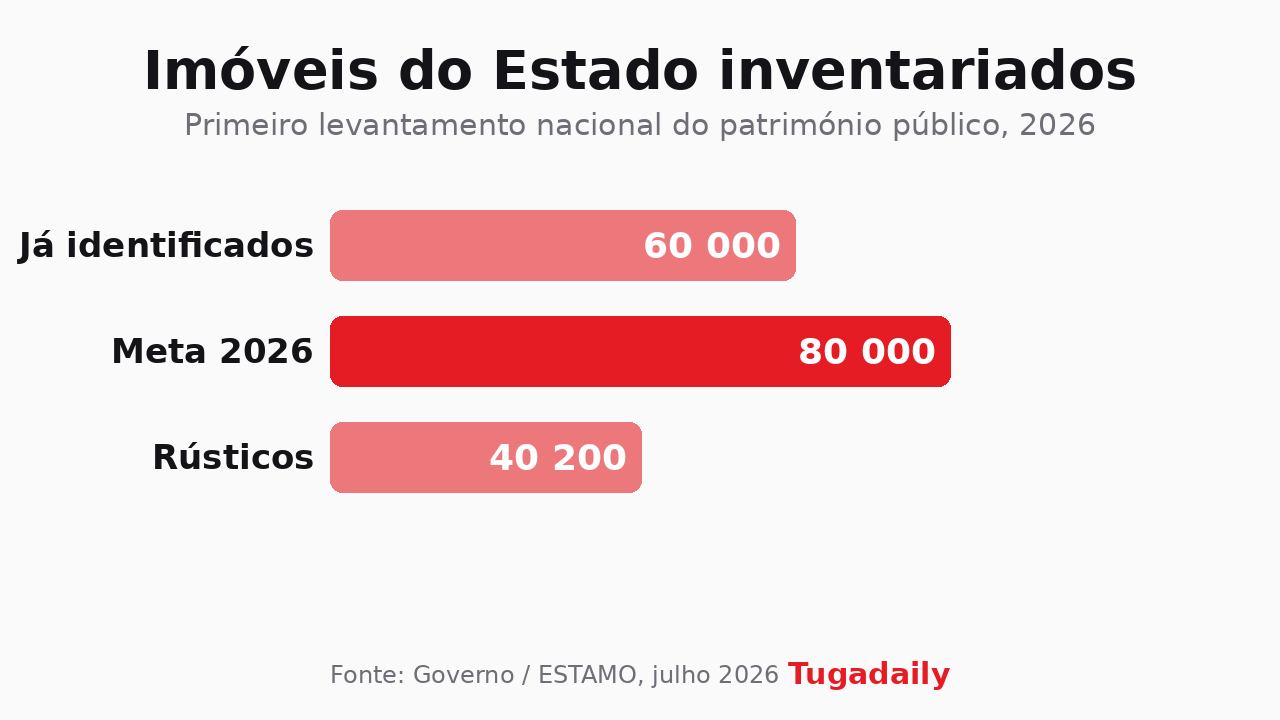
Portugal's first national inventory of state-owned property closed six months early with 60,000 buildings and plots identified. The target is around 80,000 by the end of 2026.
For decades the Portuguese state did not really know what it owned. Now it knows a large chunk of it: the first systematic survey of public real estate has closed with 60,000 properties identified, and it closed six months ahead of its own deadline.
The work was done by ESTAMO, the public company that manages state property, and it is the first attempt to put all of this on one national map. That matters more than it sounds. You cannot sell, renovate, hand to a town hall or convert into housing something you have not established that you own.
How many state properties has Portugal identified?
Sixty thousand. The next phase covers property belonging to public institutes and should push the inventory to roughly 80,000 by the end of 2026. Then comes 2027 and the unglamorous but decisive part: consolidating and validating the data by connecting registries that until now barely spoke to each other.
One detail reframes the whole thing. Around 67% of state property is rural land rather than buildings, and those parcels will be registered on the Balcão Único do Prédio, the platform built to establish who owns which piece of the country — a long-standing gap in the interior, where a lot of land was never formally registered.
Will this actually mean more affordable housing?
It might, but not by itself. The government says the inventory will guide investment and renovation decisions, and ties it to the housing crisis through three routes: selling assets, devolving management to municipalities, or converting buildings into affordable homes. Which of the three dominates is precisely the political fight under way — Lisbon’s sale of ten municipal plots showed that the people who want homes and the people who want revenue do not always end up in the same place.
There is a contrast with the people waiting, too. The rules of the new affordable rent regime kick in this September, and a list of 80,000 public properties is only worth something if it eventually ends with keys in somebody’s hand.
For now, the state has taken the step that is hardest to explain and easiest to underrate: it knows what it has. The rest is a choice.
Infographic: Tugadaily · data Government / ESTAMO