
Brazil is buying a supercomputer to teach AI Portuguese
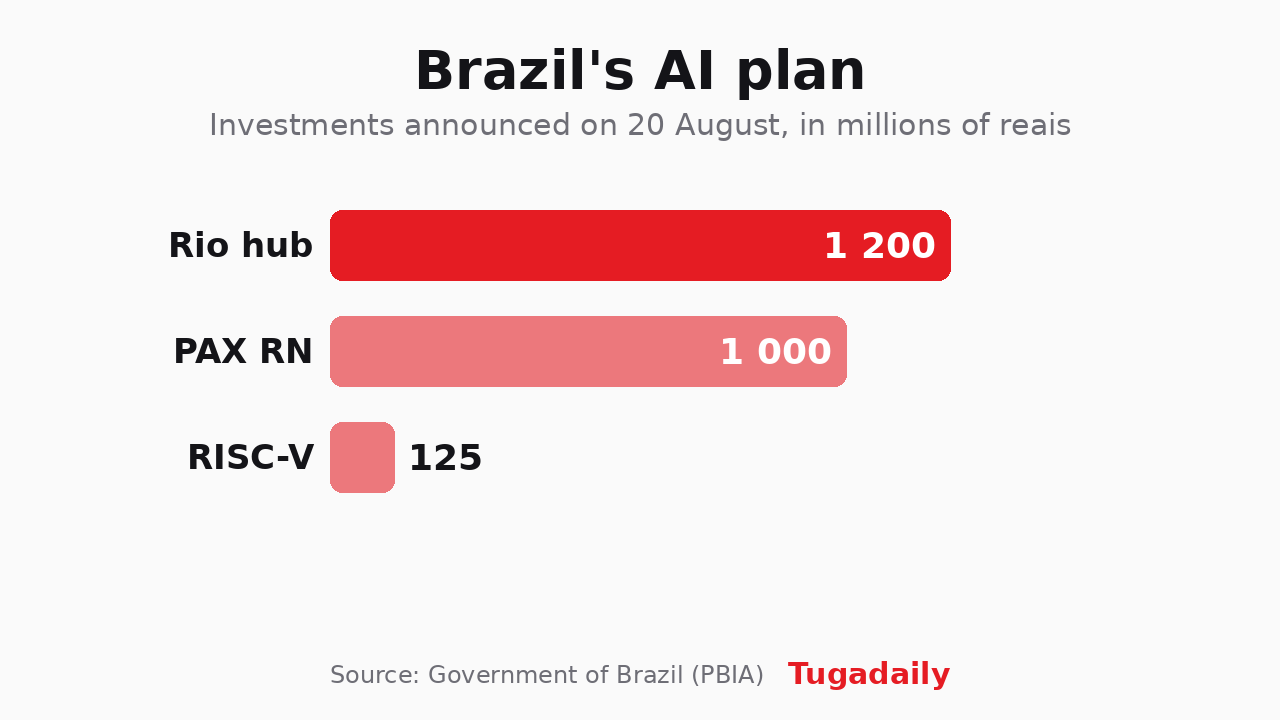
On 20 August in Macaíba, the Brazilian government announced a R$1bn tender for PAX RN, a machine targeting 7,200 petaflops. Alongside it, a second supercomputing hub in Rio with Huawei and iFlytek, dedicated to Portuguese-language models.
There is a quiet race happening on the other side of the Atlantic, and it is about the language spoken in Portugal. On Thursday, at the Augusto Severo science and technology park in Macaíba, the Brazilian government announced a public tender worth one billion reais for PAX RN, a supercomputer targeting 7,200 petaflops — roughly 7.2 quintillion operations a second, which would put it among the ten most powerful machines in the world.
The interesting part is what it is for. Brazil’s plan also includes a second supercomputing hub in Rio de Janeiro, run by the national teaching and research network with Huawei and iFlytek, budgeted at 1.2 billion reais over five years and dedicated to building Portuguese-language models. A further 125 million reais or so is earmarked, in partnership with Spain, for manufacturing open-architecture RISC-V chips.
Why this matters from here
Nearly every large language model in daily use was trained overwhelmingly on English, with Portuguese arriving as a secondary language and usually in its Brazilian form. The consequences are small and constant: an answer that swaps a European term for a Brazilian one, a legal summary that applies Brazilian doctrine to a Portuguese question, a transcript that stumbles over a northern accent. Investment on this scale in Portuguese-trained models changes how much data exists — though it does not, on its own, fix the European variant problem.
Brazil’s science ministry had already launched, in December 2025, SoberanIA, an initiative to develop advanced AI models in Portuguese, and in April 2026 it signed a protocol with Serpro and iFlytek for models adapted to Brazilian Portuguese under public control. Thursday’s announcement is the hardware those promises were missing.
All of it sits inside the Brazilian Artificial Intelligence Plan, which commits 23 billion reais between 2024 and 2028. Portugal is taking a smaller, more European route, of the kind represented by the new national advanced computing centre in Guimarães. The gap in scale is exactly the point: if most of the Portuguese-language corpus ends up trained and hosted in Brazil, the Brazilian norm becomes the default.
The PAX RN tender still has to be published in Brazil’s official gazette. Until then, the number worth holding on to is the other one: a billion reais for a machine that will spend much of its working life learning our language.
By Oliver Grant
Chart: Tugadaily · data Government of Brazil (PBIA)