
PT
Official Google launch image of the Pixel 11 Pro in Canyon pink, showing the rear camera bar
Tech 14 August 2026

Thinking of a Pixel 11 when it reaches Portugal on 20 August? Start with the footnotes

Google has confirmed Portuguese prices and a 20 August release date for the Pixel 11, Pro and Pro XL. The AI features doing most of the selling are marked in Google's own announcement as limited to selected countries and languages, and no language list has been published.

Google unveiled the Pixel 11 in New York on 12 August, and Portugal is in the first wave. All three phones, Pixel 11, Pixel 11 Pro and Pixel 11 Pro XL, go on sale on Thursday 20 August. We covered the event back in July, when all there was to report was a date. Now there are numbers.

The Pixel 11 starts at 1,019 euros with 256 GB, the 128 GB tier having been dropped entirely. The 512 GB version is 1,149 euros. The Pro starts at 1,219 euros, the Pro XL at 1,429 euros, and a 1 TB Pro XL will take 1,819 euros off you. Buy either Pro and six months of Google AI Pro come with it.

One word on the comparison you are going to see everywhere. Google’s US starting price is 899 dollars, quoted before sales tax. The Portuguese 1,019 euros already contains 23% VAT, which works out at roughly 828 euros before tax. There is a gap. It is a good deal smaller than putting the two stickers side by side suggests.

The hardware

Tensor G6 does the work, with a TPU Google says is 50% more capable on the Pro models and efficiency gains of about 20%. Security moves to a Titan M3 chip with post-quantum encryption. Cameras are the year’s real pitch: a rebuilt main sensor, 5x optical zoom on the Pro, Night Sight up to 4.5 times faster, and a new Magic Capture mode that sifts around 400 frames to pick the moment for you.

The Pro models also get HiLight, a set of LEDs beside the flash that glow when the phone is face down, either for calls from favourite contacts or to show that Gemini is listening.

Now the part in small type

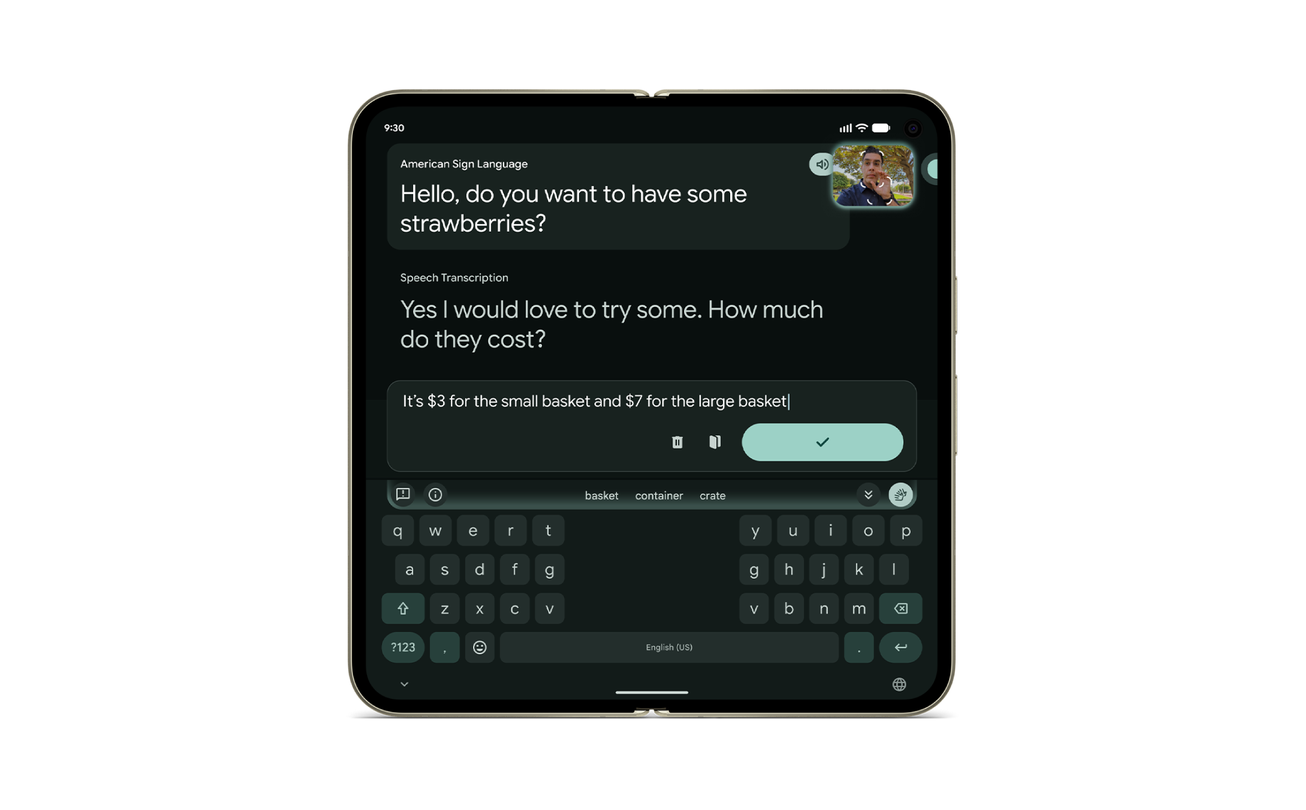
Nearly every AI feature that carries the launch comes with an asterisk attached. In Google’s own announcement, Gemini’s multi-step tasks, the filler-removing voice input, the assisted writing tools in Gboard, sign-to-text and real-time Live Translate are each flagged as available in selected countries and languages, with availability varying and some features needing a subscription for heavier use.

Google did not publish a per-feature language list alongside the launch. Buying a Pixel 11 in Portugal on 20 August gets you the phone, the chip and the cameras with certainty. It does not, on day one, get you a guarantee that Live Translate speaks Portuguese, or a date when it will.

That matters more here than in a monolingual market, and it is worth weighing against what Samsung showed on its foldables this year, which sit in a different price bracket with the same always-on-assistant sales pitch. In both cases the question to ask a salesperson is the same one: in which language.

By Oliver Grant

Image: Google

Hand holding a smartphone with the YouTube app open on its launch screen
Tech 12 August 2026

New YouTube channels will need 8,000 watch hours from February 2027

The entry bar doubles for newcomers, but existing partners are untouched by it. The change that actually bites them is a 10 million view floor on Shorts revenue, and Premium Lite is now rolling out to every country with Premium.

YouTube has changed its Partner Program for the first time since 2018, and the headline everyone reached for was the easy one: the bar to get in has doubled. That is accurate. It is also the part fewest people will feel. Read properly, the announcement YouTube published on 10 August contains three changes, and only one of them is about getting in. From 1 February 2027, a new channel applying to the programme needs 8,000 qualified watch hours over the…

Continue reading
Schematic of a graphics card with HBM memory sitting beside the GPU on a silicon interposer
Tech 11 August 2026

This is the AI bottleneck nobody argues about, and Samsung thinks stacking fixes it

Samsung unveiled zHBM at the FMS 2026 conference, claiming four times HBM4's transfer speed at a quarter of the power. SK hynix and Sandisk used the same stage to publish the first open High-Bandwidth Flash spec.

The thing slowing AI down right now is not the processor. It is the distance data travels between the processor and its memory, and that distance exists because in current designs the memory sits next to the chip rather than on top of it. Samsung's answer, shown on 4 August at the Future of Memory and Storage conference in Santa Clara, is called zHBM: stack the high-bandwidth memory vertically, directly above the AI accelerator. The company says zHBM…

Continue reading
TSMC's Fab 18 plant in Taiwan seen from a distance, farmland in the foreground
Tech 11 August 2026

TSMC has never had a July like this one: NT$467.58bn, up 44.7% in a year

That is about US$14.5 billion for a single month, 5.6% more than June, with January to July running 37.0% ahead of last year. High-performance computing, where AI chips sit, was 66% of second-quarter revenue.

If you want to know whether the money pouring into artificial intelligence is still pouring, the most useful company to watch is not Nvidia or OpenAI. It is the Taiwanese contract manufacturer that makes almost everybody else's chips. TSMC reported July revenue of NT$467.58 billion, roughly US$14.5 billion, in the monthly figures it publishes on its investor relations monthly revenue page. That is a record month: up 44.7% on July 2025 and 5.6% on June.…

Continue reading
The interior of a bookshop with full-height shelves of books beneath an arched gallery
Tech 10 August 2026

Publishers say books traded on Telegram and WhatsApp are costing them more than €75 million

Novels, school textbooks and audiobooks are passed around as files inside closed messaging groups. Portugal's book trade will publish an impact study before the end of the year to size the losses properly.

Book piracy has stopped living on obscure websites and moved to where everyone already is. In Portugal, novels, school textbooks and audiobooks now circulate as files inside Telegram and WhatsApp groups, and the trade puts the loss to publishers at more than €75 million. The mechanics are simple, which is exactly why they are hard to stop. Someone buys or scans a title, drops the PDF or EPUB into a group with hundreds of members, and the file chains…

Continue reading
Suno blog card headed How We're Building the Future of Music Responsibly, bylined Mikey Shulman and dated 6 August 2026
Tech 8 August 2026

Suno will stamp every track its AI makes (and clamp down on mass downloads)

The watermark is inaudible, sits inside the waveform itself and is meant to let platforms recognise a Suno-made track. It lands with record labels suing the company and Europe's AI transparency rules already in force.

Suno said on 6 August that it will start marking the tracks its AI produces. The watermark is embedded in the audio, nobody hears it, and the point is that a partner platform can look at a song and tell it came from there. The announcement came in a post signed by co-founder and chief executive Mikey Shulman, which describes the mark as durable and resistant to tampering without affecting the listening experience. One line is worth holding onto: the…

Continue reading
A Lisbon Metro train stopped at the platform in Baixa-Chiado station
Tech 7 August 2026

Your phone should finally hold a signal on Lisbon's Blue Line

MEO has finished upgrading 5G infrastructure along the whole Blue Line and expects the Red Line done by September. Vodafone says its own network is modernised across 95% of Metro stations.

Anyone who rides the Lisbon Metro knows the rhythm: signal on the platform, nothing in the tunnel, back again three stops later. That is being fixed line by line. MEO has completed the 5G infrastructure upgrade along the entire Blue Line, and expects the Red Line reinforcement to be finished in September. Vodafone, separately, says its own network is now modernised across 95% of Metro stations. A tunnel is close to the worst case for a radio signal. There…

Continue reading
Facade of the Portuguese Institute of Oncology in Lisbon, showing the main entrance and IPO signage
Tech 7 August 2026

This robot reached a lung nodule in Lisbon in just over 40 minutes

The PRR-funded ION platform can navigate to peripheral lung nodules that conventional bronchoscopes struggle to reach. It is the second such unit on the Iberian Peninsula.

A man of about 70 with suspected lung cancer became the first patient in Portugal to undergo a robotic bronchoscopy. The procedure took place at the Portuguese Institute of Oncology in Lisbon and lasted a little over 40 minutes. The technology is called ION, and it solves a specific problem in respiratory oncology. Nodules that show up in the outer reaches of the lung, far from the main airways, are hard to get to with a conventional bronchoscope.…

Continue reading
Apple Store on Michigan Avenue in Chicago, seen from the riverside steps
Tech 7 August 2026

Apple says an ex-engineer walked off with its hardware files. OpenAI wants the case thrown out

Apple has asked a California court for early discovery against two OpenAI staff, claiming new evidence about unannounced products. OpenAI's answer, filed 6 August, calls the suit rotten at the root.

OpenAI has answered, and answered hard. On 6 August it asked a California court to throw out Apple's trade-secrets suit in full, calling the case rotten at the root. Pulling the other way in the same docket, Apple asked for early production of evidence involving two OpenAI employees, senior systems engineer Chang Liu and hardware director Tang Yew Tan, saying it has gathered fresh indications that proprietary information about unannounced products was…

Continue reading
Demis Hassabis, 2024 Nobel laureate in chemistry, at the Royal Swedish Academy of Sciences
Tech 6 August 2026

Demis Hassabis steps down as Google DeepMind CEO to become Alphabet's chief scientist

Koray Kavukcuoglu takes over day-to-day running of the lab and reports directly to Sundar Pichai. The change lands alongside Jeff Dean's departure from Google after 27 years to found a new company.

Demis Hassabis is no longer chief executive of Google DeepMind. He becomes chairman of the lab and chief scientist of Alphabet, and continues to run Isomorphic Labs, the drug-discovery company spun out of DeepMind itself. He shared the 2024 Nobel Prize in Chemistry for the protein-structure prediction work behind AlphaFold. The day-to-day passes to Koray Kavukcuoglu, until now DeepMind's chief technology officer and Google's chief AI architect. He takes…

Continue reading
Chart comparing basic digital skills in Portugal, the EU average and the 2030 target
Tech 6 August 2026

Portugal beats the EU on fibre and 5G, and trails it on knowing what to do with them

The Digital Decade report gives Portugal 97% very-high-capacity network coverage against an EU average of 85.5%. On basic digital skills it scores 59.2%, below the EU's 60.4%.

Building a network and teaching people to use it are two different jobs, and Portugal is only good at one of them. The European Commission's annual Digital Decade report puts Portugal near the top on everything that gets buried in the ground. Very-high-capacity network coverage has reached 97%, up 2.5 points during 2025, against an EU average of 85.5%. 5G reaches 65.2% of homes. And unusually, rural and inland coverage sits above the EU average, which for…

Continue reading
NASA visualisation showing trackable objects in Earth orbit as orange dots surrounding the planet
Tech 5 August 2026

The Coimbra company that tracks 600 satellites just raised €15.6 million

Neuraspace combined €9.6 million of Portugal's recovery-plan money with €6 million of private capital from Lince Capital, Explorer Investments and Armilar. It goes into optical sensors and the defence line, NeuraspaceDEF.

There is a company in Coimbra whose job is to know, at any given moment, where more than 600 satellites are and what is heading towards them. It is called Neuraspace, it started in 2020, and it has just closed a €15.6 million funding round. The money arrives from two directions. Some €9.6 million comes from Portugal's Recovery and Resilience Plan; the remaining €6 million is private capital, in a round led by Lince Capital, Explorer Investments and…

Continue reading
The Telegram app icon on a smartphone screen
Tech 4 August 2026

Apple pulled Telegram worldwide over child abuse material. It was back within hours

App review found content violating Apple's rules. Telegram deleted it, banned the account behind it, and the app returned to the store.

For a few hours on Tuesday, Telegram was simply gone from the App Store. Not a regional block, not a server problem. The app stopped being available to download anywhere in the world, with no warning and no immediate word from Apple. The explanation came afterwards, and it is serious. Apple's review team found child sexual abuse material in the app, a direct breach of its store rules. The company confirmed it had removed Telegram while the matter was…

Continue reading
The British Army's Thales Watchkeeper WK450 drone, the system Tekever's AR5 will replace
Tech 3 August 2026

Tekever will replace the British Army's Watchkeeper drones in a deal worth up to £400m

The UK Ministry of Defence picked the Portuguese company's AR5 for CORVUS, its new surveillance capability, on a ten-year contract. Production goes to Swindon, engineering to Bristol and Southampton.

The UK Ministry of Defence has selected Tekever to deliver CORVUS, the British Army's new surveillance capability. The contract could reach £400 million, roughly €460 million, over the next ten years. At its heart is the AR5, the Portuguese company's autonomous platform. It replaces Watchkeeper, the drone the British Army has flown for more than a decade, and should start entering service later this year, subject to contract signature and final approvals.…

Continue reading
Aerial view of a large water treatment facility in the United States
Tech 2 August 2026

Water-system cyberattacks have now hit seven US states, and the FBI is looking at Iran

Michigan joined Minnesota in reporting hacks on its water systems, with federal officials citing at least seven states. The FBI is investigating a coordinated campaign.

There is one thing almost nobody thinks about protecting and everybody uses before breakfast: the water in the tap. In the United States, that blind spot has just become expensive. Michigan reported cyberattacks on nine of its water systems on Saturday, days after Minnesota counted more than thirty. Federal officials say the problem now spans at least seven states. The FBI is investigating what it calls a coordinated campaign against one of the most basic…

Continue reading