
Portugal's budget slipped into deficit by June, and old health-service bills did it
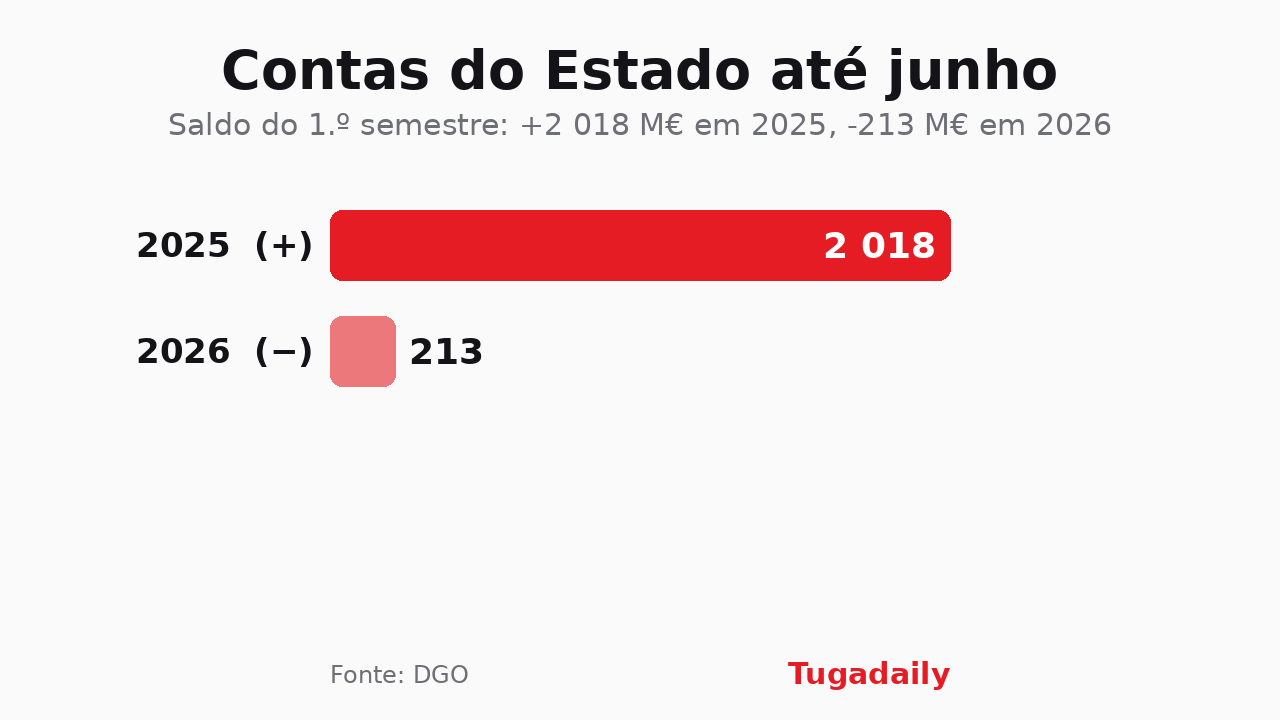
Portugal's public accounts closed the first half of 2026 with a 213 million euro deficit, after a surplus of more than two billion in the same period last year.
Portugal’s public accounts ended the first half of the year 212.6 million euros in the red. On its own that is a small number. As a swing it is not: the same six months last year closed with a surplus above two billion, so the balance moved by 2,230 million euros in twelve months.
Why did the balance flip?
Two bills the state chose to settle in one go. The big one was clearing old Serviço Nacional de Saúde debts to suppliers — invoices hospitals had been carrying for years, finally paid. The second was the support package that followed the winter storms, which landed entirely on the spending side with no matching revenue.
Strip out the health-debt clearance and the half-year would have closed with a surplus of roughly 1,100 million euros. Which is the point worth holding on to: this is not a spending spree, it is a tidy-up. Expect both readings to be quoted enthusiastically over the next few weeks, by different people.
What about tax revenue?
Solid, not spectacular. The treasury took in 29,089 million euros in taxes over the six months, up 1.9% on last year. That is growth in step with the economy rather than growth that can absorb a one-off bill of this size.
One detail that tends to get buried deserves a mention: the state’s overdue payments fell to record lows. If you sell to the public sector, that is the actual headline, because it means invoices settled rather than invoices promised.
All of this arrives while the country is already arguing about next year’s budget, and while the government is finalising things like the single social benefit rulebook that will shape the spending side. Monthly execution figures are published on the Directorate-General for Budget site if you want the raw sheet.
By September, with the third quarter closed, we will know which reading held up.
By Beatriz Mota
Infographic: Tugadaily · data from Direção-Geral do Orçamento