

From today the Portuguese state hands back 9.8 cents on every litre of diesel
Friday's order sets the extraordinary ISP rebate at 97.58 euros per thousand litres of diesel and 65.92 for petrol, in force from Monday. It is not a tax cut — it is the extra VAT the state collects when prices rise, given back.
Fill up this week and you are paying less tax than you were last week, by a wider margin than the headlines suggest. The order signed on Friday by the environment and energy minister and the secretary of state for tax affairs fixes the extraordinary fuel-duty rebate at 97.58 euros per thousand litres of road diesel and 65.92 euros per thousand litres of unleaded petrol. In the unit that shows up on the pump display: 9.8 cents off diesel, 6.6 off petrol.
The week before it was 71.63 and 51.62 euros. So the support went up by roughly 2.6 cents a litre on diesel and 1.4 on petrol, and it took effect on Monday 14 September.
This is not a tax cut
The preamble to the order is worth reading, because it says something the coverage tends to skip: the rebate corresponds to returning “the additional VAT revenue”. VAT on fuel is a percentage, it applies to a price that already contains the duty, and it therefore rises automatically when crude rises. The mechanism gives that slice back. It does not give back anything beyond it.
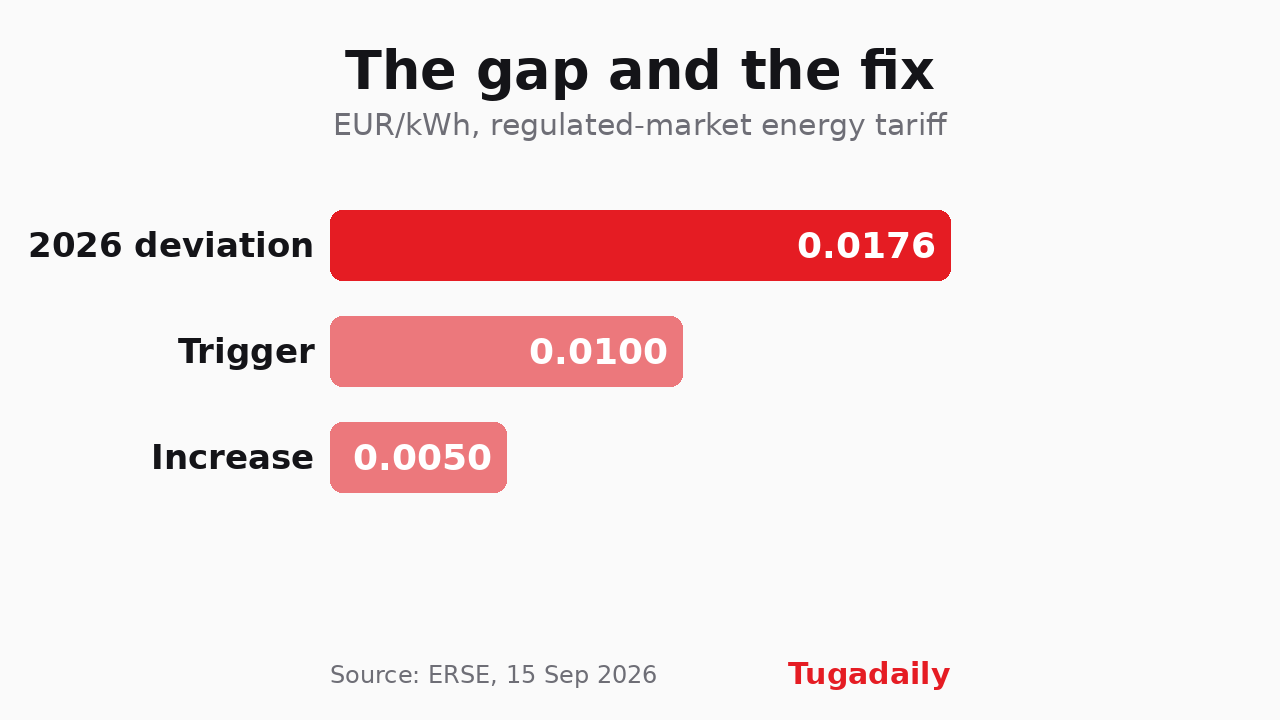
The trigger is stated just as plainly and quoted just as rarely. The rebate exists only in weeks when the price sits more than 10 cents above the average for the week of 2-6 March 2026 — the week before the joint US and Israeli strike on Iran. Since that marker, diesel is up about 47 cents a litre and petrol about 39. That is why the rebate still exists, and why it grew: not because the government decided to be more generous, but because the gap to the March benchmark widened.
The bit that confuses everybody
Diesel is expected to rise this week and petrol to fall. The rebate still went up on both. It looks contradictory and it is not: the reference point is March, not last week. As long as petrol sits more than ten cents above its March price, there is money coming back — even in a week when the price is dropping.
On the week now ending, forecast and outcome diverged sharply. The Automóvel Club de Portugal had at one point estimated rises of 15 cents on diesel and 12 on petrol; what landed was 7.5 and 8 cents, the latter still the steepest petrol increase in over three years. We have already covered how prices hit record levels in early September and how the government extended the 10-cent rebate on agricultural diesel to December, a separate scheme that stacks on top of this one for anyone farming.
Which leaves an easy question to ask and a hard one to answer. Brent closed the week up around 10%, its biggest weekly gain since 17 July, but fell nearly 3% on Friday on news of talks between Iran and the Gulf states in Oman. If those talks go well, the gap to March narrows, the rebate shrinks — and the forecourt price can still fall. That is the mechanism running in reverse, and it will happen without anyone announcing it.
By Beatriz Mota
Image: Maria Graça Carvalho / Wikimedia Commons (CC BY-SA 4.0)