
Nearly half of Portugal's gold sits in London, and none of it is in New York
The Dutch central bank has just moved close to ten billion dollars of gold out of the US, and Spain, Germany and Italy have started arguing about doing the same. Portugal moved its 3.7 tonnes in 2021 — and the reason it gave was not political.
The Dutch central bank has spent recent months moving gold. Around 60 tonnes physically travelled out of the United States and Canada, half to its own vaults and half to the Bank of England, and the rest was sold in North America and repurchased in London — the reserves change address without the bars being the same bars. Nearly 100 tonnes in total. The governor talked about “readiness” and preparing for “severe crises”. Nobody in Amsterdam said the word Trump, and everybody heard it.
The argument opened immediately afterwards in Spain, in Germany and in Italy, where roughly 43% of the reserves are thought to sit on the other side of the Atlantic. In Portugal the conversation never started, because it had already finished.
What the Banco de Portugal’s own accounts say
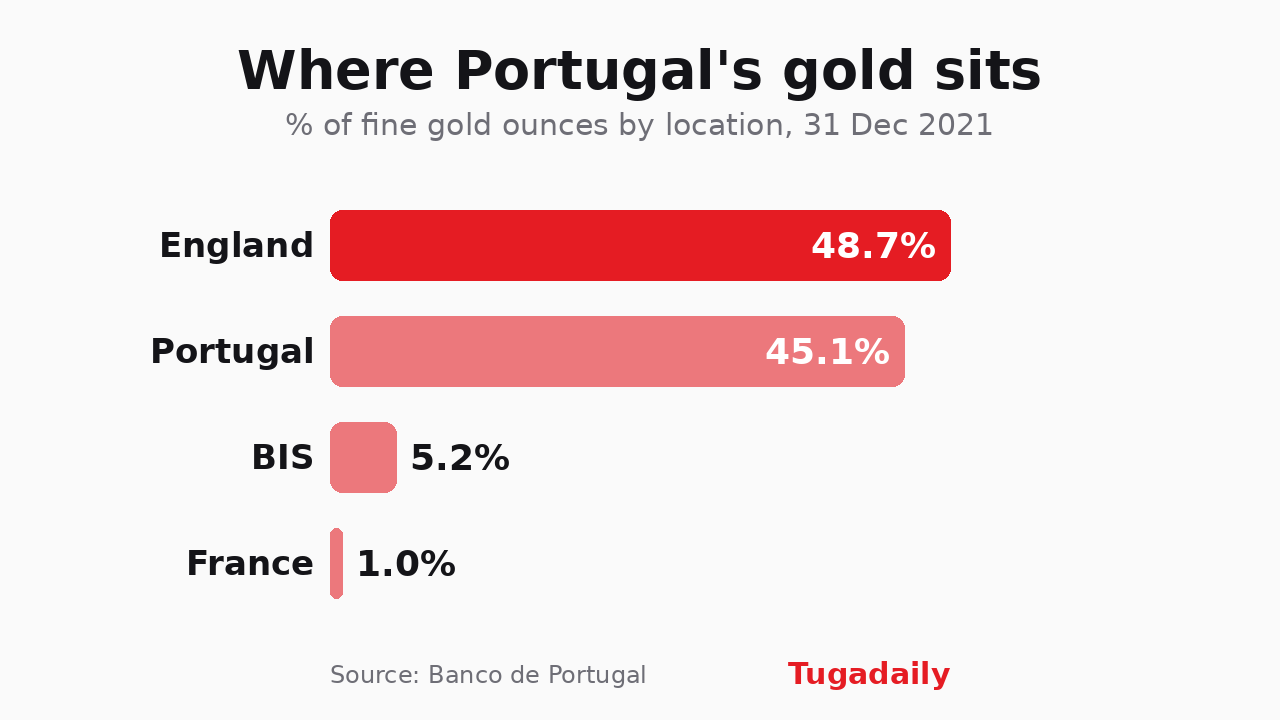
We went to the gold note in the central bank’s 2021 accounts and counted the ounces, location by location. At the end of that year, of the 12,299,794 fine ounces the bank held, 5,991,571 were at the Bank of England, 5,549,238 in the Banco de Portugal’s own vaults, 640,658 at the Bank for International Settlements in Basel, and 118,327 at the Banque de France. At the New York Fed: a dash. Nothing.
Do the division and you get 48.7% in London, 45.1% at home, 5.2% in Switzerland and 1.0% in Paris. And the 118,327 ounces that turned up in France in 2021 are, to the gram, the ones that had been in New York the year before — 3.7 tonnes that changed continent.
The reason was accounting, not geopolitics
This is the good part, and the central bank is the one who wrote it down. In its 2021 activity and accounts report, the institution explains that the gold held at the New York Federal Reserve “was transferred to the Banque de France” in order to “improve the return on gold held abroad and move its location into the Eurosystem”.
Return, and Eurosystem. Not mistrust, not sovereignty, not flags. In 2021 nobody in Lisbon was worried about the reliability of the Fed; they were worried that gold parked in New York earned less than gold inside the euro area, where it can be lent and used in collateralised operations. The right call for the boring reason, which is how most right calls get made.
Portugal has not touched the pile since 2006
Its 382.7 tonnes put the country in the world’s top 20, far above what the size of its economy would suggest, and they are the legacy of sales it did not make. The last one was in September 2006, under the central bank gold agreement. Nothing bought and nothing sold since — unlike Poland, which in 2025 alone bought more than 100 tonnes, over double the year’s second-largest buyer.
The value has not sat still. The reserves were worth more than 45 billion euros at the end of 2025 and the metal has climbed further since, a number we keep following in our markets tracker. It is money the country has without having done anything to get it, which goes some way to explaining why no government touches it.
By Beatriz Mota
Chart: Tugadaily, with Banco de Portugal data