
Portugal's regulated electricity tariff goes up on 1 October. For most homes that is under a euro a month
ERSE is raising the energy tariff by €0.005 per kWh, about 2.7% on the average monthly bill. A couple with no children pay 95 cents more; a couple with two children pay €2.70 more. It covers 779,000 customers, and the regulator is passing on less than a third of the gap it found.
Electricity gets more expensive on 1 October for anyone still on Portugal’s regulated tariff. ERSE is lifting the energy component by €0.005 per kWh, which works out at roughly 2.7% on the average monthly bill — and it is the percentage, not the amount, that will travel.
The amount deserves an airing, because it changes how the number reads. The regulator’s own statement works it through for two household types. A couple with no children, on 3.45 kVA and 1,900 kWh a year, will pay €37.77 a month — 95 cents more than in September. A couple with two children, on 6.9 kVA and 5,000 kWh a year, go to €97.73, up €2.70. Mainland figures, taxes included, bar the DGEG levy.
Who this actually reaches
Not the country. The regulated market had 779,000 customers in June and accounts for about 4.6% of all electricity consumed in Portugal. Everyone else is on the open market, where each supplier buys energy on its own terms and is under no obligation to follow — a point ERSE makes plainly, while also suggesting nobody assume their own bill is safe without checking the price comparison tool.
Why a tariff moves in October at all
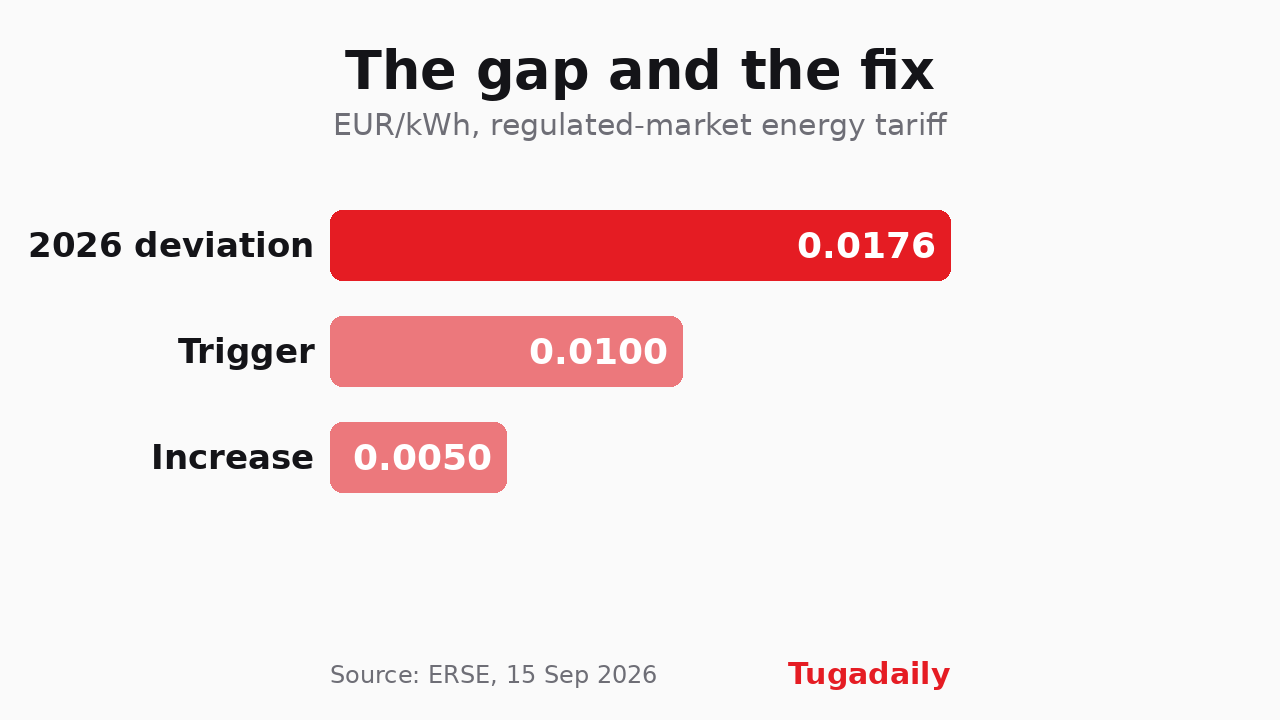
Because the tariff code requires a check every three months on whether the tariff still covers what the supplier of last resort is paying for energy. Once the gap reaches €0.010 per kWh, the tariff shifts by €0.005. It is automatic rather than discretionary.
And the most interesting figure in the document sits right there. The gap found for 2026 is not €0.010. It is €0.0176 per kWh against the forecast built into the prices that ran to 30 September. The regulator found a hole almost twice the size of its own trigger and passed on €0.005 of it — under a third. That is what the rule says to do, but the practical consequence is worth naming: the rest of the cost has not gone anywhere.
ERSE attributes the rise to wholesale prices climbing through the year, and is explicit about the cause: the war between Iran and the United States pushed natural gas up and dragged electricity with it. The effect showed most from the third quarter, when renewables carry less of national generation — the same summer in which the 1,050 MVA storage auction was put back.
One quieter correction in the statement is worth filing away. The annual price variation for 2026 is no longer the 1% announced at the end of 2025. It is now 1.7%. The year closed differently from the way it was promised — and unlike the new time bands, which only arrive in 2027, this change lands in a fortnight.
By Beatriz Mota
Chart: Tugadaily, with ERSE data