
Portugal has one of the EU's biggest shares of people working 49-hour weeks
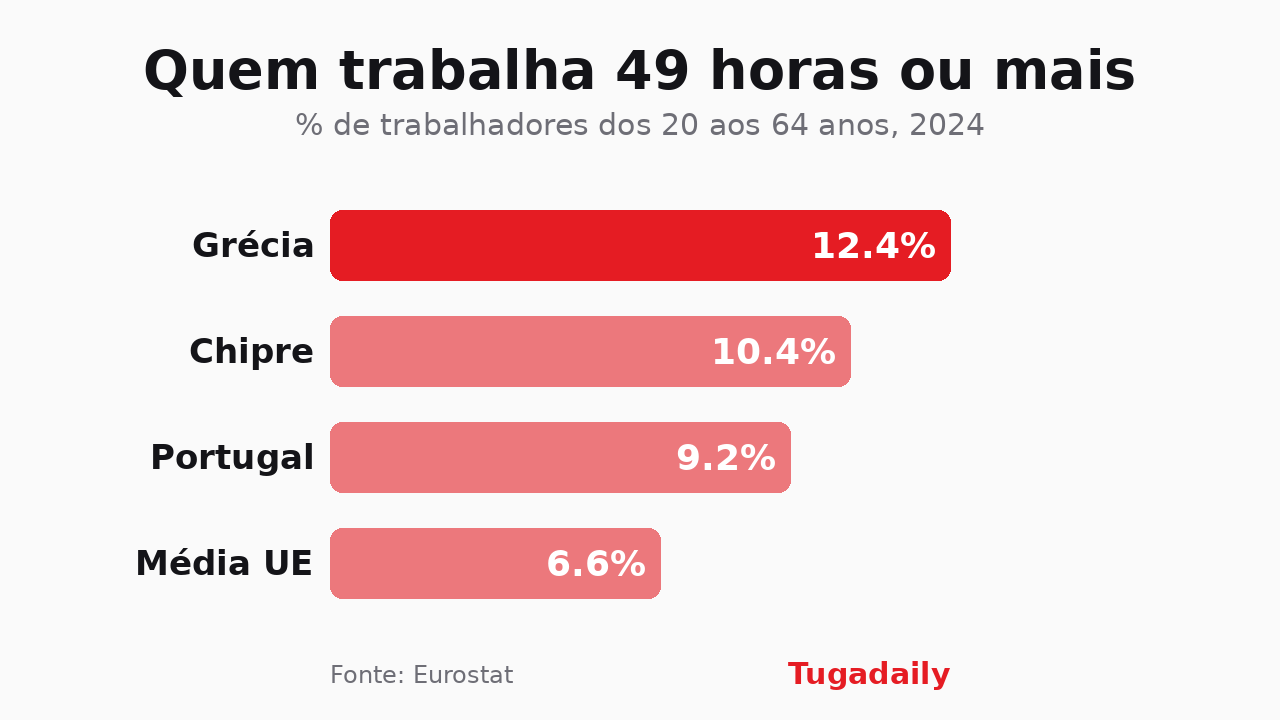
About 9.2% of Portuguese workers aged 20 to 64 put in 49 hours or more a week, against an EU average of 6.6%. The average Portuguese week runs to 37.4 hours.
The short answer: roughly 9.2% of Portuguese workers aged 20 to 64 put in 49 hours or more a week, against an EU average of 6.6%. That parks Portugal near the top of a league table nobody particularly wants to lead.
How many people in Portugal work 49 hours or more?
Just over nine in a hundred. That is close to half again above the European average, and it puts Portugal among the four or five EU countries with the largest share of long working weeks, depending on the year and the source. Greece leads on 12.4%, followed by Cyprus and France. At the other end sit the Nordics and Bulgaria, where the very long week is close to a rounding error.
What is the average working week in Portugal?
Around 37.4 hours, against an EU average of 35.9. An hour and a half sounds like nothing until you stretch it over a year, at which point it is nearly two extra working weeks per person. The two figures also measure different things: the average includes part-timers, while the 49-hour share counts the people genuinely living in the long-hours bracket.
Do longer hours mean more output?
No, and that is where the number stings. Portugal sits consistently above the EU average on hours worked and below it on output per hour, which is the textbook definition of effort going to waste. Several countries at the bottom of this table — Denmark, the Netherlands, Germany — produce more per hour while spending less time at the desk.
None of this is new, but it lands squarely in the middle of Portugal’s current argument about the four-day week, overtime rules and the right to disconnect. The country-by-country detail lives in the Eurostat database, and what those hours actually pay is laid out in our breakdown of which sectors pay best in Portugal.
Infographic: Tugadaily · data Eurostat