
The Portuguese with no schooling get their blood pressure checked most and colonoscopies least
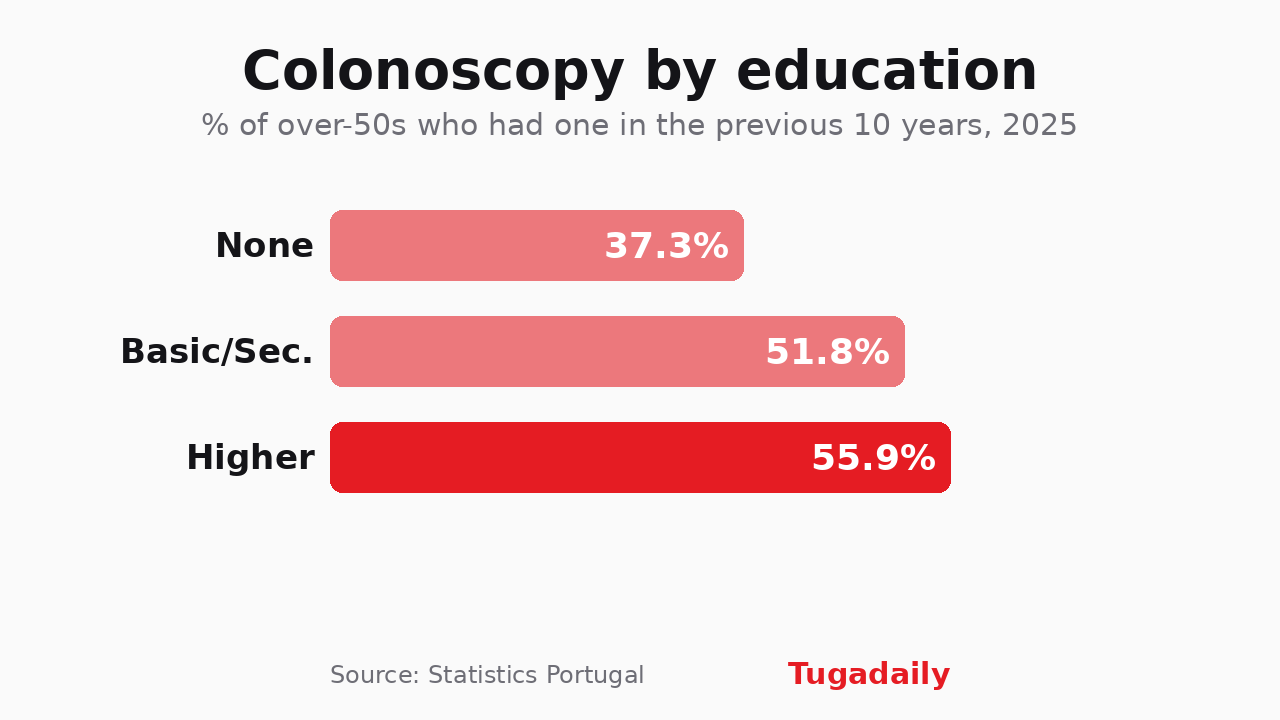
Portugal's 2025 National Health Survey puts blood-pressure checks at 80.2% among people with no formal education, the highest of any education level. On colonoscopies the same group drops to 37.3%, against 55.9% for graduates.
Statistics Portugal released another slice of the 2025 National Health Survey on Tuesday, this one on access to healthcare. The figure in its title is that 51.4% of people aged 50 and over said they had had a colonoscopy in the previous ten years. Just over half.
The headline average is not the interesting part. What the full table shows is how that average splits by education, and that it splits the opposite way to everything around it.
Three checks that rise as schooling falls
Blood pressure, blood glucose and cholesterol are the three checks the survey tracks for everyone aged 15 and over. On all three, people with no formal education come out on top: 80.2% had their blood pressure taken in the previous year, 75.1% their glucose and 77.2% their cholesterol. Graduates sit at 73.1%, 62.6% and 63.1%.
Retired people push the same pattern further, clearing 80% on all three. That is not mysterious. These are things that happen inside a GP appointment, and GP appointments happen far more to people who are older and no longer working. Among 65 to 74-year-olds, 86.6% saw a family doctor in the previous year. Among 15 to 24-year-olds, 56.0% did.
And one that does the reverse
The colonoscopy flips it. Among over-50s with no schooling, 37.3% had one in the past decade. With basic or secondary education, 51.8%. With a degree, 55.9%. That is 18.6 points between the ends of the range, in exactly the opposite order to the other three.
What separates them is how much the patient has to do. Blood pressure is measured during an appointment that was already happening. A colonoscopy needs a referral, a day of preparation at home, usually a lift there and back, and a day away from work. The unemployed are the lowest of any group, at 40.3%.
For women, the split is in cervical screening
The two women’s screening indicators tell the same story with different numbers. Mammography is fairly level: 79.7% of women aged 50 to 69 had one in the previous two years, and the gap between basic and higher education is under three points.
Cervical cytology opens up. Overall, 65.7% of women aged 20 to 69 had one in the previous three years, but it is 72.8% among graduates and 63.2% among women with basic schooling. The widest gap of all is by working status: 72.7% among employed women, 51.8% among retired women and 43.8% among the rest of the inactive population.
Read it next to what the medical association said last week about the eleven regions that cannot keep doctors, and next to the fact that the rule setting the start of this year’s flu vaccination is still unpublished. Access rarely fails for one reason at a time.
Chart: Tugadaily, with data from Statistics Portugal (National Health Survey 2025)