
Portugal sat out Europe's record summer (its August was the fifth wettest since 1931)
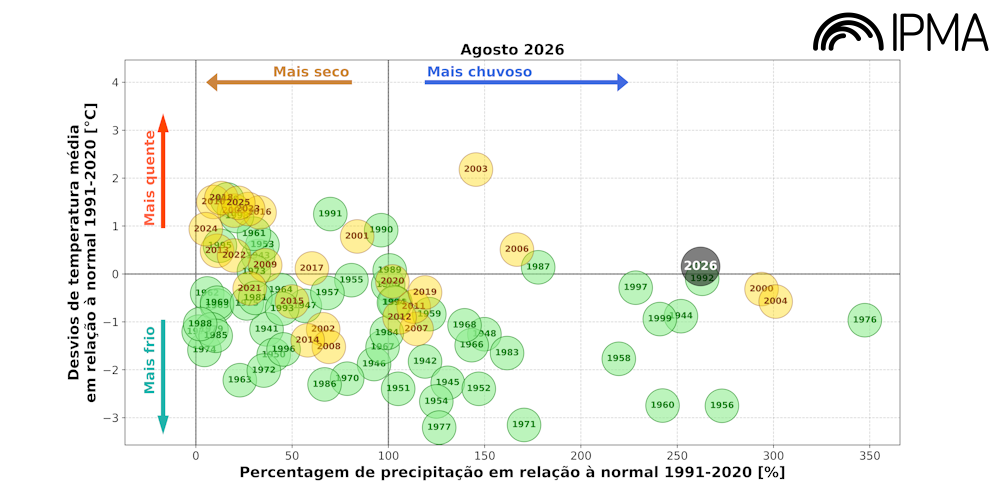
IPMA's August bulletin is out and it closes a question left open ten days ago. Mean temperature came in 0.16C above normal, the average daily high came in below normal, and more than two and a half times the usual rain fell.
Ten days ago we were left holding a question. Copernicus had just handed western Europe its hottest summer on record, 2.54C above the 1991-2020 average, and Portugal — which sits inside the geographic box that produced that record — appeared nowhere on any of the lists. The national bulletin that would explain the absence did not exist yet. It does now.
The answer is almost anticlimactic. Mainland Portugal’s mean August air temperature was 23.07C, an anomaly of just 0.16C. The average daily maximum, 29.77C, actually came in below normal, by 0.13C. While France and north-eastern Spain were running anomalies of four and five degrees, the Portuguese mainland sat on the line.
Rain did the work
A lot of it. Average monthly rainfall was 36.6mm, more than two and a half times the August normal, enough to make this the fifth wettest August since 1931 and the third wettest this century. Seventeen new rainfall extremes were recorded. The decisive stretch ran from the 23rd to the 28th, with heavy showers around Lisbon, the Tagus valley and the coast between Setúbal and Sines. Greater Lisbon took more than seven times its usual August total.
One detail is worth keeping, because it cuts against how the summer felt. Alongside the absolute high of 43.5C recorded at Pinhão on 18 August, the month also produced five new extremes for the lowest daily maximum on record. Some weather stations, in other words, logged their coolest August day ever. The averages were mild because the days were wildly uneven.
The drought moved rather than lifted
The rain eased meteorological drought across most of the country, a reversal from July, the driest month Portugal has had this century. The relief was not universal: inland Baixo Alentejo and the eastern Algarve got worse. It is the pattern of recent years in miniature — the north and west get wet, the south-east keeps drying.
The islands ran their own weather. August in the Azores was relatively warm and slightly wet, with the Flores, Pico, Horta, Graciosa and Nordeste stations all above the third quartile of their distributions since 1999. In Madeira, all four reference stations came in above normal, and Porto Santo posted its warmest August since 1961, 1.6C above the norm. On the mainland the one clearly elevated figure was the overnight low: a mean minimum of 16.38C, 0.44C above normal and the eighth highest since 2000.
Put together: the summer western Europe will cite for years was not the summer Portugal had. Copernicus has promised a fuller analysis of the European season by the end of this month, and that is when we will find out where exactly the country landed inside a region that broke its own record without us.
Image: IPMA