
Portugal's second-phase exam averages rose in 16 of 24 subjects, but the national dataset is still not online
History A climbed from 94 to 109 points and descriptive geometry fell from 108 to 95. Some 85,745 papers were sat, 2,663 fewer than in 2025, and the no-show rate went from 6% to 9%.
Average marks in the second phase of Portugal’s national secondary exams improved in 16 of the 24 papers sat, measured against 2025. The figures come from the Júri Nacional de Exames and were released by the education ministry late in the afternoon of 12 August.
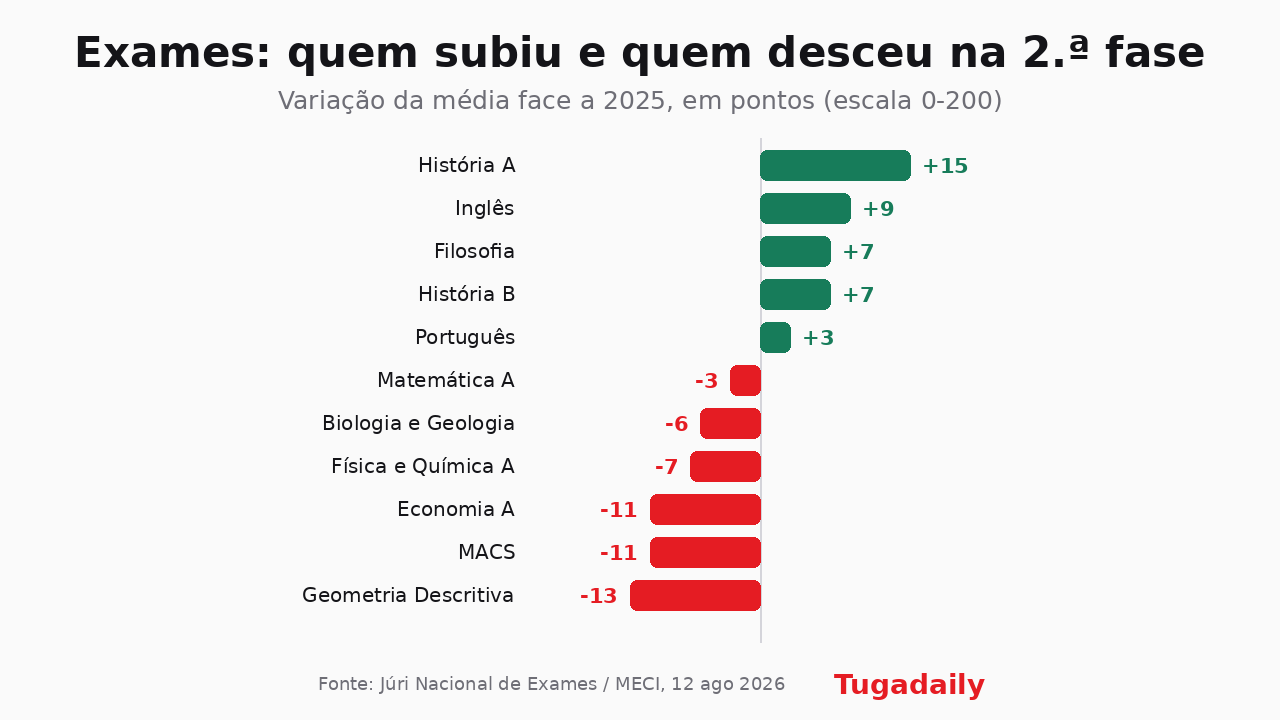
History A rose furthest, from 94 to 109 points on the 0-200 scale. Descriptive geometry fell furthest, from 108 to 95.
What sits between those two ends is more interesting than either. Among the subjects released, the humanities ones all went up: English from 135 to 144, philosophy from 99 to 106, History B from 96 to 103, Portuguese up three to 108. The numerate subjects did the opposite. Economics and applied mathematics for social sciences each dropped 11 points, to 98 and 89. Maths A slipped from 95 to 92. Biology and geology lost six, to 90. Physics and chemistry came down from 118 to 111, and even so remains near the top of the table.
Fewer papers, more empty desks
There were 85,745 papers sat this round, 2,663 fewer than last year. And more candidates simply did not turn up: the no-show rate rose from 6% to 9%.
That is the number worth pausing on. The second phase exists mainly for students improving a grade or resitting one they failed in June, so a no-show rate that grows by half in twelve months is a rough measure of how many decided not to try again. It caps an exam season that was already messy, with results suspended, marking errors and a record wave of appeals, 77% of which ended in a higher grade.
The part you cannot check yet
One detail is worth putting on the record. We went to the Júri Nacional de Exames reports and statistics page, which is where these results are normally published in full, subject by subject, for anyone to download. As of this article, the 2026 secondary-school files are not there. The most recent complete set of secondary results by subject that actually opens is from 2024.
So the averages reached the public through statements and news coverage, while the underlying dataset that lets a teacher, a researcher or a parent confirm any of it has not been posted. This is not a scandal, and it is probably a matter of days. But it is the difference between being told a number and being able to check one, and in a year when exam marking went wrong in several places at once, that difference earns its keep.
Anyone still facing this round will find the timings in our guide to the second phase.
Chart: Tugadaily · data from Júri Nacional de Exames / MECI