
Where is Portugal's secondary exam data? Not on the exam board's own statistics page
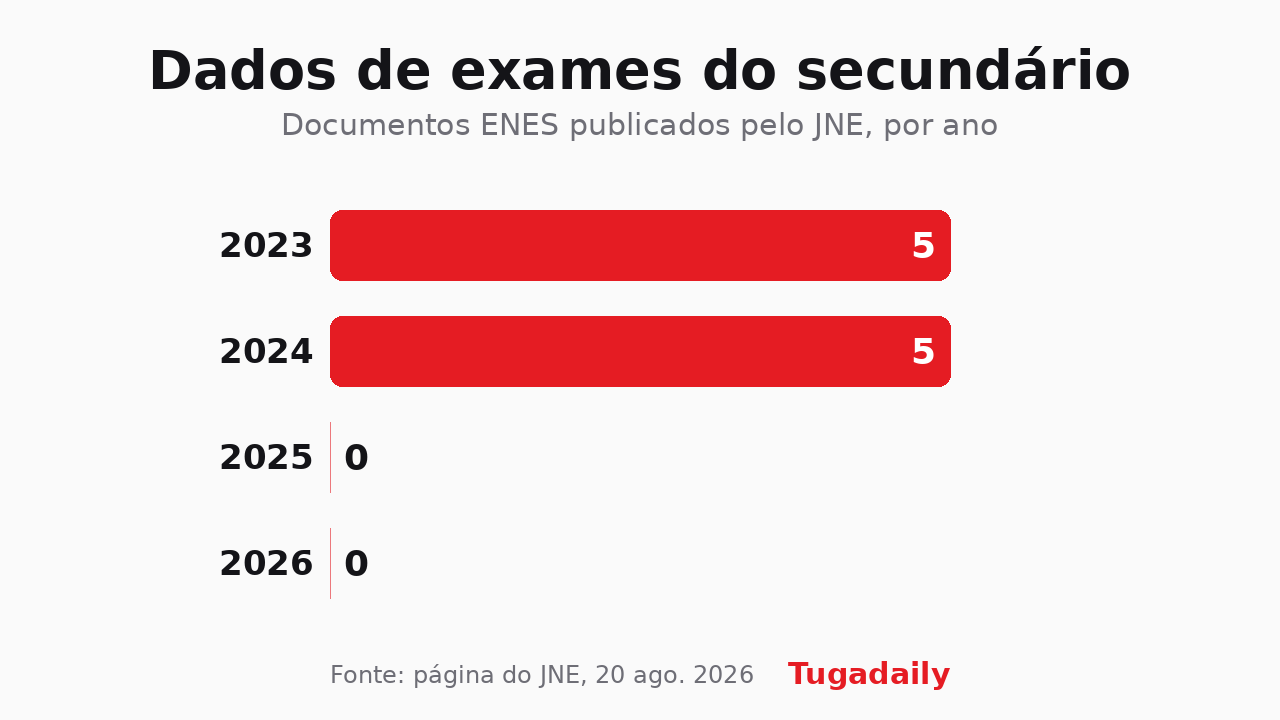
We opened the National Exam Board's Reports and Statistics page on 20 August and counted what is on it. The most recent secondary-school entry is from 2024. For 2025 and 2026 there are no files at all, even though this year's averages have already circulated.
We did something simple this morning. We opened the Reports and Statistics page of Portugal’s National Exam Board, which is where the state publishes national exam results, and counted the files year by year. This is not difficult investigative work. It is a public page, on a single tab, and it takes ten minutes.
Here is what is there. For 2024, five secondary-school entries: the ENES 2024 database plus four statistical documents, covering results by subject and grade distributions for the first and second sittings. For 2023, exactly the same five. For 2022, the same pattern again. It is a stable format, repeated for more than a decade.
For 2025, the page holds four documents, and every one of them is lower-secondary: the ENEB 2025 database and the statistics for the ninth-year final tests. None is secondary. For 2026 there is no block on the page at all.
What that means in practice
The ENES database is the file that lets anybody — a journalist, a researcher, a teacher, a parent — redo the exam arithmetic instead of accepting somebody else’s. Without it, a year’s averages exist only in the form in which they were announced. That was precisely the point we noted when we wrote that second-phase averages rose in 16 of 24 subjects: the numbers circulated, the dataset behind them did not open. A week on, it still has not.
Two things are worth saying in the education directorate’s favour. First, the site carries a news item dated 12 July announcing that first-phase secondary statistics are available on that very tab, so the intention to publish exists and is on the record. Second, a summer delay inside a directorate-general is not a scandal; databases for earlier years have surfaced as late as October. One month late is one thing. Two exam seasons in a row with no secondary file is another.
Why this matters if you are not a teacher
It matters because August is the month these numbers decide things. This is when university applications close and averages get compared, and when the country argues about whether exams are getting easier or harder. That argument happens either way. The only question is whether it happens with data. It also matters because the same ministry published, with no apparent difficulty this week, the full list of 20,404 teachers placed for 2026/27. When a number is good news, it moves quickly.
None of this means the files will not appear tomorrow. If they do, we will update this piece and be glad. Until then, the JNE’s Reports and Statistics page is open to anyone who wants to check our count. It is the same page we opened.
Chart: Tugadaily · our own count on the JNE page