
Where in Portugal is it hardest to hire? Not Lisbon, and not Porto either
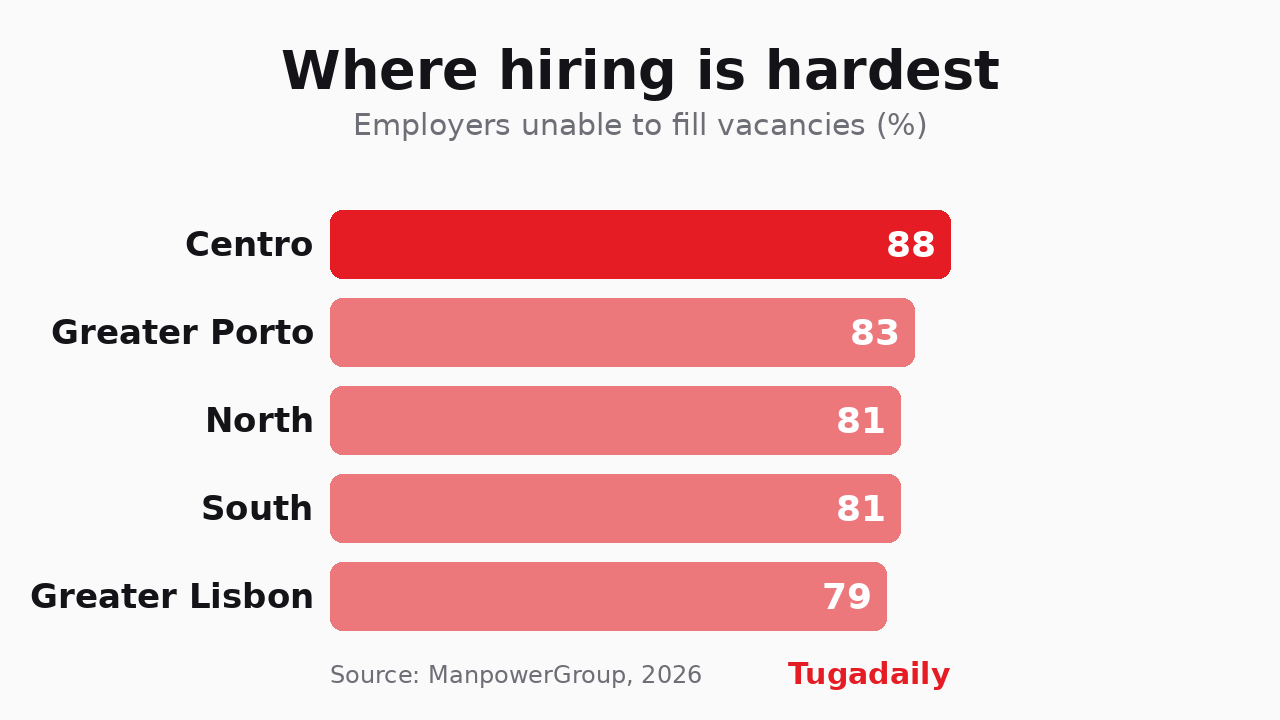
ManpowerGroup's 2026 talent shortage study puts the Centro region at 88% of employers unable to fill vacancies, against 79% in Greater Lisbon. Nationally the figure is 82%, the fifth highest in the world.
Job hunters tend to assume the openings are all in Lisbon. Employers report something close to the opposite. Companies in central Portugal complain hardest about not finding people, and the gap to the capital runs to nine percentage points.
The figures come from ManpowerGroup’s 2026 talent shortage study, built on a survey of more than 39,000 employers across 41 countries. In the Centro region, 88% of organisations say they cannot fill their vacancies. Greater Porto follows on 83%, then the North and the South, both on 81%. Greater Lisbon comes last on 79%, which is still well above the global average.
Why a hiring crunch is good news if you are the candidate
A high shortage figure is not a warning for jobseekers. It is the opposite. It means roles have been sitting open too long and employers are running out of patience with their own requirements, whether that is years of experience, salary bands or how often someone has to be in the office.
Worth looking beyond the Lisbon-Porto corridor before ruling an application out on geography.
Portugal is in the global top five
Across the country, 82% of Portuguese employers say they cannot find the talent they need. The global average is 72%. Only four markets are worse off: Slovakia on 87%, Greece and Japan on 84%, and Germany on 83%.
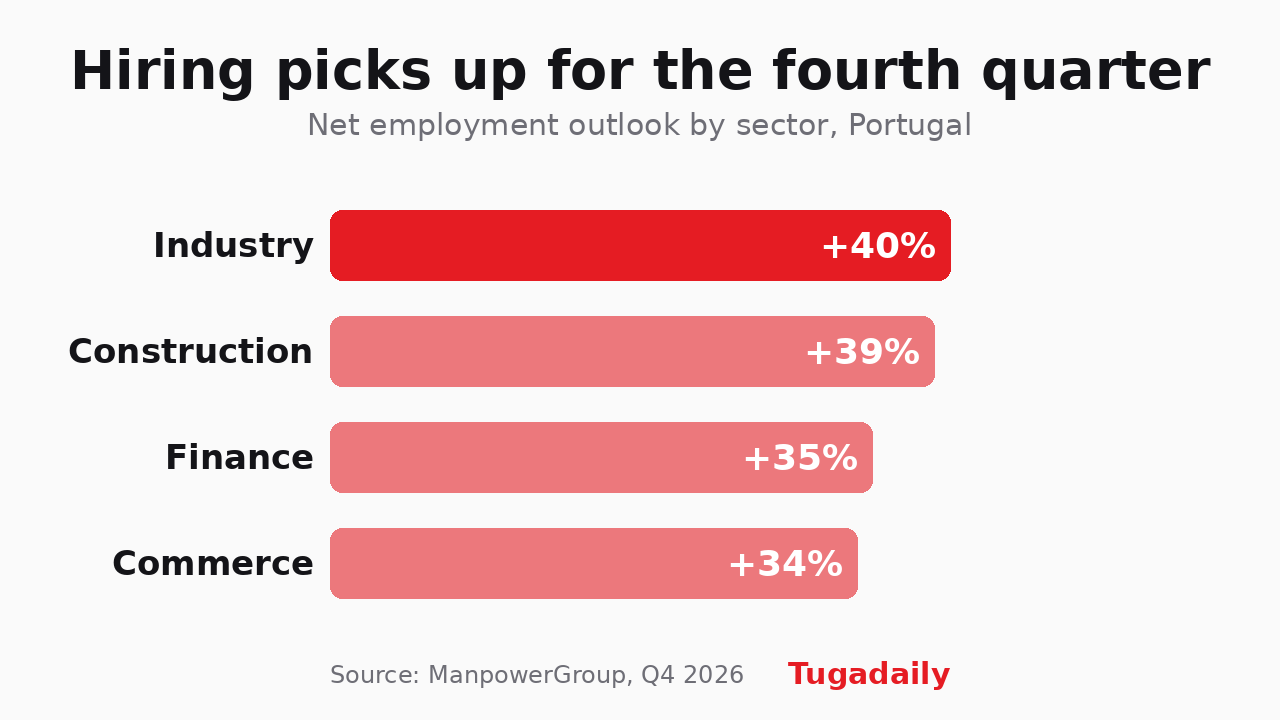
The pressure runs across the economy, though it bites hardest in industry, hospitality and restaurants, the public sector, and IT services.
The skills nobody can find
Industry is the sector with the deepest shortage. Within it, 41% of employers report trouble finding industrial and production skills and 25% point to engineering profiles.
It is the third item that says something new. Some 24% of industrial employers now say they cannot recruit people who can work with AI models and application development. Two or three years ago that line would not have appeared in a survey about factory floors at all.
That is the same pressure behind schemes like the Porto incubation programme handing out supercomputer time. Demand for people who can actually get a model running has outgrown the supply of people who learned how.
If you are choosing what to retrain in this autumn, that is a reasonably clear signal. And it does not require moving to the capital to act on it.
Chart: Tugadaily · data from ManpowerGroup