
This grant pays artists up to €2,250 to move between Portugal, the CPLP and Latin America
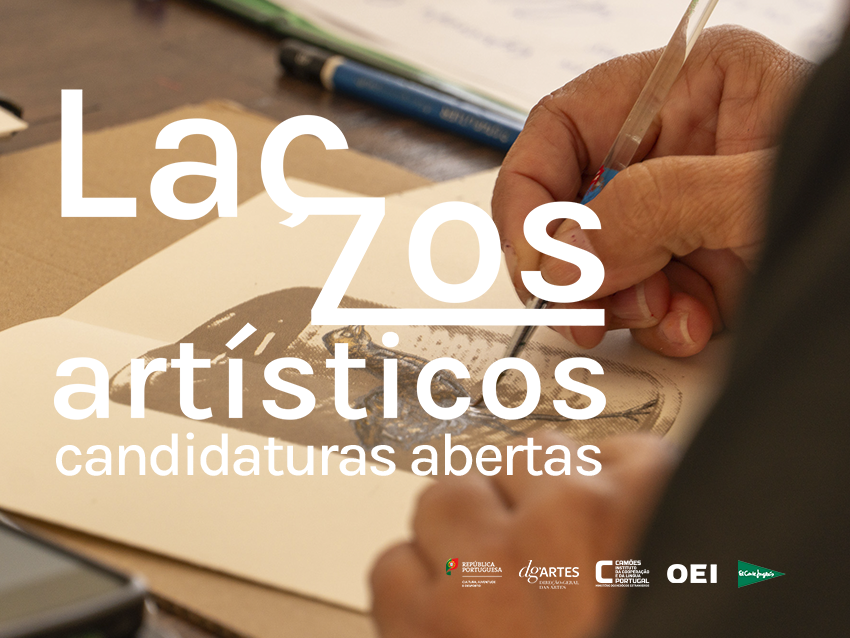
The second edition of Laç(z)os Artísticos is open until 15 September with 20 mobility grants covering travel and insurance. Three are ring-fenced for young artists from Portuguese-speaking Africa and Timor-Leste.
Apply / Learn moreThe first round of Laç(z)os Artísticos handed out eleven grants. This one has twenty, and applications close on 15 September.
The programme pays for artists to travel and develop a project outside their own country, within a bloc that combines the CPLP member states with the Ibero-American countries. Each grant is worth a maximum of €2,250 and covers the cost of the journey, health and travel insurance included. Eligible fields are visual arts, performing arts, street arts and cross-disciplinary work, and the full rules and application form sit on the DGARTES page.
The three grants that do not compete with the rest
Three of the twenty are Laç(z)os Artísticos CPLP grants, with their own perimeter. They go to applicants aged 18 to 30 living in the Portuguese-speaking African countries or Timor-Leste who want to bring a project to Portugal.
That is the sharpest change from the first edition, and it is worth pausing on. An artist in Bissau, Praia or Dili is no longer competing for the same seventeen places as everyone else. In mobility schemes, a ring-fence like that is often what separates a realistic application from a theoretical one.
What the first edition looked like
Useful as a gauge of what to expect. Eleven grants went out across six fields: dance, street arts, circus, photography, music and cross-disciplinary work. The host countries were Brazil, Cape Verde, Chile, Peru, Portugal and São Tomé and Príncipe, and the artists themselves came from Argentina, Brazil, Colombia, Cuba, Mozambique and Portugal.
So not everything routes through Lisbon. South-to-south movement is built into how the programme is drawn.
Who is behind it
The cooperation protocol was signed in July and brings together DGARTES and Camões, I.P. on the Portuguese side, the OEI as the Ibero-American multilateral body, and El Corte Inglés as a private partner. That is an unusual mix for a mobility scheme, and it explains why the amount per grant is modest while the geographic reach is not.
If your project needs more than a plane ticket, the Gulbenkian is running its own internationalisation support with a €5,000 ceiling on a later deadline. Applying to both is not a conflict, provided it is the same project and you are not claiming the same expense twice.
Image: DGARTES / Camões, I.P. / OEI