Portugal's Brazilians backed Lula by far more than Brazil did (Faro was the exception)
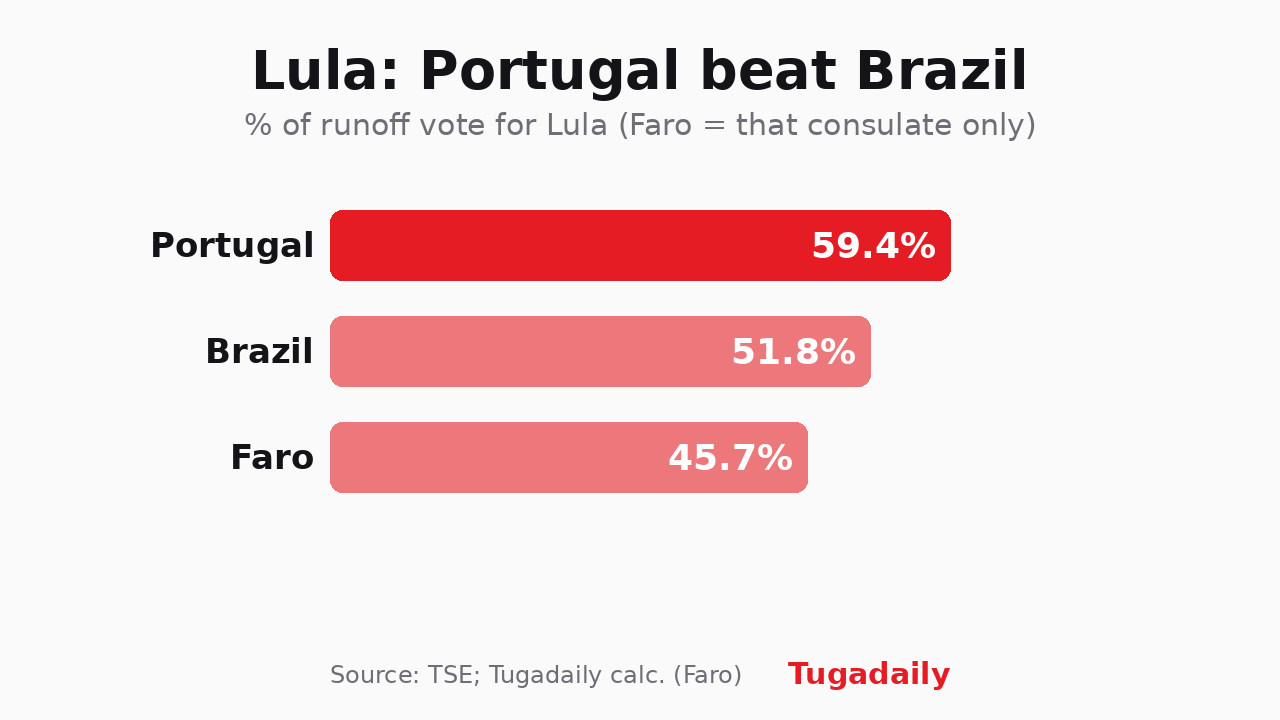
Brazil's electoral court gave Lula 51.79% against Flávio Bolsonaro's 48.21%. Among Brazilians voting in Portugal he took 59.42%, but lost the Faro consulate.
Luiz Inácio Lula da Silva has won a fourth term as Brazil’s president. On Sunday night Brazil’s electoral court announced his re-election with 64,256,232 votes, or 51.79% of valid votes, against 59,826,041 (48.21%) for Flávio Bolsonaro.
That is a margin of about 4.4 million votes out of 128.2 million cast. More than 158 million Brazilians were eligible, and abstention fell to roughly 19.2% from 21.08% in the first round.
Portugal saw it differently
Brazilians registered in Portugal were far less divided. Lula took 34,319 votes here and Flávio Bolsonaro 23,433, which works out at 59.42% to 40.58%. In Brazil the gap was three and a half points. In Portugal it was more than eighteen.
That fits the pattern from three weeks ago. As we noted in our guide to voting in the runoff from Portugal, Lula had already won the Portuguese first round 52.45% to 38.57% while trailing back home. This time he led in both places, but the Portuguese lead stayed far wider.
The Algarve exception
Portugal’s three consular posts did not vote alike:
- Lisbon: 14,948 for Lula, 10,548 for Flávio Bolsonaro
- Porto: 10,356 for Lula, 7,559 for Flávio Bolsonaro
- Faro: 1,097 for Lula, 1,305 for Flávio Bolsonaro
Counting only votes for the two candidates, Lula got 45.7% in Faro. It is a small sample, just over 2,400 votes from a consulate with nearly nine thousand registered, but it is the one corner of the Portuguese map where Jair Bolsonaro’s son came out ahead.
A messy night, a clear result
Election day had one unusual twist. A court order kept some polling sections open until 7pm Brasília time, after many machines had already shut at 5pm. The court’s president, Kassio Nunes Marques, said afterwards that extending a vote is possible but has to be planned properly. Over the runoff the court handled 2,265 cases.
For Brazilians in Portugal, the largest foreign community in the country, the result settles who sits across the table for the next four years on the things that touch them directly, from pension agreements to mobility within the Portuguese-speaking bloc.
Chart: Tugadaily, data from Brazil's TSE