
Portugal's ministers got more specialised. The parties never loosened their grip
A Fundação Francisco Manuel dos Santos study reads every one of the 507 ministers appointed since 1976. Technical credentials climbed across five decades, and so did the share of ministers carrying a party card — from 52% under Costa to about 70% under Montenegro.
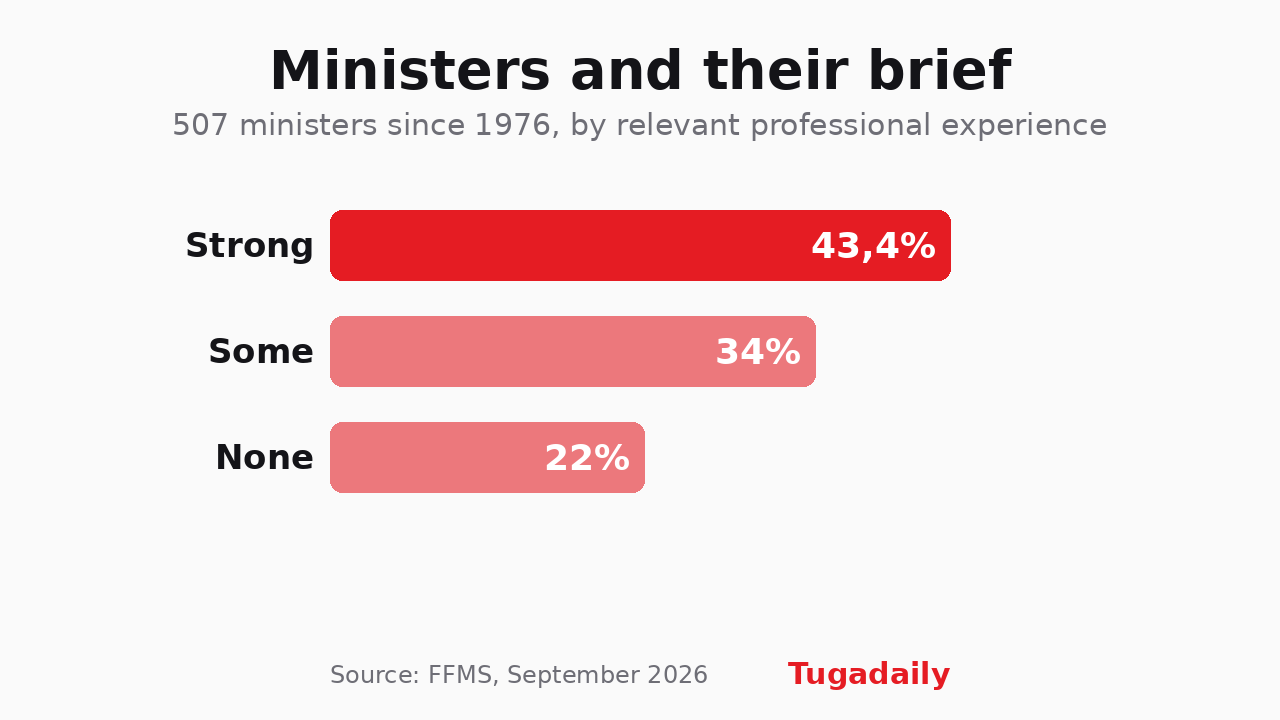
The headline number from Monday’s Fundação Francisco Manuel dos Santos study is the unflattering one. Of the 507 people appointed to a Portuguese ministry since 1976, 113 of them — 22% — took the job with no professional experience anyone would call relevant to it. That comes from Who Governs Portugal? A Comparative Analysis of Ministerial Profiles (1976–2025), coordinated by Marcelo Camerlo and António Costa Pinto, which sets Portugal against Spain, Italy and Greece.
The rest of the distribution is gentler. 43.4% arrived with strong experience in the field, senior roles included, and another 34% had some connection to it without ever reaching the top of the sector. Degrees are close to universal: 98.4% of Portuguese ministers have been through higher education.
But the study’s real finding sits somewhere else, and it is not about CVs at all.
Specialisation rose. Party control did not fall
Over fifty years the technical profile of the Portuguese cabinet did improve. The earliest governments were run by politicians; from Cavaco Silva’s first majority in 1987 onwards, management credentials and prior professional experience steadily gained ground. What never happened was the second half of that story — the part where parties recede.
António Costa’s first two governments are the most balanced of the whole period, at 52% party ministers to 48% non-party, then 53% to 47%. Under Luís Montenegro, since 2024, party ministers run at roughly 69% to 71%. And these are not rank-and-file members. Seventy per cent of the party ministers are what the authors call heavyweights: senior officials, or figures with standing inside the organisation in their own right. They cluster in the coordinating briefs. It is the economic and social portfolios, the technical ones, that make room for outsiders.
Even the outsiders are only partly outside. More than a third of ministers never held a party card, but strip out the three presidentially-initiated governments of the late 1970s and that falls from 36% to about 29% — and half of those are semi-independents, formally unaffiliated people with a lifetime of political collaboration behind them. The authors call the arrangement endogenous technocracy: technical competence absorbed without any loss of party control.
What a bad economy actually does
Here the data pushes back on the textbook. The literature expects parties in trouble to reach for technocrats, because experts buy credibility and absorb the blame for unpopular decisions. Portugal does the opposite. When inflation accelerates and unemployment climbs, it is the share of political ministers that goes up, and the presence of experts shows no statistically significant increase — not even in the technical briefs.
The authors ask for caution, since the dataset is small and an association is not a cause. Still, the pattern is hard to unsee: under economic pressure, loyalty and coordination appear to be valued about as highly as the résumé. Worth holding in mind while reading the tax package the Government has promised for the autumn or the internal rebuild Chega has scheduled for November. Who ends up with the coordinating briefs is rarely an accident.
Chart: Tugadaily, with data from the Fundação Francisco Manuel dos Santos