
How long can Brazil take to answer US tariffs? Its own decree allows 270 days
Brasília opened its first reciprocity case on 13 August. Add up every maximum the decree sets, stage by stage, and the outer limit falls in May 2027.
A month has passed since Brazil opened the first case in its history under the Economic Reciprocity Law, and nothing has been taxed. That is not drift. It is the regulation working as written.
So we read the regulation and did the addition. The decree that puts the law into practice is Decree 12,551 of 14 July 2025, and the deadlines sit in articles 11, 13 and 15. Four stages, each with its own clock, and every one of them slower than a first reading suggests.
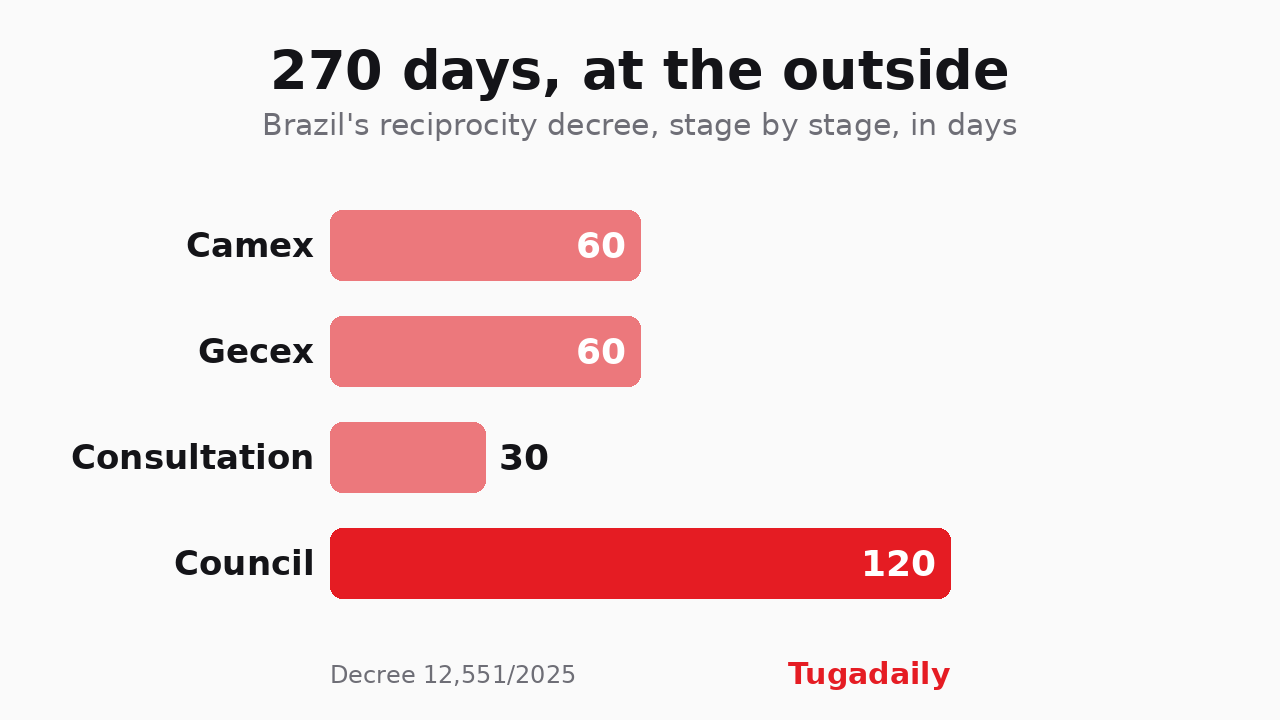
Camex’s executive secretariat gets thirty days to produce the report deciding whether the American measures even fall under the law, renewable once for the same period. Gecex then gets thirty of its own to rule on that finding, also renewable. The draft countermeasures go out to public consultation for up to thirty days. And the Camex Strategic Council, which takes the final decision, gets sixty days renewable by another sixty.
Sixty, sixty, thirty, one hundred and twenty. That is 270 days. Counted from 13 August, the outer edge is 10 May 2027.
The stage with no clock at all
The sharpest detail is not in those numbers. It is article 12, which sets up a working group to design the actual countermeasures once the case is accepted, and attaches no deadline to it whatsoever. The stage where someone decides what gets taxed and by how much is the one stage nobody has to finish.
There is an explicit escape hatch too. The sole paragraph of article 15 lets the Strategic Council defer adoption depending on how diplomatic negotiations are going. In plain terms, as long as someone is still talking to Washington, the file can sit still without breaking a single rule.
Brazil’s development, industry and trade minister, Márcio Elias Rosa, said as much on 19 August. No reciprocity process would finish before December, he said, and ministries were at that point gathering information to hand over within sixty days. He was describing a negotiation, not a retaliation.
The first marker has already gone by. Article 11’s opening thirty days ran out on 12 September with no finding made public, which breaks nothing, because that deadline can be extended by the same period. The next date worth watching is 12 October.
When we wrote this up in August we said a clock had started. It had. It simply runs slowly, and deliberately so: the law was built to give diplomacy room before it gives trade any teeth.
For Portugal the stake is indirect and real enough. Brazil is the largest lusophone partner in Portuguese foreign trade, and a full year of tariff limbo between Brasília and Washington moves the real, the supply chains behind it, and eventually some prices here.
Chart: Tugadaily, from Decree 12,551/2025