Who made Brazil's election AI posts? More than a third came from the candidates' own accounts
Fact-checker Agência Lupa's VigIA monitor confirmed 1,423 political posts made or altered with AI between 16 August and 22 October. About 54% carried no label, even though Brazil's electoral rules require one.
Brazil’s presidential runoff ended on Sunday with Lula re-elected. It also closed the most AI-heavy campaign the country has seen, and the data on who made that content is not what most people would guess.
Agência Lupa’s VigIA monitor reviewed 1,486 suspect posts between 16 August and 22 October and confirmed that 1,423 had been made or altered with AI. The figures are in the project’s third interim report, published the day before the vote.
Not just anonymous accounts
The common assumption is that election AI comes from fake profiles. Of the 1,423 pieces, 548 came from the candidates’ own official accounts, more than a third. Another 560 came from ordinary voters and activists, and only 300 from anonymous accounts or avatars.
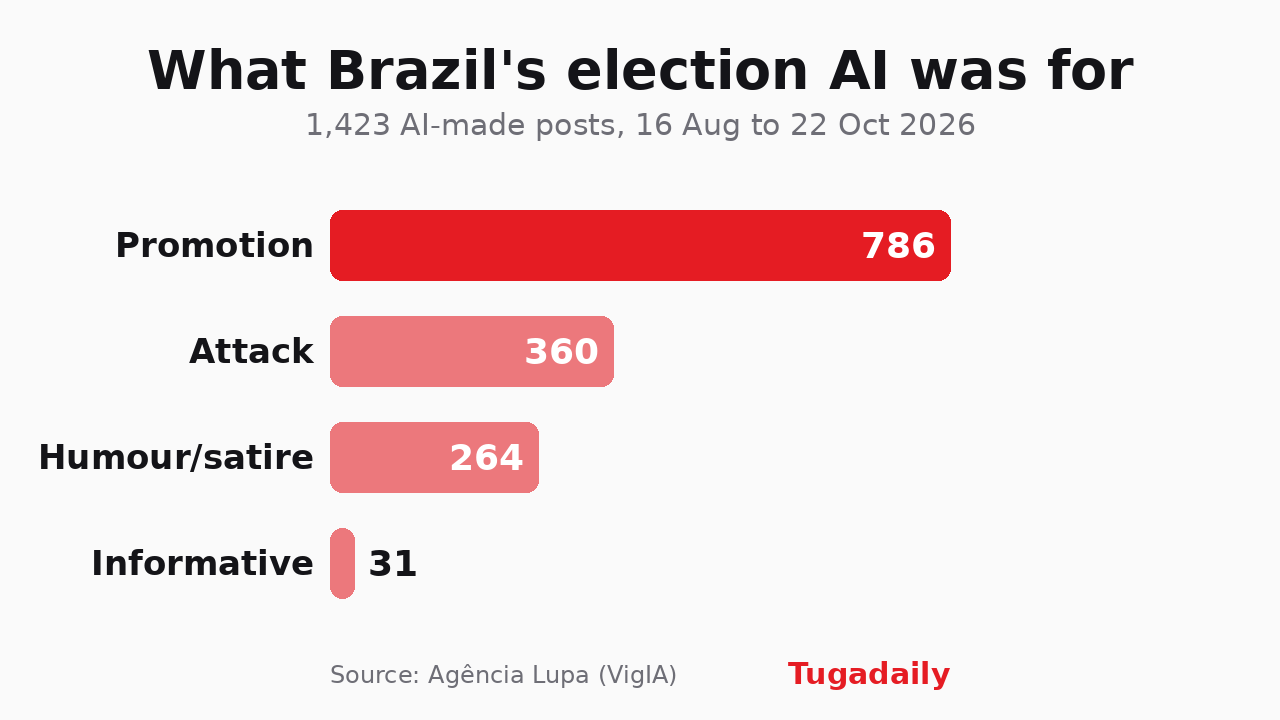
Most of it was not even aimed at a rival. More than half (786 posts) promoted a candidacy, showing candidates in flattering work settings or plugging rallies. Attacks on opponents numbered 360, and humour or satire 264.
The missing label
Brazil’s electoral court requires any campaign material made or altered with AI to say so, and bans deepfakes outright. In practice only 655 posts carried any label: 352 added by the authors, 300 by the platforms and 3 by both. The other 768, about 54%, went out unmarked.
And half of the total (716) was classed as deepfake, or deepfake mixed with other synthetic material, which is exactly the category that is banned.
Where it spread
Instagram accounted for 794 cases and Facebook for 690 (the same piece can appear on both). Lula featured in 508 items and Flávio Bolsonaro in about 247.
One footnote worth adding. The report’s opening line says there was almost one manipulated post every hour. By the study’s own count the average was 20.9 a day, a little under one an hour. It does not change the conclusion. It just shows the numbers reward reading to the end.
By Oliver Grant
Chart: Tugadaily, data from Agência Lupa