Want to see the Leonids in Portugal? Tonight in the south is your best shot
The International Meteor Organization puts the Leonid peak on the night of 16-17 November, and the usual timing points to late on the 17th. IPMA forecasts rain across almost all of mainland Portugal on Tuesday and Wednesday, so the clearest window is the small hours of tonight in the Alentejo and Algarve.
The Leonids, November’s meteor shower, are at their peak. The International Meteor Organization puts the maximum on the night of 16 to 17 November, which means the small hours of tonight. On the solar-longitude timing the peak usually follows, the busiest moment lands around 11.45pm on Tuesday the 17th. So, two nights.
The catch is the weather. IPMA’s city forecasts give a 100% chance of rain on Tuesday and Wednesday in Lisbon, Porto, Évora, Beja, Faro, Aveiro, Bragança and Viseu. Tonight there is also a yellow warning for persistent rain in Viana do Castelo, Braga, Porto, Vila Real and Aveiro until 6am.
Where can you see the Leonids tonight?
In the south, before dawn. For Monday IPMA has only partly cloudy skies and next to no rain in Évora (4%), Beja (0%) and Faro (2%). By our sums the Moon sets at about 11.20pm in the Alentejo and Algarve, and the radiant (the point in Leo the meteors appear to come from) clears the horizon just after, around 11.45pm. Proper darkness lasts until about 6.15am.
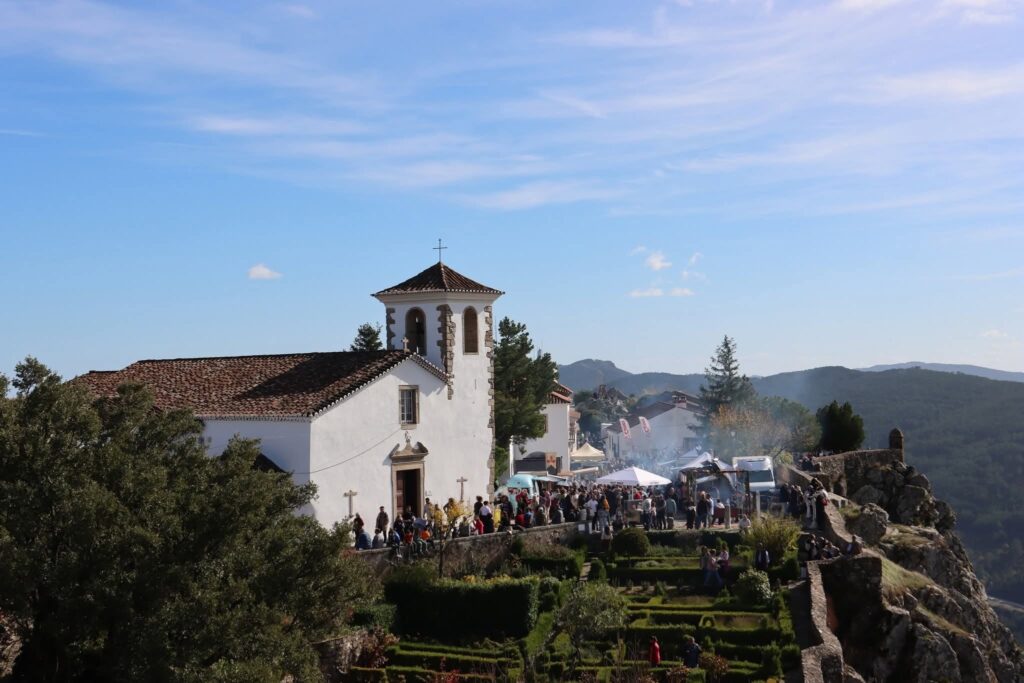
In practice: head out after midnight, get well away from street lights and give your eyes 20 minutes to adjust. Face east without staring at one spot. Alqueva has the darkest skies in the country, and the photo above was taken just down the road, near Mértola.
How many Leonid meteors will you see?
Not many, and that is worth knowing before anyone drives an hour in the dark. The IMO expects around 10 an hour under perfect skies, and real counts usually come in lower. The upside is speed. Leonids hit the atmosphere at more than 70 kilometres a second, among the fastest of the year, and the odd one leaves a trail that glows for a few seconds.
The storms that made this shower famous, in 1966 and 2001, are not on the cards. According to the IMO, Earth will not cross a dense cloud of debris from comet 55P/Tempel-Tuttle until 2099.
What if it is cloudy tonight?
There are weaker second chances. In Madeira, IPMA forecasts few clouds over Funchal on Tuesday (2% chance of rain), and there the Moon does not set until about 1am on Wednesday, leaving more than five dark hours around the peak. In the Azores, Ponta Delgada clears on Wednesday.
On the mainland, Thursday brings a break in the south again (8% in Évora, 20% in Beja). The shower runs until 30 November, fading each night but still there. If you caught the bug in August with the Perseids, this is the winter edition: shorter, colder, and very much a coat job.
Image: S. Conceição / ESO / Wikimedia Commons (CC BY 4.0)