
96% of the Moon slides into Earth's shadow before dawn on Friday, and Portugal is well placed to watch
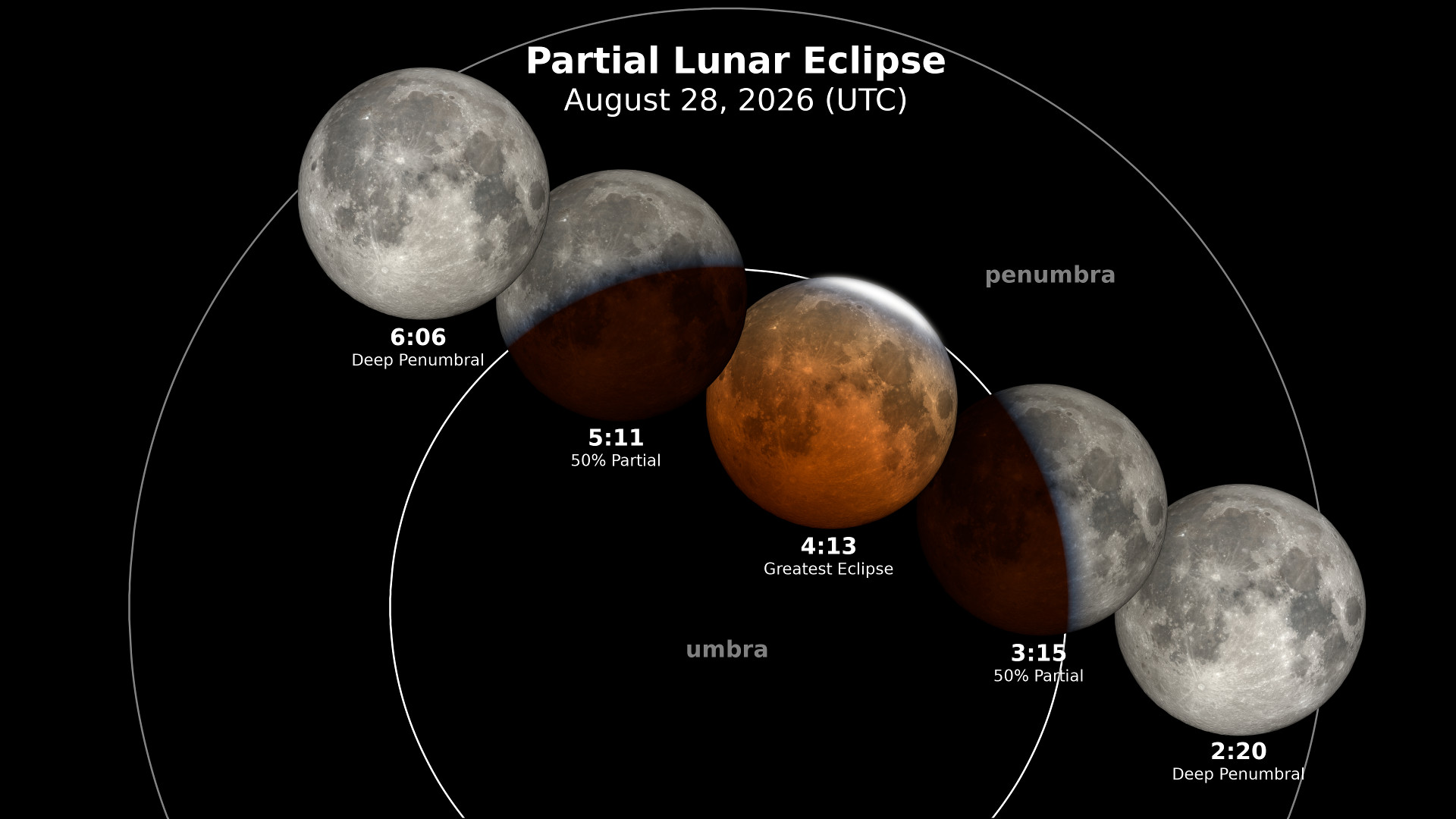
The partial phase starts at 3.33am in Lisbon and peaks at 5.13am, with 96.3% of the lunar disc inside Earth's umbra. Unlike the 12 August solar eclipse, this one needs no eye protection.
Two weeks after half the country spent an afternoon squinting at the Sun through cardboard glasses, there is another eclipse coming. This one asks for the opposite: nothing over your eyes, and an alarm set.
In the early hours of Friday 28 August, the Moon crosses Earth’s shadow. Technically it is a partial eclipse, but only just. At greatest eclipse, 96.3% of the lunar disc sits inside the umbra, the part of the shadow where Earth blocks the Sun completely. The eclipsed portion does not vanish. It turns coppery, for the same reason sunsets are red.
The times, mainland Portugal
Official times are published in universal time, and the mainland and Madeira are currently an hour ahead. Converted, the sequence runs:
- The Moon enters the penumbra at 2.23am. It is subtle enough that you may not notice.
- The partial phase begins at 3.33am, when the dark shadow starts biting into the disc.
- Greatest eclipse is at 5.13am.
- The partial phase ends at 6.52am.
- The penumbra clears shortly after 8am.
In the Azores, take an hour off each of those: greatest eclipse falls at 4.13am. Fred Espenak’s computed contacts give the partial phase a duration of 3 hours and 19 minutes, which is long for an eclipse that never reaches totality.
How to watch, and what you do not need
You need nothing. No lunar eclipse requires eye protection, unlike the solar eclipse on 12 August, which demanded certified filters and a certain amount of patience. Binoculars sharpen the edge of the shadow and a telescope brings out the colour, but a balcony will do.
What actually matters is your horizon. Seen from western Europe, the Moon sinks westward as the eclipse deepens, so the difference between a good night and a frustrating one comes down to clear sky and nothing tall to the west. Portugal is among the better places in Europe for it: NASA puts the Americas, western Europe and western Africa inside the zone where the partial phase is visible.
When the next one comes
This eclipse belongs to Saros cycle 138 and is the twenty-ninth of 82. The previous one in the same series fell on 16 August 2008. The next arrives on 7 September 2044, which is an unsubtle argument for setting the alarm.
If you sleep through it, the consolation is that August 2026 has already been generous. A total solar eclipse and the Perseids in the same month is not a combination that comes round often.
Image: NASA's Scientific Visualization Studio / Ernie Wright