
The 351,000 public workers behind Portugal's 2 October strike are not teachers or nurses
Three CGTP-affiliated unions have called out the general career grades of the public administration — operational assistants, technical assistants and senior technicians — with a Lisbon march at 11am. They want pay talks opened now rather than next year.
Say public-sector strike in Portugal and most people picture teachers, or nurses. The one called on Monday for 2 October is neither, and it is bigger than either.
It was announced jointly by the national federation of public and social service unions, by STAL, which organises local and regional government staff, and by the union for Lisbon city council workers. All three sit under the CGTP confederation. The strike covers the general career grades across central, local and regional administration, and there is a march in Lisbon the same morning at 11.
Who are the general career grades striking on 2 October?
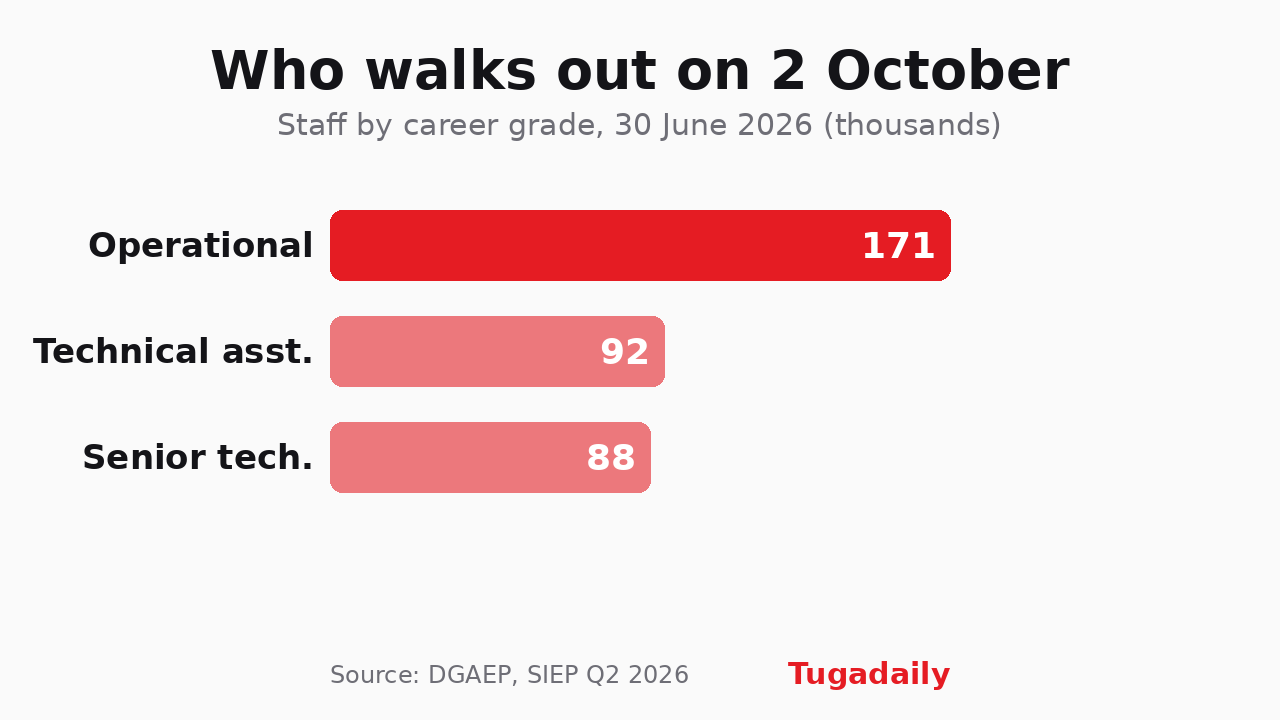
There are three of them, and the label means nothing unless you work there. The most recent official public employment figures, for 30 June, count 170,800 operational assistants, 92,200 technical assistants and 88,400 senior technicians. That is 351,000 people.
In practice: operational assistants unlock the schools in the morning, watch the playground and serve lunch, collect the bins for the councils, clean the wards and move patients around hospitals. Technical assistants are the people at the counter in the town hall, the land registry, the tax office and the school secretariat. Senior technicians are the lawyers, engineers and economists who process the applications that then take months.
Notice who is missing from that arithmetic. Teaching is a separate career of its own, another 143,300 people. Doctors, nurses, police officers and the armed forces all have their own grades too. General grades and teachers together account for 64.4% of everyone the Portuguese state employs, which means this strike shakes the single largest block of the machine without touching any of the professions that normally make the front page.
What the unions are asking for
The demand is easy to state and hard to cost: an immediate uplift for these grades, formal recognition of what each job actually involves, and pay talks opened now instead of being pushed into next year. The unions argue that operational assistants are the worst-paid group in the public administration, and that the gap between their pay and the national minimum wage has narrowed to almost nothing.
The government’s calendar cuts the other way. Public-sector pay is usually negotiated in the autumn, alongside the state budget, and pulling that forward is precisely the point of the exercise.
If you rely on any of these services, the practical facts are that there are four weeks to go and that minimum service levels still have to be agreed. Closed schools, disrupted bin collections and thinner counter service is the picture the unions themselves are painting. It lands in a busy season: on Monday the polytechnics said the state still owes them 38 million euros in unpaid performance assessments, and smaller grades such as prison reintegration staff have spent months pressing for risk supplements.
Chart: Tugadaily, with data from DGAEP (SIEP, Q2 2026)