
What happened to hospital teleconsultations after the pandemic? We added up six years of SNS data
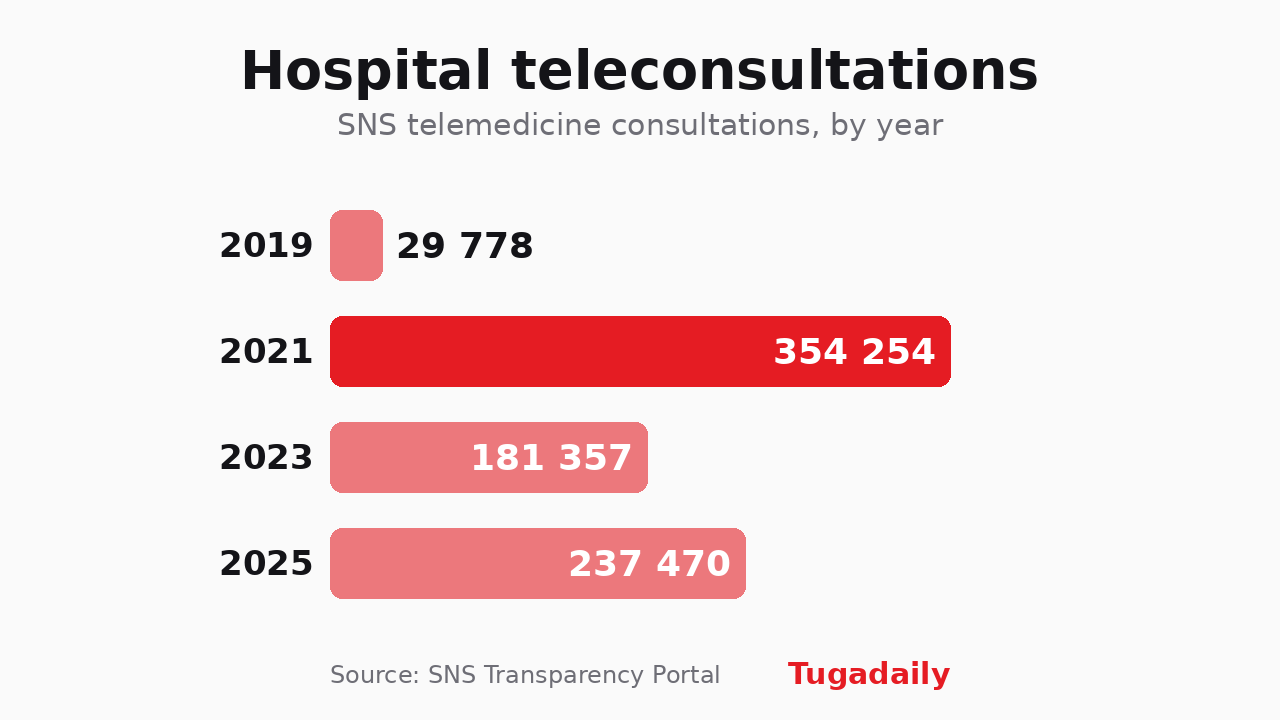
Portugal's health service publishes its telemedicine numbers as open data, so we summed them across every institution: 29,778 consultations in 2019, 354,254 at the 2021 peak, 237,470 last year. Through May 2026 the count is 133,681, up 37 per cent year on year.
Portugal’s health service publishes a great deal about itself, and almost nobody reads it. So we opened the SNS Transparency Portal, pulled the telemedicine consultations dataset and added up every institution, month by month, back to 2013. The series runs cumulatively within each calendar year, so the December figure is the year’s total.
In 2019, the last full year before covid, SNS hospitals and local health units recorded 29,778 telemedicine consultations. In 2021 they recorded 354,254.
Then came the fall everyone predicted. Numbers dropped to 195,572 in 2022 and 181,357 in 2023, roughly halving in two years. What happened next is the part nobody predicted. The line turned back up: 228,492 in 2024, then 237,470 in 2025. It has never gone anywhere near where it started. Last year sat 7.9 times above 2019.
2026 is running faster still
Through May, the portal counts 133,681 hospital telemedicine consultations. At the same point in 2025 the figure was 97,259. That is a 37 per cent increase with seven months of the year still to come.
What the count does not cover
Be clear about the boundary. This dataset covers hospitals and local health units. It does not include remote appointments at health centres, which are the larger share of the total and, on figures reported this week, stood at roughly 459,000 through July. Put the two halves together and 2026 is heading past a million teleconsultations across the whole service, a level only 2021 has reached.
Nor can we tell from here how many of these replaced a journey and how many were added on top of one. The portal counts appointments, not trips saved.
What the data does show, without much room for argument, is that hospital telemedicine stopped being an emergency measure. It arrived with a public health crisis and stayed as ordinary practice, inside a service still wrestling with waiting lists and now testing structural fixes such as the first state health centre handed to private management. If you live two hours from a central hospital, the difference between a video appointment and a round trip is not an administrative detail. It matters as much as knowing where to get this autumn’s flu jab.
Chart: Tugadaily · data from the SNS Transparency Portal