
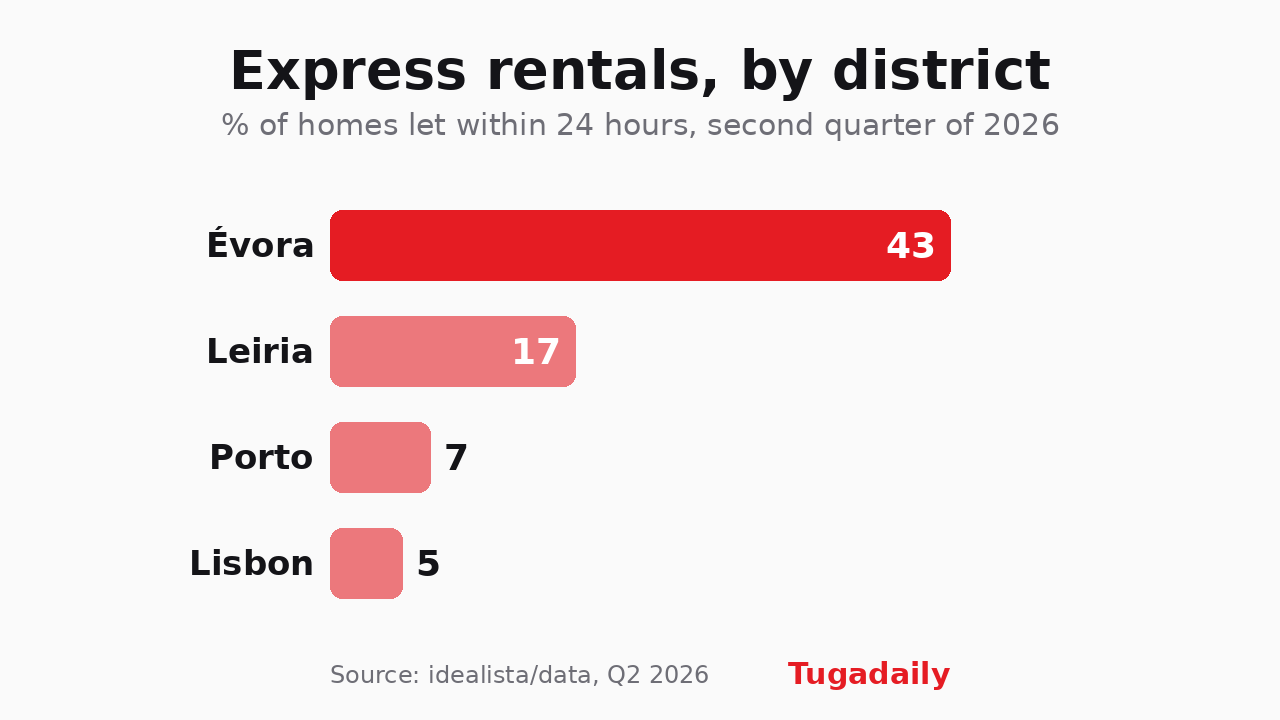
43% of rental listings in Évora disappear within 24 hours
In the second quarter, 43% of rental adverts in the Évora district left the market inside a day. Lisbon managed 5% and Porto 7%. Nationally the figure fell from 11% to 7% quarter on quarter.
House-hunting in Évora is a different sport. Almost half the listings in the city vanish before most people manage to book a viewing.
The figures come from idealista/data and cover the second quarter of this year. Across the Évora district, 43 per cent of homes advertised to rent left the market in under 24 hours. Narrow it to the city and the share climbs to half.
The map is not the one you would draw
Instinct says Lisbon. Instinct is wrong.
In the capital, only 5 per cent of adverts came down the same day, and within the city of Lisbon the figure drops to 4 per cent. Porto recorded 7 per cent across the district and 6 in the city. Portugal’s hottest markets by price turn out to be its slowest to close a deal.
After Évora come Leiria on 17 per cent, Santarém on 16, and Castelo Branco and Faro tied on 13. Braga and Setúbal sit at 11. Among cities, Évora is followed by Faro on 25 per cent, Santarém on 20 and Vila Real on 17.
Five districts registered no express rental at all in the quarter: Beja, Bragança, Guarda, Portalegre and the island of São Miguel.
Why the small districts move fastest
The likely explanation has less to do with frenzied demand than with thin supply. Where only two or three homes are listed at any moment, anything half-decent goes immediately, because there is no alternative to weigh it against. Lisbon carries far more listings, so a searcher can compare and take their time. Time on market measures the depth of supply as much as the heat of demand.
That also means speed is not a compliment to a market. In a district where everything goes in a day, anyone arriving from outside who cannot decide on the spot is simply out of the running.
Nationally, the pace eased
The national average was 7 per cent, or one in every fourteen homes advertised. That is a meaningful fall from 11 per cent the previous quarter, even though demand pressure has not let up: each listing drew an average of 24 enquiries in the quarter, 36 per cent more than a year earlier.
The backdrop is familiar. The stock of homes to rent keeps shrinking, and the government is pushing an urban lease reform designed to give landlords enough confidence to put properties back on the market, though it still has to clear parliament. Prices, meanwhile, carry on doing what they do, with Faro overtaking Lisbon as the most expensive district to rent in in July.
Infographic: Tugadaily · data from idealista/data