Paying down a Portuguese mortgage? Waiting for January only pays below a 4.15% rate
Parliament has backed ending the 0.5% early repayment fee on variable-rate home loans, with the budget's final vote on 24 November. We ran the numbers on whether holding off is worth it.
If you have a variable-rate mortgage in Portugal and savings set aside to pay it down, you now have a timing question. The fee for repaying early looks set to disappear in 2027. Parliament voted on Wednesday night, in the line-by-line stage of the State Budget, for both a PSD/CDS suspension until 31 December 2027 and a Socialist amendment scrapping the fee for good. The final budget vote is set for 24 November.
None of it is law yet. And waiting has a price of its own, which for some borrowers is bigger than the fee.
How much does early repayment cost in Portugal today?
Up to 0.5% of the amount repaid on variable-rate loans, or €100 for every €20,000. The charge was suspended for several years, but that relief was not renewed for 2026. By September borrowers had repaid €6.43 billion early, and banks had collected at least €32 million in fees.
What did Portugal’s parliament approve on the early repayment fee?
Two amendments, on the same day. The PSD/CDS one suspends the fee until the end of 2027 and, on mixed-rate loans, applies only during the variable-rate period. The Socialist one, passed without PSD or CDS support, bans it permanently during variable-rate periods. Banks can still pass on third-party costs such as registry fees, notaries and taxes, and fixed-rate periods are left out.
Is it worth waiting until January to repay?
That depends on your interest rate. While you wait, you keep paying interest on money you could have cleared. The sum is short: divide 0.5% by your annual rate and multiply by 365. The answer is how many days of waiting the fee would cover.
At the average rate across Portuguese mortgages, 3.194% in September according to the national statistics office, that is about 57 days. At 2.5% it is 73, at 3.5% it is 52 and at 4% it is 46. There are 44 days between today and 1 January, which puts the tipping point at roughly 4.15%. Above that, waiting costs more than the fee.
In euros, at 3.194%, holding back €20,000 costs about €77 in interest and saves €100, a gain of €23. On €50,000 the gain is around €57. At 4.5%, the same €20,000 costs €108 in interest, and waiting loses.
What should you check before deciding?
Three things: your contract’s actual rate, the fee your bank really charges, and the notice it requires. If the money earns interest in a deposit meanwhile, waiting gets slightly cheaper. There is still some risk, though less than before: the wording is only settled at the final vote, and the law must then be signed and published. If the change is not in force on 1 January, waiting costs more than these sums suggest.
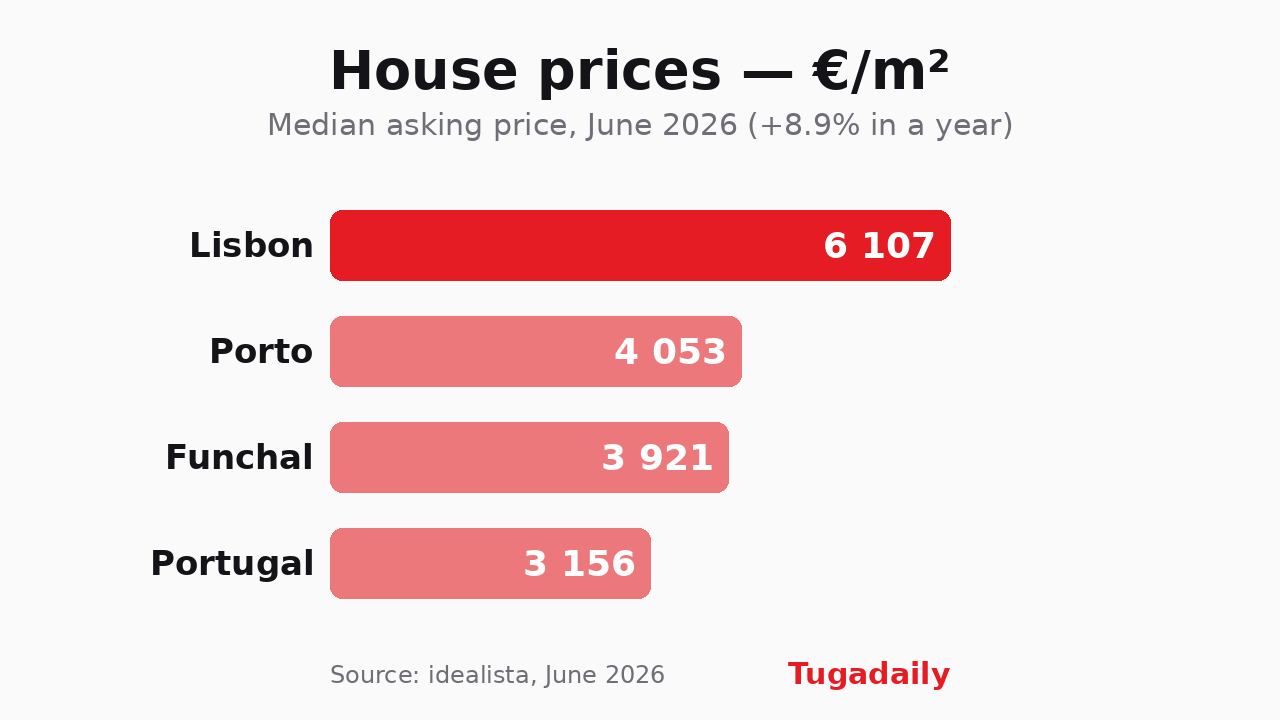
It is one more sum for recent buyers, alongside the IMT Jovem rules when you change jobs, in a market where prices keep climbing.
Image: GualdimG / Wikimedia Commons (CC BY-SA 4.0)