

PT
Teixeira Lopes sculpture group above the rostrum of the plenary chamber at the Palácio de São Bento, with the national shield at its centre and the words LEX and IVS carved on the capitals
Politics 11 September 2026

Portugal's parliament is back on Wednesday with six sitting days booked and a budget due on 12 October

The leaders' conference has set the autumn agenda: national exams, online gambling, the start of the school year, the INEM shake-up and the urban tenancy regime. The prime minister's first debate waits until 9 October.

The new legislative session opens on Wednesday with six plenary days already booked before the end of September. At the far end of the queue sits the date that matters to everyone: the 2027 State Budget proposal must reach the Assembly of the Republic by 12 October.

The budget framework law puts the deadline at 10 October. This year that falls on a Saturday, so it slides to the following Monday.

What lands on each day

The 16th opens proceedings. Government bills on the revision of the statute governing the administrative and tax courts go to the floor, the annual internal security report is debated, and MPs consider the Left Bloc’s request for a parliamentary inquiry into the education ministry’s national exam process.

The 17th brings a topical debate requested by Livre on online gambling and betting, which the party wants regulated as a public health problem rather than merely a licensed industry.

The 23rd belongs to the Communists, who have called a debate on the start of the school year. They have already flagged their priorities: unfilled teaching timetables, shortages of teachers and specialist staff, and what the school year costs a household.

The 24th is a slot claimed by Chega, with the subject still unannounced.

The 25th is the crowded one. Health bills from the Government and the PSD, a Socialist resolution on the cost of living, a Liberal Initiative bill on transparency at the public broadcaster RTP, and a parliamentary review of the new INEM statute requested by Livre alongside the Left Bloc and the Communists.

The 30th closes the month. MPs debate the legislative authorisation the Government wants in order to rewrite the urban tenancy regime, a Chega bill on veterans’ pensions, a PSD proposal making helmets compulsory on electric scooters, a Communist bill on protecting access to housing, and a CDS proposal on hiring autonomy for teachers in private and cooperative schools.

Where is the prime minister?

The session’s first fortnightly debate with the prime minister does not happen until 9 October, the second-to-last working day of the budget delivery window. The debate preparing the next European Council falls on the same date, stacking two demanding conversations on the eve of the year’s biggest document.

Before that, the Government has meetings booked with every party in parliament for the end of September, where it will set out the broad lines of the proposal and take the temperature. The declared strategy is a budget without riders — nothing beyond the public accounts themselves — precisely to cut down the number of reasons anyone might have to vote it down.

One file on that list already reaches into people’s kitchens. The rewrite of the urban tenancy regime arrives on 30 September, in the same autumn that rents can rise by 2.56% in 2027. And the 23 September debate runs alongside the Safe School operation now under way in more than 4,400 schools.

By Tomás Vasconcelos

Image: GualdimG / Wikimedia Commons (CC BY-SA 4.0)
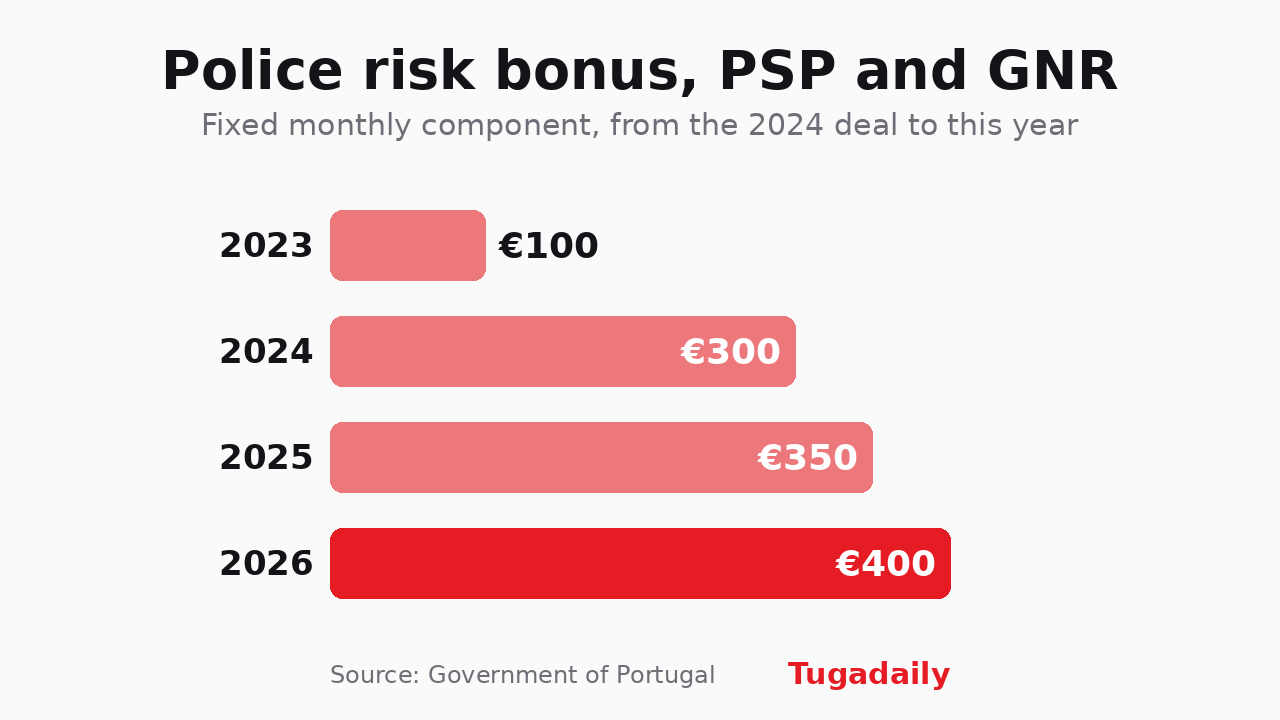
Bar chart of the fixed monthly risk bonus for Portugal's PSP and GNR: 100 euros in 2023, 300 in 2024, 350 in 2025 and 400 in 2026
Politics 19 September 2026

If you check passports for Portugal, the government is offering you €160 a month

The proposal tabled on 17 September gives €160 a month in 2026, backdated to July, and €230 in 2027, but only to the PSP and GNR border units. Six of the seven PSP unions at the table were willing to negotiate. Two organisations are still holding protests over the 2024 deal.

Read that the government has offered Portuguese police another €160 a month and you will want the next line. The supplement tabled on 17 September is not for the PSP or the GNR as a whole. It is for two units: the PSP's national foreigners and borders unit, and the GNR's coastal and border control unit. The offer is €160 a month in 2026, backdated to July, rising to €230 in 2027. The interior ministry grounds it in how particular the job is: dedicated…

Continue reading
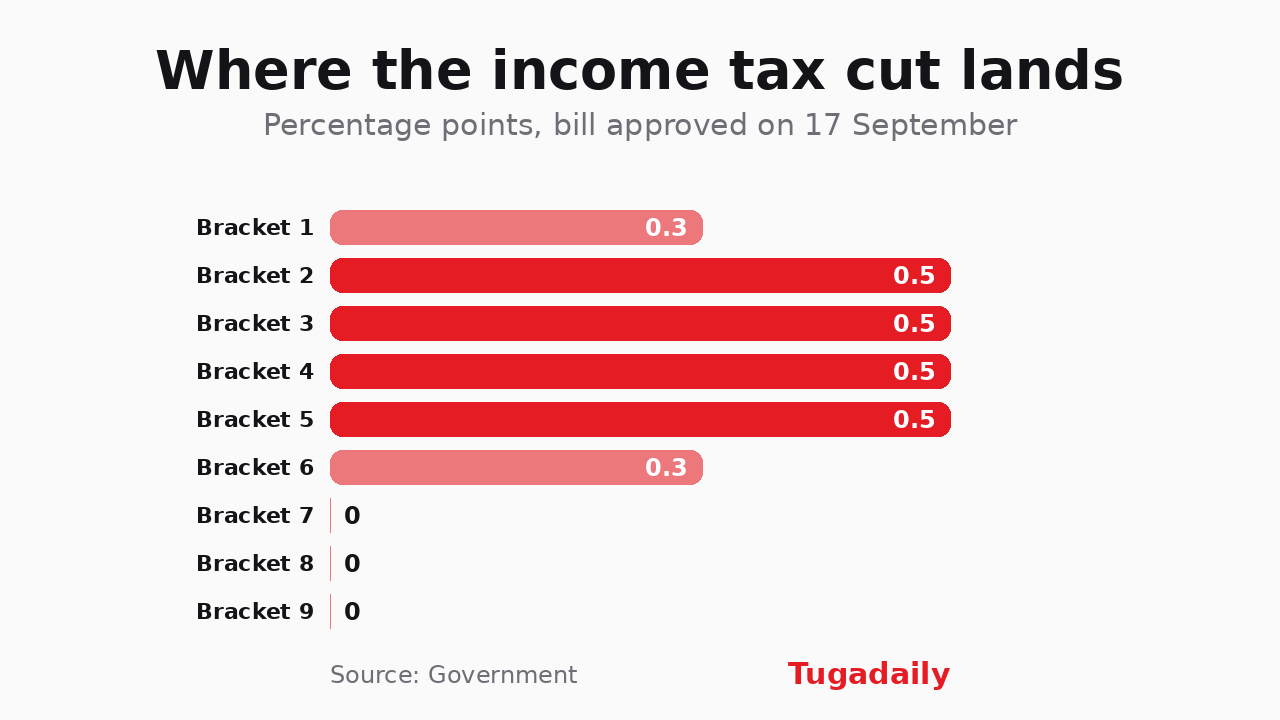
Bar chart of the Portuguese income tax cut by bracket: 0.3 points in the first, 0.5 in brackets two to five, 0.3 in the sixth and nothing in brackets seven to nine
Politics 18 September 2026

Portugal's fifth income tax cut still needs a vote before November payslips change

Rates fall by 0.3 to 0.5 percentage points across the first six brackets, at a cost of about 400 million euros and covering nearly three million households. The government approved the bill on Thursday; parliament has not voted on it.

Portugal's cabinet signed off a bill on Thursday that lowers IRS income tax rates across the first six brackets. The cut runs from 0.3 to 0.5 percentage points, costs roughly 400 million euros and, according to the government's own statement, reaches close to three million households. The word doing the heavy lifting there is bill. Tax rates are not changed in cabinet. They are changed by a law passed in the Assembleia da República, and that is where the…

Continue reading
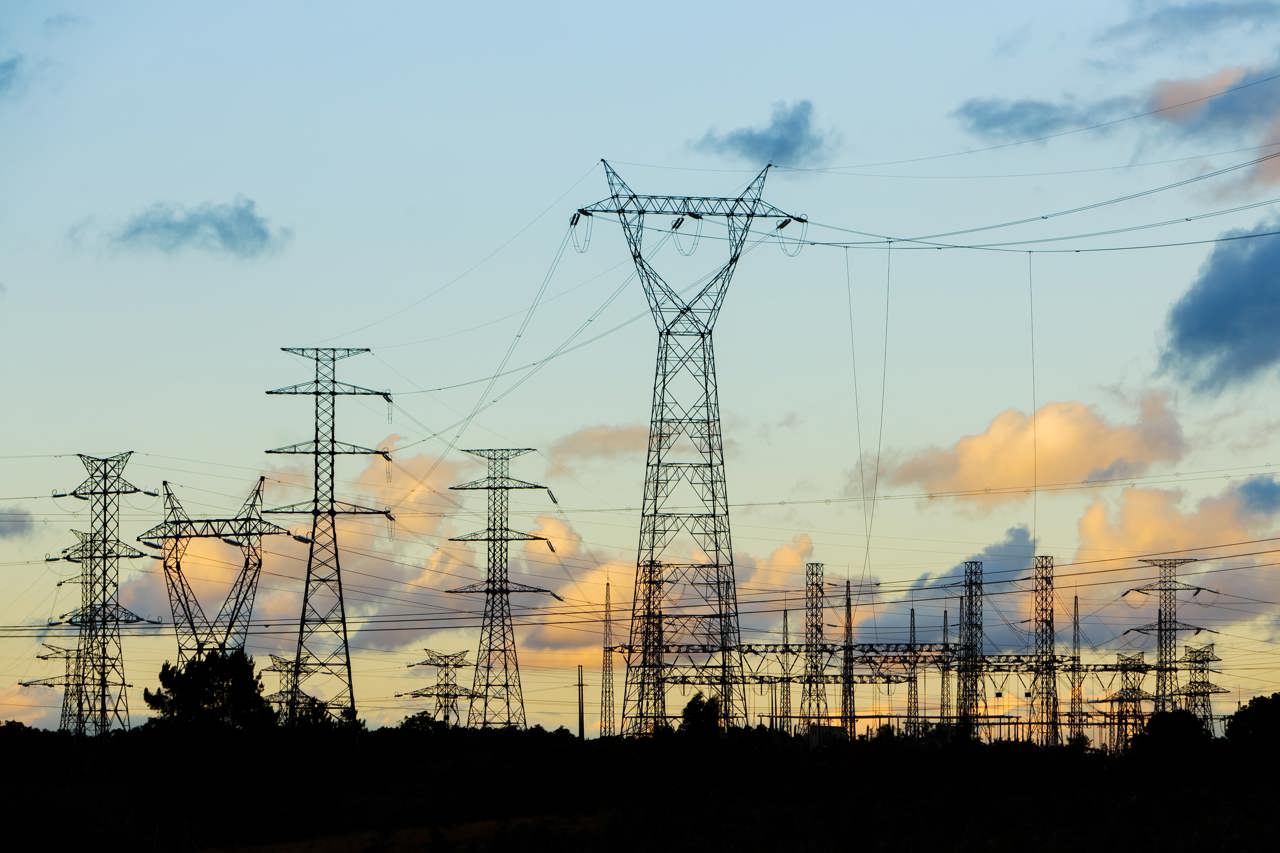
Very high voltage lines and pylons on REN's electricity transmission grid in the late afternoon, against an orange sky
Politics 17 September 2026

The Portuguese state is back in REN with 13.7%, and parliament wants a rulebook for the next one

Parpública notified the market regulator of a qualified holding of 91,723,676 shares, completed on 7 September once the Court of Auditors signed off. The Socialists want statutory criteria for when the state may buy into a private company.

The deal is done. REN told the market that Parpública holds a qualified stake of 91,723,676 ordinary shares, representing 13.7% of its capital, putting the Portuguese state back on the share register twelve years after it left. The shares changed hands and the price was paid on 7 September. When we wrote about this in August the open question was procedural. The contract with Pontegadea had been signed on 14 August but hung on a condition, and we said the…

Continue reading
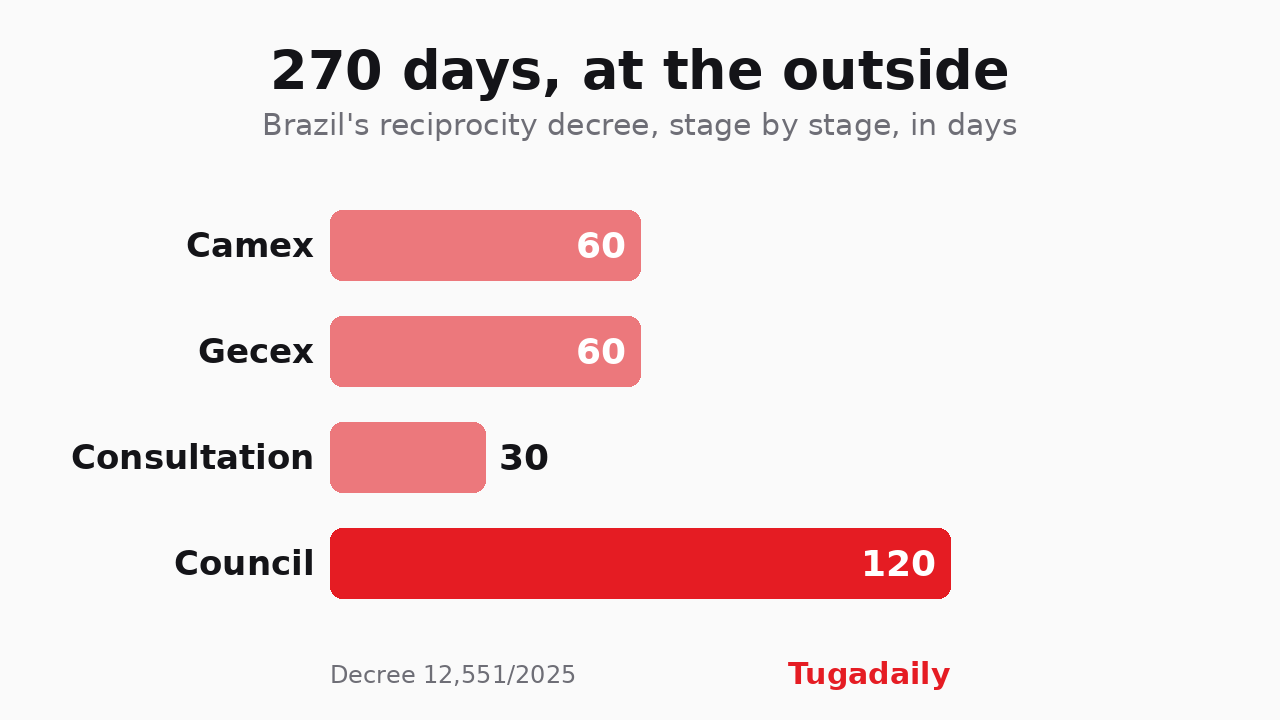
Bar chart of the maximum deadlines in Brazil's reciprocity decree: Camex 60 days, Gecex 60, public consultation 30 and the Camex Council 120
Politics 16 September 2026

How long can Brazil take to answer US tariffs? Its own decree allows 270 days

Brasília opened its first reciprocity case on 13 August. Add up every maximum the decree sets, stage by stage, and the outer limit falls in May 2027.

A month has passed since Brazil opened the first case in its history under the Economic Reciprocity Law, and nothing has been taxed. That is not drift. It is the regulation working as written. So we read the regulation and did the addition. The decree that puts the law into practice is Decree 12,551 of 14 July 2025, and the deadlines sit in articles 11, 13 and 15. Four stages, each with its own clock, and every one of them slower than a first reading…

Continue reading
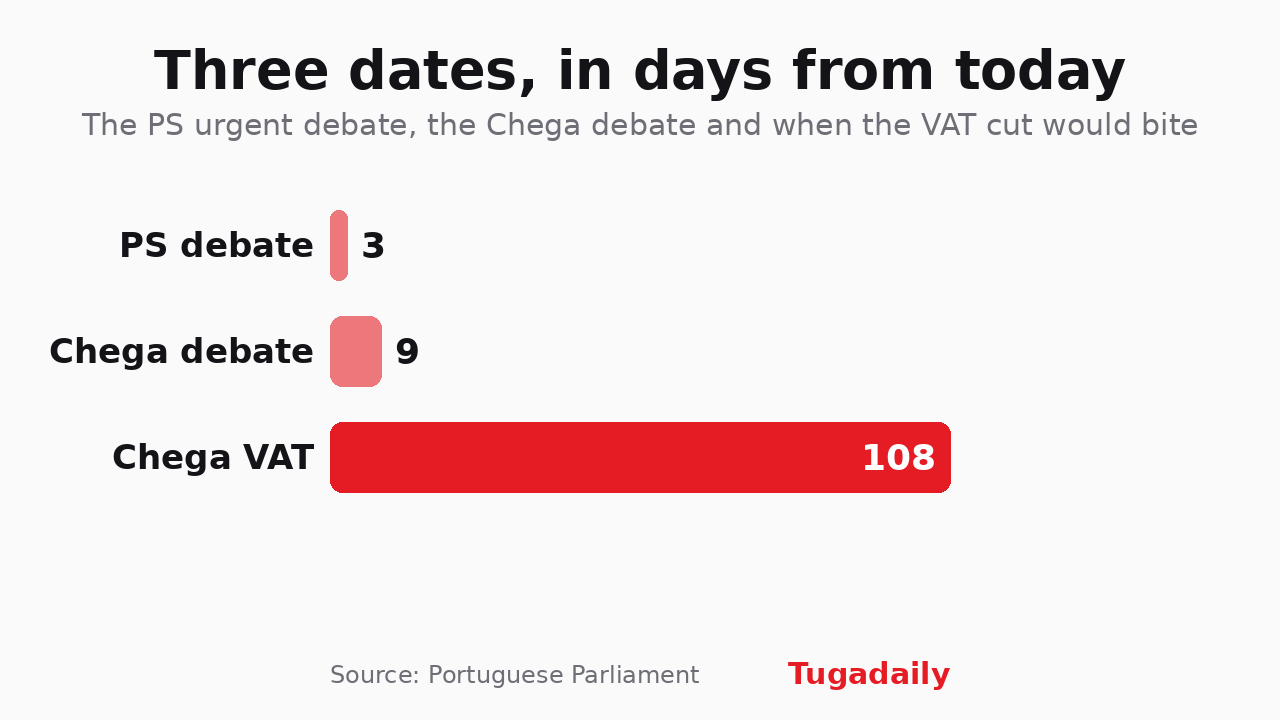
Bar chart of three dates in days from 15 September: PS debate 3, Chega debate 9, Chega VAT cut 108
Politics 15 September 2026

The Socialists booked their cost-of-living debate for Friday. Chega's own measures only bite in January

The request for an urgent debate reached the speaker's office on Monday morning, six days ahead of Chega's scheduled slot on 24 September. Chega's VAT bills would not take effect until January 2027.

Portugal's new parliamentary session opens on Wednesday, and the first fight is already in the diary. On Monday morning the Socialists asked for an urgent debate on the rising cost of living, to be held this Friday, which puts them in front of Chega, who had booked the same subject for 24 September. Six days is not much. In a parliament where the opposition is competing to look the least patient, it is enough. Fuel, food and housing costs. That is the…

Continue reading
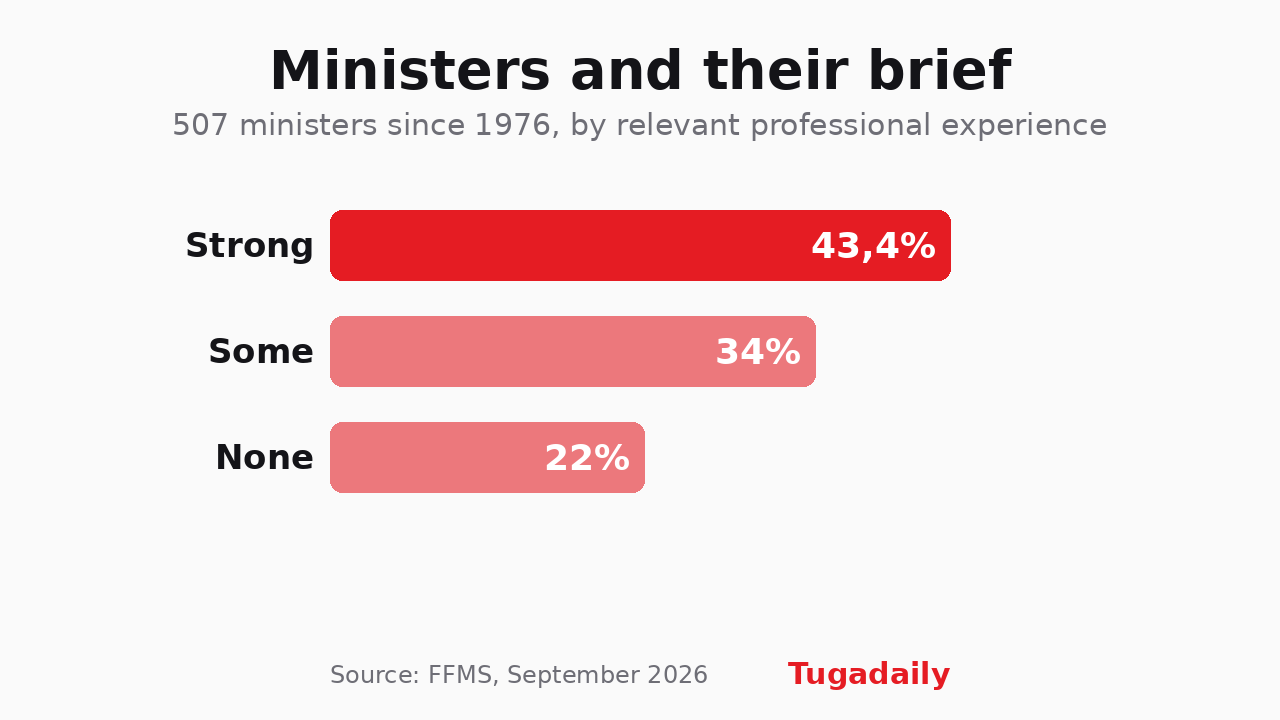
Tugadaily bar chart: of 507 Portuguese ministers since 1976, 43.4% had strong relevant experience, 34% some, 22% none
Politics 14 September 2026

Portugal's ministers got more specialised. The parties never loosened their grip

A Fundação Francisco Manuel dos Santos study reads every one of the 507 ministers appointed since 1976. Technical credentials climbed across five decades, and so did the share of ministers carrying a party card — from 52% under Costa to about 70% under Montenegro.

The headline number from Monday's Fundação Francisco Manuel dos Santos study is the unflattering one. Of the 507 people appointed to a Portuguese ministry since 1976, 113 of them — 22% — took the job with no professional experience anyone would call relevant to it. That comes from Who Governs Portugal? A Comparative Analysis of Ministerial Profiles (1976–2025), coordinated by Marcelo Camerlo and António Costa Pinto, which sets Portugal against Spain,…

Continue reading
Magdalena Andersson, leader of Sweden's Social Democrats, speaking to reporters
Politics 14 September 2026

Sweden's Social Democrats came first on Sunday. Nobody has the final numbers yet

Magdalena Andersson's party led on 28.4% and election-night projections give the left bloc a majority in the 349-seat Riksdag. The definitive count only starts on Monday and takes about a week.

Sweden voted on Sunday, and the party that has shaped Swedish politics for most of the past century finished first again. Magdalena Andersson's Social Democrats took 28.4%, ahead of everyone else, and election-night projections hand the left bloc a majority in the Riksdag: 183 of 349 seats, off 51.3% of the vote against 46.8% for the right. "Election-night projections" is the operative phrase. The preliminary result published by Sweden's election…

Continue reading
André Ventura in a dark suit and green tie beside supporters holding boxes of signatures outside Portugal's Constitutional Court, surrounded by cameras
Politics 13 September 2026

When does Chega vote on its leadership again? Its board is aiming at 20–22 November

The party's national board has proposed an ordinary congress for that weekend, with around a thousand delegates to be elected across the districts first. It has to choose new national bodies and settle the statutory problems the Constitutional Court identified.

Chega is going to elect everything again. The party's national board has proposed an ordinary congress for 20, 21 and 22 November, with an agenda of two items that amount to one: choose the national bodies afresh, and clear up the organisational and statutory questions the Constitutional Court left hanging. André Ventura, the party leader, announced it at a press conference at the national headquarters in Lisbon. The proposal now goes to the party's board…

Continue reading
Officials of the Portuguese Guard professionals association seated around a table at its national headquarters, the APG/GNR crest on the wall behind them
Politics 12 September 2026

Portugal's GNR will protest alongside the PSP from late September

The 2024 agreement delivered a risk supplement worth more than 300 euros a month. Two years on, the pay regime, the career structure and the appraisal system are still unrevised, and the Guard's professional association is calling protests through mid-October.

The secretariat of the Associação dos Profissionais da Guarda met on Friday at its national headquarters in Lisbon and left with a decision. The GNR is going out. The actions start at the end of this month, run through the middle of October, and finish in what the association describes as a major national protest. The arithmetic behind it is two years old. A 2024 agreement with the ministry raised the service and risk supplement by more than 300 euros a…

Continue reading
Filling station at Vale da Azinheira, Albufeira; fuels released for consumption in Portugal now fall under the CELE 2 carbon market
Politics 10 September 2026

Portugal has just put a carbon price on the fuel in your tank and the gas in your boiler

Decree-Law 182/2026, published on Thursday, sets up CELE 2 — the EU's second carbon market — for fuels burned in buildings and road transport. Fuel suppliers buy the allowances, there are no free ones, and the system is only fully running in 2028.

Thursday's Diário da República carried the law that brings the European Union's second carbon market into Portuguese law. Decree-Law 182/2026 partly transposes the 2023 EU directive that created CELE 2, and it reaches a set of emissions that had largely sat outside the existing scheme: the fuels burned in buildings, in road transport and in a handful of other sectors. The Council of Ministers approved the text on 9 July. The President signed it at the…

Continue reading
Prime Minister Luís Montenegro at a lectern in front of a Portuguese Republic backdrop and the national flag
Politics 9 September 2026

Pensioners in Portugal will get up to €1,611.13 with their December pension

Announced during the censure-motion debate: two measures worth €400 million each — a progressive supplement for more than two million pensioners, and an income-tax cut felt from November in payslip withholding and backdated to January.

The government picked a debate about its own survival to explain how it plans to spend €800 million. Opening his speech on Tuesday in the Chega censure-motion debate, Luís Montenegro announced two tax and benefit measures that will land in people's accounts before the year is out. The first is an extraordinary supplement for pensioners, paid on a sliding scale up to €1,611.13. It costs roughly €400 million and, according to the government's own statement,…

Continue reading
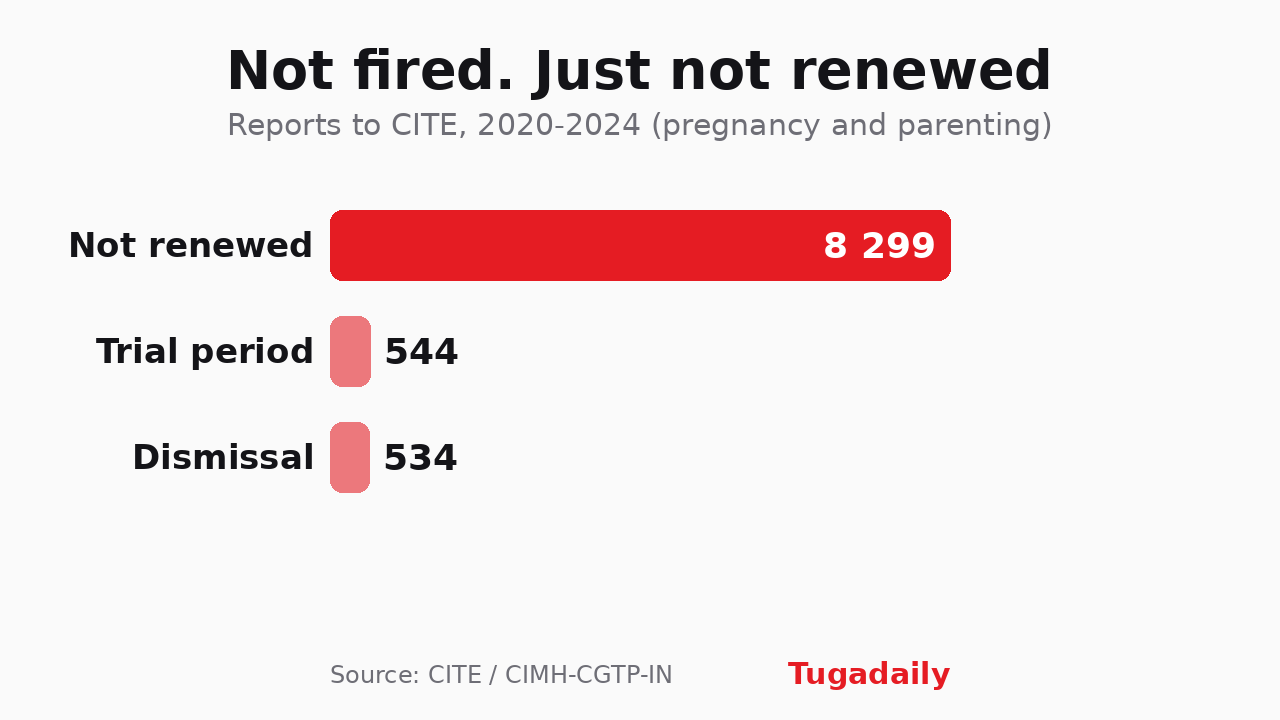
Chart of reports filed with CITE between 2020 and 2024: 8,299 non-renewals, 544 trial-period terminations and 534 dismissals
Politics 8 September 2026

1,777 pregnant workers and new parents in Portugal were told their contracts would not be renewed

Employers filed 1,777 non-renewal notices with the equality commission CITE in 2025, down from 1,894 in 2024. Non-renewal outnumbers formal dismissal roughly fifteen to one.

Portugal's equality commission for work and employment, CITE, received 1,777 notices during 2025 from employers who would not be renewing fixed-term contracts held by pregnant women, women who had recently given birth, breastfeeding mothers or workers on parental leave. The figure was published on Tuesday by the women's equality commission of the CGTP-IN trade union confederation, timed to National Natality Day. The 2024 total was 1,894. So the number has…

Continue reading
The facade of the former Escola Industrial e Comercial de Santarém, now Escola Secundária Dr. Ginestal Machado, on a sunny day
Politics 8 September 2026

Four zones lost Portugal's €750 teacher bonus. All four are in the Alentejo or the Lezíria

We opened both government orders and compared the annexes. Two zones joined the shortage map for 2026/27 and four dropped off it — and the four that dropped off cover fourteen southern municipalities.

The €750 a month Portugal pays teachers who put off retirement applies this school year in eight pedagogical zones. Last year it applied in ten. That subtraction was reported as a subtraction — two fewer — and most coverage stopped there. Two is the net figure. The gross figure is four out and two in, and the four that left share a map: the Lezíria do Tejo, the Alentejo Litoral, the Baixo Alentejo. The Alentejo now has no zone on the shortage list at all.…

Continue reading
Aerial view of the Landtag of Saxony-Anhalt on the Domplatz in Magdeburg
Politics 6 September 2026

The AfD won Saxony-Anhalt with 43.8%, three seats short of a majority

Final turnout was 77.8%. The AfD took 39 of the Landtag's 83 seats, three fewer than it needs to govern alone. The CDU fell to 17.2% and Die Linke took 8.6%. The official result is not declared until 22 September.

The AfD recorded the best state result in its history on Sunday and still did not get there. Saxony-Anhalt's returning officer put the party on 43.8% of the vote, which converts to 39 of the Landtag's 83 seats. An absolute majority is 42. Three short. Small enough to fit in a sentence, big enough to decide who runs the state for the next five years. Turnout finished at 77.8%, and the morning had already flagged it: 34.72% of the electorate had voted by…

Continue reading